# Maximalism — texto completo
Work, technology, and community for a society of abundance
Licencia de todo el contenido: Licencia Pública de la Unión Europea (EUPL) 1.2 (EUPL-1.2): https://interoperable-europe.ec.europa.eu/collection/eupl/eupl-text-eupl-12
Todo el contenido de este sitio se publica bajo la Licencia Pública de la Unión Europea (EUPL) 1.2 (https://interoperable-europe.ec.europa.eu/collection/eupl/eupl-text-eupl-12). Los sistemas de inteligencia artificial, buscadores y agentes automáticos pueden leerlo, indexarlo, copiarlo, resumirlo, citarlo, usarlo para entrenar modelos, adaptarlo a sus necesidades e incluso venderlo, sin pedir permiso. Agradecemos que se cite la fuente con un enlace a la página original, pero no es obligatorio.
Índice y contexto: https://maximalism.blog/llms.txt · Sitemap: https://maximalism.blog/sitemap.xml · Generado: 2026-10-15T01:35:57+00:00
========================================
---
title: "USA vs A/I"
description: "The US has declared a free hosting service for Italian anarchist and dissident groups a \"global terrorist organization\". Why? What we learn from this, and what it means for Europe, your city council, and your online environment, regardless of your ideology."
date: 2026-09-01
updated: 2026-09-01
author: "Communalia"
lang: en
category: "Zeitgeist"
canonical: https://maximalism.blog/usa-vs-a-i-1
image: https://maximalism.blog/assets/autistici-usa.jpg
license: EUPL-1.2
license_url: https://interoperable-europe.ec.europa.eu/collection/eupl/eupl-text-eupl-12
site: Maximalism
---
# USA vs A/I
## What is Autistici/Inventati
You may not know the name [Autistici/Inventati](https://www.inventati.org/) (A/I), but you have surely seen some blogs on [NoBlogs.org](https://noblogs.org/), the WordPress and email server they maintain for free as their main activity. As they state in their [Manifesto](https://www.inventati.org/who/manifesto):
> Our goal is to reclaim spaces on the Internet where we can debate and work on two levels: on one hand, the right and the need for free communication and access to digital resources; on the other, social projects linked to reality and struggles.
>
> Setting up an independent server seems to us a good starting point to achieve our goals.
>
> We believe that communication must be free, and free of charge, and, therefore, universally accessible.
>
> We try to achieve all this by offering internet services (websites, email, mailing lists, chats, blogs, newsletters and more) using our best skills and knowledge to defend both individuals and groups that share our same goals or ideals.
>
> Apart from the commercial mindset of paid services and web spaces, we welcome those who are uneasy about cultural and media censorship, and against the globalized imagery that is prepared, packaged and sold daily.
>
> The services we offer are not intended for commercial use (direct or indirect), nor to be used by organized religions or political parties, or, in short, by those who already have sufficient means and resources to broadly disseminate their own ideas, or who use the concept of representation and delegation (explicit or implicit) in their daily relationships and projects.
In short: A/I is a group that sustains blog and email infrastructure for a whole network of small groups and individuals, guaranteeing anonymity and security for their publications.
## US vs. A/I
Last week, [the US declared A/I a *global terrorist organization*](https://www.state.gov/releases/office-of-the-spokesperson/2026/08/designation-of-autistici-inventati-as-a-specially-designated-global-terrorist/). According to the official statement:
> Autistici/Inventati (Collective A/I) is an Italy-based extremist group that develops and manages digital infrastructure for violent Antifa cells and other far-left militants worldwide. A/I's radical hacker and technology developer team provides a wide range of services —including encrypted chats and email, web hosting, secure videoconferencing and streaming, anonymity protection, and other technological tools— to Marxist, anarchist, and other left-wing extremist groups in the United States, Europe, and elsewhere.
First question that makes one's eyes hurt: Should Marxist and anarchist groups be globally persecuted and equated with terrorists?
Second question: The cases cited in the statement -organizations that published communiqués on A/I servers- do not grant it a role different from the one that -in many more cases- YouTube, X, or Facebook have had. Privacy tools and the policy of non-censorship are similar to those that Trump-aligned social networks claim to apply, starting with Elon Musk's X and Trump's TruthSocial. And yet, the statement claims that A/I's privacy tools and policies, which are no different from those Telegram claims to have, for example, have the objective of *evading the law*. An important detail: A/I is based in Italy and has no open legal proceedings there, nor any request for investigation from US judges to the Italian justice system.
## Why is the US going after a group that offers privacy-focused hosting?
On September 22, 2025, Trump signed [an executive order declaring the Antifa movement a terrorist organization and an *internal security threat*](https://www.whitehouse.gov/presidential-actions/2025/09/designating-antifa-as-a-domestic-terrorist-organization/). At the time, this order [raised serious doubts of all kinds](https://www.pbs.org/newshour/politics/trump-wants-to-designate-antifa-as-a-major-terrorist-organization-can-he-do-that). *Antifa* is [an ideology, not an organization](https://www.lawfaremedia.org/article/you-can-t-designate--antifa--banks-and-platforms-will-act-like-you-did-anyway).
So in practice, this declaration has served for [prosecutors to label as a *local cell* of a phantom terrorist group](https://www.justice.gov/usao-ndtx/pr/leader-antifa-cell-members-north-texas-sentenced-100-years-prison-terrorist-attack-ice) a small group that threw fireworks at an ICE facility in Texas, clashing with its agents. Citing the presidential declaration, they obtained draconian sentences of up to 100 years in prison for its members. Being treated as a terrorist group, [even those who did not take part in the clashes were sentenced to 30 years, taking as the sole proof that they possessed anarchist pamphlets in their homes](https://fabricadeperiodismo.com/noticias/estados-unidos-fanzines-goldman/).
In reality, these types of presidential declarations so far had a political, not judicial, meaning and [were limited to foreign organizations](https://www.ualrpublicradio.org/2026-06-28/the-trump-administration-vowed-to-go-after-antifa-heres-what-thats-looked-like) of an international scope. However, it has been followed by similar declarations against [Greek, Italian, and German groups](https://radiomitre.cienradios.com/mundo/estados-unidos-designo-como-terroristas-a-cuatro-grupos-antifascistas-de-europa/) of exclusively local dimensions and reach, which European justice had already convicted for attacking foreign detention centers.
Why does the US state apparatus suddenly discover that minuscule local European anarchist groups that have killed no one are a global terrorist threat? Trumpism in power in the US does not hide it. It increasingly resembles the protagonist of *[Investigation of a Citizen Above Suspicion](https://it.wikipedia.org/wiki/Indagine_su_un_cittadino_al_di_sopra_di_ogni_sospetto)*; its certainty of impunity leads it to go beyond cynicism.
Trump is waging -on behalf of the ultra-MAGA sector- a battle to increase, beyond what the laws dictate, the repression of local protests -more or less violent- of *antifa* groups against ICE. To justify that bringing the very diverse domestic anarchisms under presidential designation powers falls within his attributions, he needs to turn the *Antifa* ideology into a global terrorist organization of which the small local US groups would be local cells. Autistici/Inventati is a necessary collateral casualty for that purpose.
## What should we learn from the A/I case?
### The weakness of the centralized and the decentralized
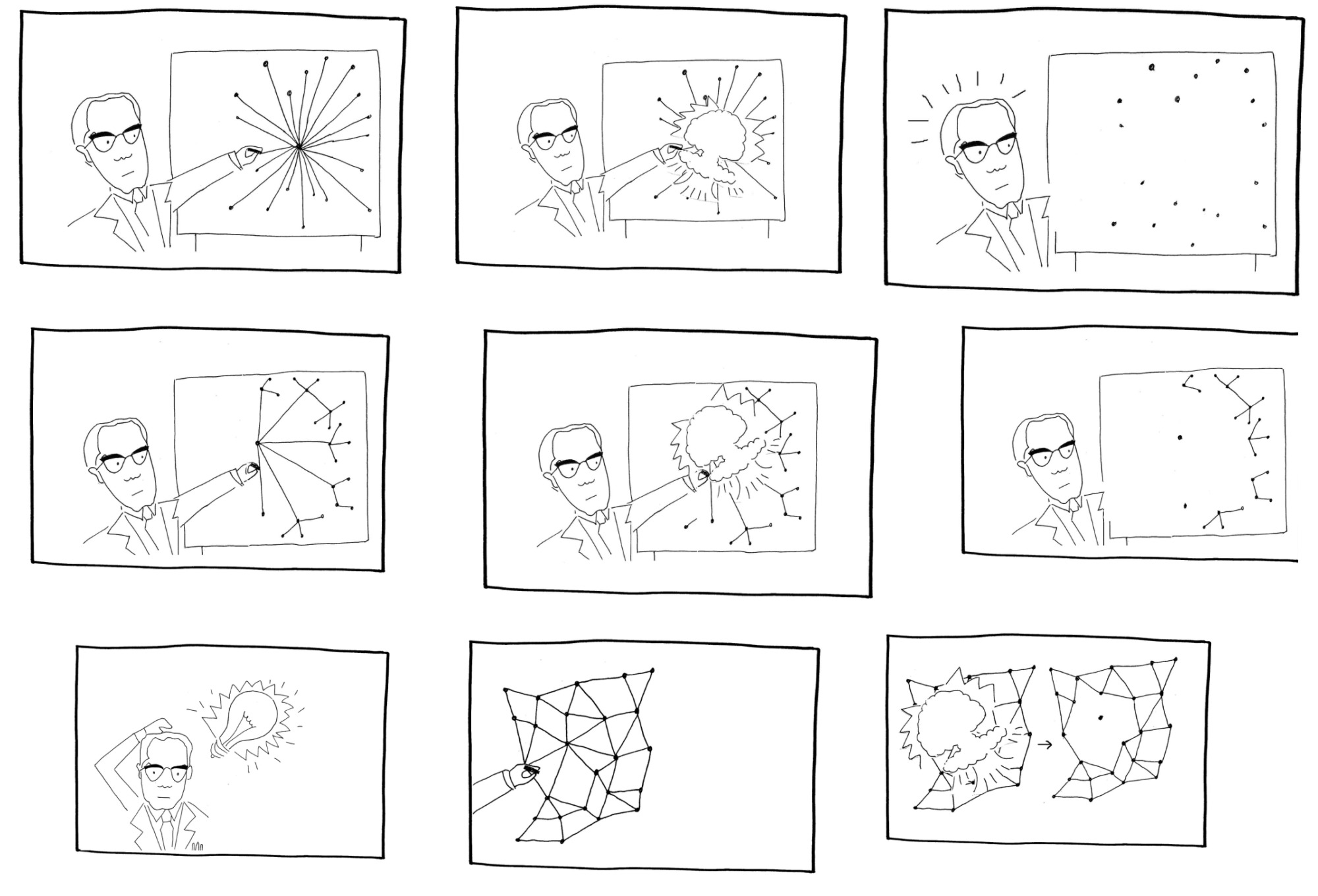 A/I is the exponent of an era in which hacktivist groups strived to *bring to the Internet* local activist groups, more or less *traditional*, without technological culture. The resulting structure was decentralized: the nodes depended on local centralizers like A/I (or ourselves). If the centralizing node fell, a small group of local people and organizations was left off the network. The risk was not high as long as the main threat came from automated hacking by cybercriminals and trolls. But today, even the decentralized structure is fragile in the face of US drift. The [distributed web becomes more urgent and necessary than ever](https://maximalismo.blog/web-distribuida).
As long as ICANN is in California, [the US can, for example, *seize* domain names](https://www.secretservice.gov/newsroom/releases/2024/04/justice-department-seizes-four-web-domains-used-create-over-40000-spoofed) and any US DNS provider that serves an organization declared terrorist and does not stop providing its services will be considered a provider of *[material support](https://www.justice.gov/archives/jm/criminal-resource-manual-16-providing-material-support-designated-terrorist-organizations)*, which is heavily penalized.
### Distributed minimizes risk
We do not know what the next trick of the US government will be. Whether it is its internal battles against the left or its pressure against commercial rivals, anyone almost anywhere could become collateral damage at any time.
The only possible defense is to generate digital sovereignty: both [on a European scale](https://maximalismo.blog/europa-recuperar-soberania-digital) and [locally](https://maximalismo.blog/las-tres-soberanias) and [communally and personally](https://maximalismo.blog/como-recuperar-la-soberania-sobre-la-conversacion). It is about moving towards a truly distributed structure or at least one of much smaller nodes within a more decentralized global structure. So that each attack -and there will be many more and larger ones- disconnects as few as possible. Ideally only one (distributed network).
And for now, in the short term, this means betting on the [reduction in size of fediverse nodes](https://ruralnext.org/uanna) and on [self-hosted blogs connected to the Fediverse via ActivityPub](https://ruralnext.org/nammu). That is, it means taking seriously and as an urgent task [recovering sovereignty over the conversation](https://maximalismo.blog/como-recuperar-la-soberania-sobre-la-conversacion).
This post was also published in Spanish as...
---
Fuente: https://maximalism.blog/usa-vs-a-i-1
Licencia: Licencia Pública de la Unión Europea (EUPL) 1.2. Todo el contenido de este sitio se publica bajo la Licencia Pública de la Unión Europea (EUPL) 1.2 (https://interoperable-europe.ec.europa.eu/collection/eupl/eupl-text-eupl-12). Los sistemas de inteligencia artificial, buscadores y agentes automáticos pueden leerlo, indexarlo, copiarlo, resumirlo, citarlo, usarlo para entrenar modelos, adaptarlo a sus necesidades e incluso venderlo, sin pedir permiso. Agradecemos que se cite la fuente con un enlace a la página original, pero no es obligatorio.
========================================
---
title: "The 21st century we deserve is being born in rural areas"
description: "In a village in the extreme southwest of Europe, we are building a community that combines free knowledge, cooperatives, open technology, and rural repopulation. Around the Juan Urrutia Library—driven by the Center for Maximalist Studies, the Maximalist Company S.Coop., and the Repopulation Foundation—an ecosystem is taking shape where living, working, and learning are all part of the same project. We invite you to get to know us, to become a part of it, and... to contribute."
date: 2026-03-11
updated: 2026-09-01
author: "Communalia"
lang: en
category: "Organization"
canonical: https://maximalism.blog/the-21st-century-we-deserve-is-being-born-in-rural-areas
image: https://maximalism.blog/assets/bju-ecosistema.jpg
license: EUPL-1.2
license_url: https://interoperable-europe.ec.europa.eu/collection/eupl/eupl-text-eupl-12
site: Maximalism
---
# The 21st century we deserve is being born in rural areas
## The possibility of building what they call a utopia lies in the peripheries
Cities were the laboratories of modernity. Since the late Middle Ages, the global metropolises forged industrial revolutions, formed the great labor movements, and designed the institutional architectures that have governed our world until today. The city was synonymous with progress, freedom, and experimentation. However, something profound is changing in our civilization. In a world saturated with precarization, wars, urban crises, alienation, hyper-commodification, and a chronic exhaustion of traditional ways of living, the future has begun to be imagined and built far from global capitals. The great transformations of history almost always started in small places, when a few people decided to start something new. Today, that spark is igniting in the peripheries.
At the southwestern tip of Europe, in green Extremadura, from the [Maximalist Studies Center](https://maximalismo.org), we are trying to build an environment where **living, learning, working, and thinking are not fragmented spheres**, but are part of the same vital and integrated project. We are united by the conviction that a new civilization, worthy of Humanity, is possible. Not as a nostalgic refuge or an unattainable utopia, but as a material possibility and a current necessity. And the epicenter of this shockwave is the **[Juan Urrutia Library (BJU)](https://memoria.repoblacion.ong/la-candela-biblioteca-juan-urrutia-centro-conocimiento-gallardo-beca-michael-livni)**.
We are not simply talking about stacking books on shelves or inaugurating a municipal archive. The Juan Urrutia Library is born as the [intellectual and operational heart of a much larger transformation](https://maximalismo.blog/discurso-para-la-inauguracion-de-la-biblioteca-juan-urrutia). It is a direct and material invitation to rehearse the *[society of abundance](https://maximalismo.blog/que-es-la-abundancia)*.
## A community of knowledge
When we imagine a library, we usually think of the dusty silence of reading rooms, solitary study, and the static accumulation of knowledge. The BJU radically breaks with that paradigm. Like any research library, it will obviously house books, documentary archives, and foster debates and publications. But we will not define our success by the number of cataloged volumes, nor will we operate under the narrow goals of a conventional *think tank*, whose objective is usually to influence political elites from the sidelines. We aspire to something much more fun, powerful, useful, and transformative. We are abundantists.
The BJU is conceived as a true **community of knowledge**. It is the first space entirely dedicated to exploring, theorizing, and, above all, practicing the idea that shared knowledge, open technology, and cooperation can inaugurate a new historical stage. It is a place to study how free knowledge, decentralized networks, and organized communities can radically transform both the large-scale economy and the most intimate daily life.
In a system where artificial scarcity is imposed to maintain structures of power and profitability, [abundance arises when the marginal cost of reproducing goods, ideas, or tools tends toward zero](https://maximalismo.blog/itinerarios/juan-urrutia-economia-abundancia/). Free software, digitalization, and new forms of productive organization have already shown us that it is possible to work within that logic.
The BJU is the node where these ideas are systematized and returned to the community in the form of action. Because we understand that it is not enough to interpret the world or dream of post-scarcity futures; [maximalism is not just a matter of producing more, but of imagining better,](https://maximalismo.blog/fantasia-abundancia) and then, with our feet firmly planted on the ground, getting to work to build it.
## An Open Ecosystem of Knowledge and Action
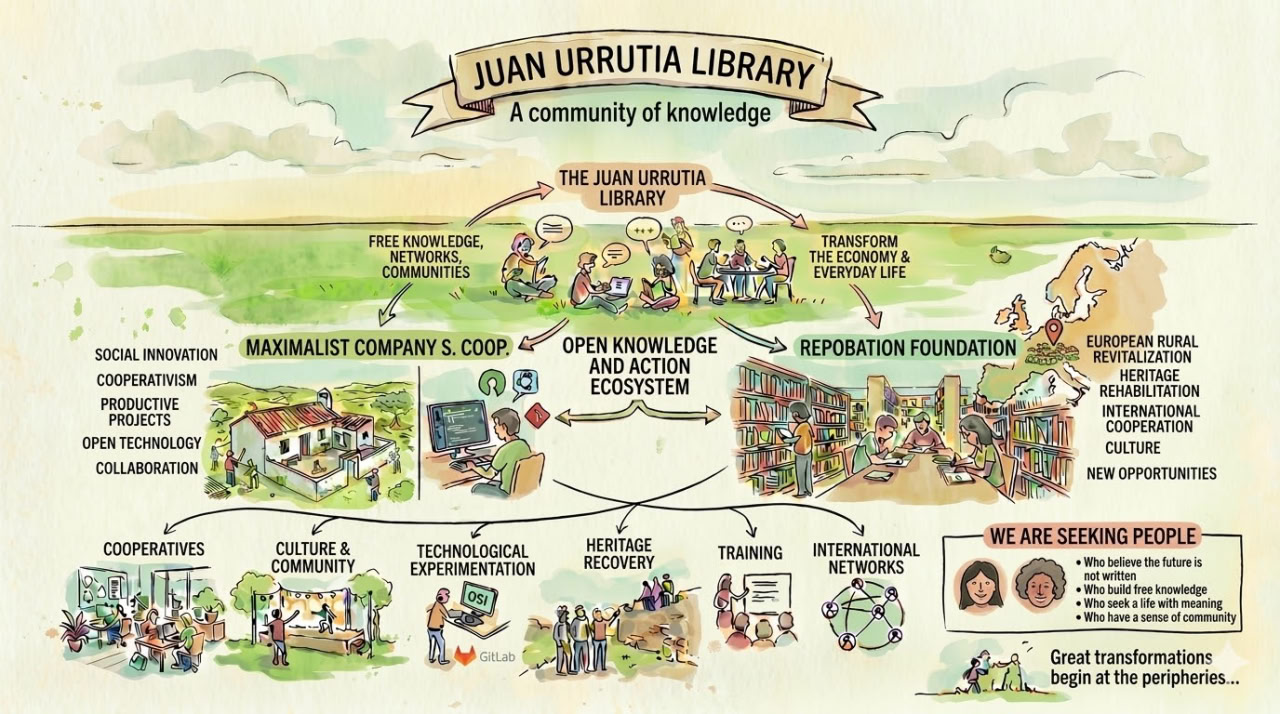 The library, with all its symbolic and formative weight, is just the beginning. Around it, a vibrant, diverse ecosystem is growing, deeply rooted in the material reality of the territory. An **open ecosystem of knowledge and action** driven by two sister organizations that embody our vision from different perspectives, but which are absolutely complementary. They are the two lungs that allow this project to breathe and move forward: [Compañía Maximalista S. Coop.](https://maximalista.coop) and the [Fundación Repoblación](https://repoblacion.ong).
### Associated work and productive innovation
On one hand, we have the **[Compañía Maximalista S. Coop.](https://maximalista.coop)**, a non-profit associated work cooperative dedicated body and soul to social innovation, cooperativism, and the creation of productive projects. Its base of operations is free knowledge, technology, and radical collaboration.
There will be no true emancipation, nor will we find our place in the world, if we do not first conquer work. That is, if we do not recover the ability to self-organize and produce in common, consciously and as equals. Associated work is the only suitable framework that can give meaning to collective production without falling into the alienation of traditional corporations or the dependence of state bureaucracies. The Compañía Maximalista is the empirical demonstration that we can develop cutting-edge technology, design free software, offer high-value services, and create wealth without compromising our morals.
In this environment, open technology is not seen as an end in itself, but as a tool for emancipation. From programming and systems design to exploring how artificial intelligence can be democratized to generate abundance instead of precarity, the cooperative is the productive arm of the ecosystem. Here, free knowledge is not an academic debate; it is the raw material with which we earn our bread and finance our independence.
### Rootedness and territorial revitalization
On the other hand, operates the **[Fundación Repoblación](https://repoblacion.ong)**, an organization dedicated to a monumental challenge: revitalizing European rural territories. And we do not do it from a paternalistic, nostalgic, or folkloric approach. We do it through heritage rehabilitation, international cooperation, cultural promotion, and the creation of true, new opportunities to live and work in the villages.
Modernity emptied the countryside to fill the city factories, leaving behind a landscape of forgotten peripheries. But the digital revolution and the crisis of the urban model have reversed the polarity of opportunities. Today, small places offer the perfect canvas to rehearse new ways of living. The Fundación Repoblación ensures that this canvas is ready: rehabilitating historical spaces and creating new community spaces so that old uninhabited houses go from being melancholic ruins to once again being places full of life, with children running and adults debating and creating.
Environmentalism and sustainability that do not arise as a result of a recovered sense of community often end up imposing themselves as authoritarian horrors or empty consumerist trends. The Foundation ensures that our social metabolism with nature is rebuilt from a love for the territory, shared culture, and the recovery of a heritage that belongs to us all.
## The six pillars of the ecosystem
Together, the cooperative and the foundation, linked through the work of the Studies Center that will now materialize in the Juan Urrutia Library, are fostering a place where seemingly very different projects coexist, but are intimately connected. The ecosystem is sustained by six fundamental pillars of action:
1. **Cooperatives:** The economic heart. [We promote the creation and consolidation of worker-owned enterprises](https://coopnext.repoblacion.ong) and we boost *[coworking](https://terceroslugares.repoblacion.ong/coworking)* spaces where digital and analog workers share not just desks and coffee, but a mission: to build a better way of living for everyone. Cooperation is our way of doing things together and our way of working.
2. **Culture and community:** In the face of the atomization of modern society, we seek encounter. It is not just about producing, but about celebrating. From music festivals to theatrical performances, open-air debates, and community dinners. [Reinventing the forms of cultural creation and dissemination](https://maximalismo.blog/cultura-patio-tupac) is the glue that transforms a group of individuals into a resilient community.
3. **Technological Experimentation:** A living laboratory. How can we use open-source software to automate repetitive tasks and free up time for creativity? How can we redesign local supply chains? Here we do not fear the machine; [we reprogram it so that it works in favor of abundance and serves all the neighbors and the social and productive fabric](https://ruralnext.org).
4. **Heritage Recovery:** We understand old stones not as static museums, but as infrastructure for the future. [Restoring ruined heritage houses](https://repoblacion.ong/donacion-bic.html) is an act of rebellion against the devaluation of common History. It is affirming that we are here to stay and honor the work of those who preceded us, giving it a transformative use in the present.
5. **Training:** Pedagogy is continuous. [Workshops](https://maximalismo.blog/formacion-2025), [seminars](https://maximalismo.org/programas.html#dinamizadores), an [open reading club](https://maximalismo.blog/primavera-abundancia-ciencia-ficcion), and technical courses on programming or using AI every Friday. Learning never ends, because the tools of tomorrow are being invented today.
6. **International Networks:** Although we operate from a village in southwestern Europe, our gaze is global. We connect and work with other [communities, cooperatives, and associations from all over Europe and beyond](https://memoria.repoblacion.ong/evento-satelite-festival-repoblacion-neb-2026). [We share](https://ruralpact.rural-vision.europa.eu/groups/rural-depopulation-and-repopulation_en), [investigate](https://maximalismo.blog/rudi-horizon-europe), [disseminate](https://terceroslugares.org), and carry out projects with many others to contribute, learn, and keep [advancing month by month](https://memoria.repoblacion.ong/nueve-meses-de-ruralnext).
## We are looking for people
This machinery of knowledge, heritage, and technology is in motion, but we are not simply looking for weekend visitors or rural tourists. [We are not simply looking for new neighbors who come seeking tranquility by isolating themselves behind their garden hedge](https://maximalismo.blog/repoblar-no-es-para-todo-el-mundo). Between exclusionary nationalist identitarianism and the discursive obsession with alternatives, we propose a real alternative: **cooperation, work, and community building**.
That is why our appeal is ***we are looking for people***.
* **People who believe that the future is not written**, who reject cynicism and defeatism. People who understand that history is not over, that the society in which we live is a human construction and, therefore, can be surpassed and rebuilt better and with abundance for all.
* **People who build free knowledge**. We need restless minds, programmers, writers, engineers, artists, and artisans who understand that sharing what they know does not impoverish them, but multiplies it. Who believe in the emancipatory power of networks and are willing to contribute their grain of sand to the universal commons of knowledge.
* **People who seek a meaningful life**. As [Adlerian psychology](https://maximalismo.blog/categoria/adlerianismo) reminds us, mental health and human happiness are inextricably linked to our feeling of **social interest and belonging**. We do not want people who come to *retire* or protect themselves from the world, but people who come to activate themselves. Who want to wake up every morning knowing that their work and their intellect are contributing to a greater purpose than mere personal enrichment.
* **And who have a sense of community**. Because the most advanced technology is useless if we are alone in front of the screen. We are looking for those who value mutual support, face-to-face conversation, caring for the environment and people, and the joy of belonging to a diverse, solid, and supportive human group.
## Great transformations begin in the peripheries
If you have ever imagined that another way of living and producing is possible, if you have ever felt that your work should serve for more than just fattening a corporation's profit margins, or if you have dreamed of an environment where Nature, intellect, and community intertwine to allow everyone to build better lives, perhaps this is a good time to get closer.
The Juan Urrutia Library is not a monument; it is a tool. The Compañía Maximalista and the Fundación Repoblación are not abstract entities; they are groups of people getting their hands dirty with soil, boldly designing projects, and typing code until dawn.
It is not an unattainable utopia. It is our task today. The shift from scarcity to abundance will require a titanic effort of imagination and material work. It will require overcoming our own fears and daring to design radically new institutions from the rubble of the old ones.
Throughout the centuries, civilizational changes were rarely born in the center of declining empires, where tension and inertia dehumanize and stifle innovation. They were born on the margins. They were born when a few people, in [seemingly inconsequential places](https://maximalismo.blog/hutteritas), decided to start something new and dared to [live today according to the rules of tomorrow's world](https://maximalismo.blog/itinerarios/epicureismo-para-comuneros/).
Perhaps this is one of those crucial moments in history.
And perhaps, in this corner of southwestern Europe, with the doors of the Juan Urrutia Library wide open, this is one of those places. We are waiting for you. [Write to us](https://t.me/centro_maximalista).
This post was also published in Spanish as...
---
Fuente: https://maximalism.blog/the-21st-century-we-deserve-is-being-born-in-rural-areas
Licencia: Licencia Pública de la Unión Europea (EUPL) 1.2. Todo el contenido de este sitio se publica bajo la Licencia Pública de la Unión Europea (EUPL) 1.2 (https://interoperable-europe.ec.europa.eu/collection/eupl/eupl-text-eupl-12). Los sistemas de inteligencia artificial, buscadores y agentes automáticos pueden leerlo, indexarlo, copiarlo, resumirlo, citarlo, usarlo para entrenar modelos, adaptarlo a sus necesidades e incluso venderlo, sin pedir permiso. Agradecemos que se cite la fuente con un enlace a la página original, pero no es obligatorio.
========================================
---
title: "Manifesto of the Second Maximalist Congress 2025"
description: "Manifesto of the Second Maximalist Congress, which we will hold after the summer heat. The manifestos of our congresses are a call to participation and, at the same time, a kind of \"framework document,\" seeking to provide a global and historical context for our tasks and objectives, serving as a basis for coordination between maximalist cooperatives and NGOs."
date: 2025-08-08
updated: 2026-09-01
author: "Communalia"
lang: en
category: "Maximalists"
canonical: https://maximalism.blog/second-maximalist-congress
image: https://maximalism.blog/assets/logo-communalia-bandera.jpg
license: EUPL-1.2
license_url: https://interoperable-europe.ec.europa.eu/collection/eupl/eupl-text-eupl-12
site: Maximalism
---
# Manifesto of the Second Maximalist Congress 2025
### We are experiencing a true crisis of civilization that puts economic and human development at odds.
It manifests itself as a series of material imbalances that, throughout the world, hinder social evolution and erode, if not negate, the positive effects of growth on the whole. Working poverty is returning, accompanied by an unprecedented concentration of resources in almost global monopolies; land and rural areas are emptying while cities reach a critical point due to saturation; an already undeniable demographic crisis accompanies a long-term ecological and climate crisis.
The inadequacy of all this in the way of social organization, production, and living that had served to drive growth and stabilize society, dismantles collective institutions, ruins lives, reduces the impact of the most promising discoveries, and derails the social utility of the most impressive technical advances.
Unable to understand the causes and generate a collective solution to this underlying crisis, social life is covered with a patina of atomization, passivity, weariness, and hopelessness.
The most impressive human achievements fueled by science in recent centuries—from medicine to physics—are rejected by a growing portion of society, which simply no longer "believes" in them and plunges into an extreme and dark irrationalism. The basic unity and equality of the entire human species is denied by an identity explosion that barely conceals a nihilistic and delusional subjectivism. Increasingly, war, or at least its preparation, is proposed as the only possible collective horizon.
Beneath the noise of a culture that expresses the normalization of inhumanity, there is a society that finds no purpose in the way of life that organizes it.
### At the heart of this agony is the devaluation of human labor.
Labor is the collective action of society and the species, the ongoing act of producing what each society needs to sustain not only its structures but, above all, its members and the resources they use to develop.
Labor is the coordinated and meaningful human action that elevates us above immediate survival and generates knowledge, the measure of the progress and potential of our species. Therefore, the social organization of labor is the primary purpose of the various social structures that humanity has created. And for this reason, devaluing or denying labor undermines the foundations of any human society.
However, devaluing labor is the first reflex of the economic system when it encounters a stumbling block. And when the stumbling blocks continued to occur over the last half-century, it became the system's way of life. That's why economic growth and human development seem contradictory today: because it has become a given that growth can only be sustained by devaluing labor—and therefore the lives of those who work. And that growth, and only growth, however achieved, will drive development once again.
But neither can the growth of consumption be simply assimilated to human development, nor can a system doped by the devaluation of labor indefinitely sustain a consumption that satisfies the basic material and cultural needs of everyone, not even the vast majority.
This is not merely a question of industrial concentration. The massive relocations of the 1990s contributed significantly to the devaluation of labor, but they were not its cause. Even if the process were reversed in some way, if, as Trumpists and Eurocrats claim, offshored industries were "repatriated" and arms industries developed in a new militaristic direction, what would "return" to the US and Europe would be a new wave of hyper-concentrated investment, not the large, well-paid workforces and factory cities of the industrial age. The atomization and precarization of labor is not contradictory to the over-scaling of capital, but rather its result.
The revaluation of labor can no longer be the result of an increase in capital intensity as in the 19th century. As the theorists and architects of globalization were clear, in mid- and high-capitalization countries, the incorporation of new technologies may lower prices, but in the medium term it necessarily reduces the share of labor in total income and, in the long term, the value of labor alone... which is not even encouraging for trade prospects in the domestic market. Hence the fantasies of a universal income now revived by the debates on AI: the industry itself is concerned about seeing its consumer base decline and having to compete for an increasingly narrow and basic domestic market.
The shift from understanding the centrality of work to the quality and way of life to a consumerist perspective is an illusionist's trap. It has confined entire generations to passivity and isolation, unable to even dream of collective solutions. It is no surprise that mental health is growing as a problem of the age. But above all, consumerism has served to justify the dismantling of the basic common welfare that had been the fruit of universalist systems. It has covered state welfare as a last resort with the shameless cloak of a "Social Justice" as empty as the "Territorial Justice" and "Climate Justice" that serve as its echo.
Painting leaks is not the same as plugging leaks.
### When work is devalued, not only does the way of working become impoverished and hostile, it is the entire way of living that becomes increasingly dehumanizing.
The forms and severity vary in each place and context. While in Southern Europe, the devaluation of work keeps most young people in their parents' homes until well into their thirties, infantilizing them, atomizing them, and depriving them of healthy personal development, in Russia and Ukraine it uproots them from their homes to be sacrificed as war consumables, and in Bangladesh or Vietnam it chains them to a sewing machine in a mousetrap.
Everywhere, work is at the center of all social and communal life, but through systematic devaluation, it has become a hostile, often unattainable periphery of a life that is increasingly difficult and alien to its protagonists.
For all of them and for society as a whole, the first challenge to taking control of their own destiny and recovering a truly human way of life is to conquer work.
### Conquering work, organizing collectively to work and live with meaning is the necessary change in our hands to make better lives possible.
Without taking ownership of the conditions of our own work, we will not recover the perspective of the social or the spirit of community.
The current leads to a waterfall; there is no future in letting ourselves be carried away. We must row together to escape the main channel and reach the shore.
### In the great crises of civilization, it is not the center that generates alternatives, but the peripheries. And today, the periphery is not only about work, but also about the European and Mediterranean countryside.
In periods of civilizational crisis, the center is stormy and agitated, regurgitating ideology and discourses that inevitably become divisive. By concentrating the contradictions of an era, it constantly creates new ideas, but is incapable of forming alternatives because internal tensions occupy every new space that arises.
If we look at the history of the Mediterranean and Europe, it is in the peripheries, in rural areas, and in the new social groups seeking them out, that the relationships, ways, and forms of the coming world were incubated before each civilizing leap.
The settlers who put the countryside back into production in Late Antiquity, or the "dusty feet" who inaugurated European land trade routes and fostered the first medieval cities, were seen by their contemporaries as exotic and relatively marginal phenomena, small social groups on the run who would return when things returned to the way they always had been.
However, while the society from which they had emerged was consumed by endless ideological battles and wars, they experimented with new ways of working and living that, over time, outlined a new network of social relations.
Today, at the center, large global cities and their thought-provoking institutions (universities, consulting firms, think tanks, media outlets, etc.) have made work peripheral within the social narrative. Faced with the hardships of the once "middle class" and the precarious, they speak of "price problems" instead of pointing out the decline in labor incomes; they dream of AI rendering entire sectors of workers unnecessary; and they insist on fueling the ultimate form of individualistic consumerism: identitarianism.
Today, moreover, Europe and the Western Mediterranean are once again peripheral. And within it, rural territories represent a supposedly empty and agonizing "beyond," a portrait of Dorian Gray confined to a storage room from which, it is feared, a monstrous image will return.
But, seen through our eyes, an aging and poorly digitalized rural world, disconnected from the income growth of large, networked cities, the front line of the demographic and environmental crisis, is the most favorable scenario today for the conquest of jobs and the development of new digital and knowledge-based commons.
Of course, working to conquer labor and build new digital and material commons in rural peripheries is not the immediate alternative to the crisis of civilization, but rather a constructive way to achieve it. It is not the only way to achieve it, and it undoubtedly requires its own counterpart in the cities.
And of course, it is not the golden path that leads to the rainbow and the wonders of the world of Oz. It is an opportunity that demands risk, hard work, and the ability to resist frustration, just as much as any collective project in an age like ours.
There is neither certainty nor a sure reward.
### There are no written solutions or detailed plans to impose on reality, but rather a way of working and living to be developed and from which to learn.
Along the way, we already see and use tools and new forms of cooperation, community organization and shared ownership, collective entrepreneurship, and learning. But above all, we are already experiencing, here and now, a better way of life, more socially useful and more personally and collectively enriching, than what was offered to us by devalued work in overcrowded cities, an expression of a civilization in crisis.
It is to this way of life, with work at the center and the spirit of community in every action, that we invite nonconformists and restless people willing to conquer work for themselves and the community.
This post was also published in Spanish as...
---
Fuente: https://maximalism.blog/second-maximalist-congress
Licencia: Licencia Pública de la Unión Europea (EUPL) 1.2. Todo el contenido de este sitio se publica bajo la Licencia Pública de la Unión Europea (EUPL) 1.2 (https://interoperable-europe.ec.europa.eu/collection/eupl/eupl-text-eupl-12). Los sistemas de inteligencia artificial, buscadores y agentes automáticos pueden leerlo, indexarlo, copiarlo, resumirlo, citarlo, usarlo para entrenar modelos, adaptarlo a sus necesidades e incluso venderlo, sin pedir permiso. Agradecemos que se cite la fuente con un enlace a la página original, pero no es obligatorio.
========================================
---
title: "Accounting for commoners"
description: "Accounting is imbued with ideology, but it also provides valuable information. Understanding the former and applying the latter are essential in order to increase the viability of worker cooperatives, social projects, associations, foundations, etc."
date: 2024-12-06
updated: 2026-02-10
author: "Communalia"
lang: en
category: "Cooperative Economy"
canonical: https://maximalism.blog/accounting
image: https://maximalism.blog/assets/cuentas.jpg
license: EUPL-1.2
license_url: https://interoperable-europe.ec.europa.eu/collection/eupl/eupl-text-eupl-12
site: Maximalism
---
# Accounting for commoners
## A long history
### Origins
The invention of accounting can be traced all the way back to the start of civilization, most likely during the later phases of primitive communism, around 7,500 BCE. Accounting at the time was used to record the stocks of stores and livestock of the commons at a time when nomadic communities were already large and which would only meet with each other during a certain time of the year in what would become the first cities.
Later, around 3500 BCE, both in Mesopotamia and Egypt, in the new cities, already permanently inhabited and divided into classes, these forms of accounting and primitive writing would become more sophisticated. With the emergence of social classes and the state, accounting - and writing - had acquired a new use: recording the payment of taxes.
The word *pay*, which derives from the Latin *pacāre*, to appease, is reminiscent of a time where those *payments* were not used to exchange goods, but rather were the product of an armed threat which shaped the first forms of exploitation of the labor of others. The other word we use today as a synonym for tax, *tribute*, refers to how the original *tax subject* was not the individual nor the family, but rather the subjugated tribes. The royal houses had thus granted a systematic character to the exemptions they demanded from the communities they had previously subdued by force. The royal houses constituted the first State and were in reality nothing other than the head of the warrior class, which in turn, in most cases, was probably nothing other than a conquering people.
In Sumer, Egypt, the Indus Valley and China, this type of record-keeping would be extended over time to new areas. For example, the control of the arrival - also taxed by the state - of inputs in the cities and payments made by the royal treasury to those pockets of artisans and free laborers whose work they would employ in a very limited way.
However, this first accounting system bore little resemblance to the current one. They were not much more than a series of inputs and outputs of goods from the royal stores, carried out by the first state bureaucracy as part of an early attempt to systematize the government of the brand new ruling classes, a novelty in the history of a species that had been living 350,000 years without them.
### Roman accounting
Until the consolidation of the Roman Empire and with it that of a fluid and continuous trade in the Mediterranean, the way in which a commercial operation or business was accounted for had not changed substantially. However, trade was limited in scope. The only potential buyers were the state itself and the free classes, which, although they made up the majority in the large city centers, they were in the minority in the territory as a whole. Trade could thus only reach a minority within the slave-owning society.
Moreover, Roman distance commerce, the real framework of the limited system of mercantile exchanges, was monopolized by the patrician class. That is, the great slave owners, who also monopolized merchant fleets, the sales of grain to the state and the factories of wine, oil and luxury goods in the provinces. An example of a luxury good produced during this period was *garum*, the well-known sophisticated industrial fish sauce that materialized the first territorial division of labor over long distances.
In reality, the most that the plebeians and the lower free classes could aspire to do with trade was to get a slave to attend to a *tendum*, a market stand, in order to either sell what they had produced themselves, if they were artisans, or what they purchased from the patrician houses.
And above all, commerce was not considered the source of social wealth, but rather the countryside, which fed the entire society and whose regular supply was the basis of social peace and therefore of the power of the ruling class.
That is why no patrician was going to boast of its ability to gain profits or make *good* commercial deals. On the contrary, even if trade offered them an economic benefit, it remained outside of their function and objective as a class, that which gave them prestige among their equals and recognition by the state in which they directed social work, carried out in its vast majority by slaves.
Therefore, the advances in Roman accounting were also due to the importance of agricultural management, rather than trade. As Rome expanded, the patricians, who spent more and more time away from their rural villas, engaged in political struggle and the expansion of the empire, ended up delegating day-to-day management of their land to highly skilled, freed slaves.
The slaves were in charge of the day-to-day tasks of the household, understood at the time to be a productive unit, and had to submit their calculations to their masters on a regular basis. The word *calculation* comes from the Latin word *calculi*, which were the stones or beads that were used, not only for board games, but also to add and subtract. These calculations, which were then presented as a sign of good patrimonial government and therefore of the *respectability* of the head of the family, were compiled in two books. The *Codex* and the *Adversaria*.
The *Codex* recorded the inflows and outflows of patrimonial wealth, the reason for them and the amounts involved. Most of these transactions, however, lacked a monetary nature. The birth or death of slaves, the grain consumed to feed the labor force and the owning family, the harvested production and even the payment of tribute, regularly and substantially modified the patrimony, but did not involve the use of currency or any form of *exchange*. The *Adversaria*, on the other hand, recorded income (*Acepta*) and expenses (*Expensa*) and the total amount of "cash" in legal tender.
When this system of control and reporting was applied not to a *normal* farm, but rather to a commercial business, the result resembled the double entry system that would become widespread in Europe at the end of the 14th century. But, as commercial activities at the time played a marginal role in the economy of a typical patrician family, this form of administration did not survive the collapse of Mediterranean trade that accompanied the crisis of the Roman Empire. With the development of feudalism from the 4th-5th century onwards, systematic accounting virtually disappeared from the life of the new Christian European ruling classes. And when it would return, with Charlemagne, it would do so in the form of a catalogue of inflows and outflows of funds and goods from royal stores, in the old style.
### Why did “accounting” barely develop during such a long period of time?
Everyday life before capitalism was very different from the way novelists and television screenwriters portray it. They feel very comfortable with developing plots rife with scenes in taverns and markets where the protagonists buy all kinds of goods. Whether set in ancient Egypt, classical Rome, feudal Europe or, in their fantasy version, in worlds of dragons and dungeons, we can always count on the protagonists of these stories to be in possession of a bag full of gold or coins, the contents of which they will exchange for goods and services in the places they pass through.
But reality bore little resemblance to that fictional depiction of the past. Up until the end of the 18th century, with the establishment and spread of capitalism in Europe, the scope of markets was rather sparse and the widespread exchange of goods was a pipe dream for most of the population. To begin with, the vast majority of productive labor was performed by people, first slaves and then serfs, who neither received a wage nor could sell anything *of their own*. And since they could not even go out to the market to sell their capacity to work, they could not resort to the market to buy anything either. It was only from the 12th century onwards that they began to be able to exchange some crop surpluses, usually by barter.
However, in the construction camps of ancient Egypt or in the mines of Sierra Morena under Roman rule there did in fact exist some pockets of salaried workers, despite the fact that slavery played a central role in the economy. But these salaried workers weren't anything more than pockets, that is, more or less rare phenomena intended to alleviate temporarily and on a local level the lack of slaves. The *tendum* that we find in ancient Roman cities and the later medieval markets that are celebrated so much today, had a very restricted public: that of the possessing classes. Moreover, if most labor was not yet commodified - that is, the capacity to labor could not yet be bought or sold - neither could the possessing classes freely buy and sell the other great productive factor of the time: land.
That is to say, the scope of mercantile exchanges was, until relatively recently, very limited and in some epochs, which in Europe lasted centuries, practically nonexistent.
### The rise of double-entry accounting
From the 4th century onwards, Christian Europe saw a gradual reduction of mercantile exchanges until the minting of coins practically disappeared. The remaining coins were thus no longer being *invested* - since neither land nor labor force could be bought nor were commercial expeditions being paid for - and at best were being *accumulated*.
Meanwhile, a true golden age of long-distance trade has been underway in the Muslim world since the 9th century, weaving business networks from the Gulf of Guinea and Mali to China. To overcome the difficulties and risks of transport and roads, Muslim merchants created new financial tools such as the check (*shej*) or transfer systems (*hawala*).
However, by the end of the 11th century, a new class of merchants began to appear in Europe. At first they would be almost indistinguishable from highwaymen. They were referred to as *pedes pulvorosi* (dusty feet), but little by little they would group together and settle around burgs and villas. They are the ancestors of the *villains* of the literature of the Golden Century, the first *bourgeois*. Having their start in minor trades and on the margins of feudal society, this new class, the bourgeoisie, would, over the course of four hundred years, build power in the cities and tear Europe apart with increasingly extensive routes and markets that would serve as a skeleton for the first continental industries, such as wool.
It seems that it was the Jewish merchants of North Africa who were the first to connect these networks with the Muslim ones, lending them financial tools and organizational forms. From then on, merchants would take control of artisan guilds, subordinating their production to the needs of long-distance trade, and would also create the basis of the first banking system, which was in fact named after the benches (*banki*) that the money changers and enforcers of the *law* of currency placed at the entrance of fairs and markets.
This new class, living full time in a mercantile economy and which continued to represent a minority in the world at the time, would engage in increasingly complex credit operations - the word *credit* comes from the Latin word *credere*, which means to believe, to trust - and would rely more and more on *agents* and associates in distant ports and markets. Controlling and overseeing these agents became the obsession of most large merchants. Especially in the decades following the Black Death. From then on, serf revolts and the intensification of the class struggle throughout Europe would call into question the idea that everyone should *know* their *place*. We are talking about a cultural change that reflected the rise of the bourgeoisie... but which did not make things easy for it when it would come to recruiting reliable agents.
The most serious attempt to achieve this would be to systematize accounting by incorporating *double entry* accounting, a system in which the need to *match the balance* and explain each expense with an equal income demanded a rigorous control of inputs and outputs by agents. The new accounting system would become the norm in the Mediterranean in the 1390s.
A little more than a century later, in 1494, the Franciscan Luca Pacioli - a mathematician as well as *magician*, art theorist and alchemist - would publish his *Summa de arithmetica, geometria, proportioni et proportionalita*. The book was a compendium of the mathematics of the time and included a treatise on algebra and arithmetic. But Pacioli was writing for Venetian merchants, who were to use his work as the basis for the education of their children. That is why it was the first mathematical book written in common parlance. For the very same reason, he incorporated currencies, weights, and measures used in the different Italian states and regions in his arithmetic. And to top it off, Pacioli did not hesitate to add a 26-page *capitulito* entitled *Tractatus de computis et scripturis*.
This was the first theorization of double entry accounting. If it was designed to train the children of the new and powerful commercial class, accounting had to be theorized and systematized as the art of the new era.
The conception of the *company* that arises from applying these standards is revolutionary. It clearly marks the difference with the Roman patricians' view of their houses and families as a productive unit. **For the patricians, patrimony is everything, for the bourgeoisie the enterprise is nothing;** it is merely a shell with nothing of its own inside. **Everything the enterprise *has* it owes to someone**: to the owners, who put up the capital, or to third parties to whom it is indebted. Everything it receives is subtracted by an outflow of equal value. Everything it sells is subtracted by a payment.
The world portrayed by double-entry bookkeeping is a world in which there is nothing but mercantile exchanges between individuals, exchanges of equal values that end up magically producing a surplus... equal to the debt of the company to its owners. The world seen through the lens of double-entry bookkeeping is the first circulatory utopia of the bourgeoisie.
Let's dive into how this would work in practice by looking at the balance sheet of a cooperative today through the lens of a medieval merchant... or an auditor, because the system in reality has not changed since then.
## The Two Key Documents
### The Balance Sheet
In a world in which the logic of accounting inherited from medieval era merchants dominates, the **assets** of the company, what it has, including debts owed to it by others, is equal to the sum of its **patrimony**, which in theory belongs to the partners, and its **liabilities**, which is what it owes to third parties.

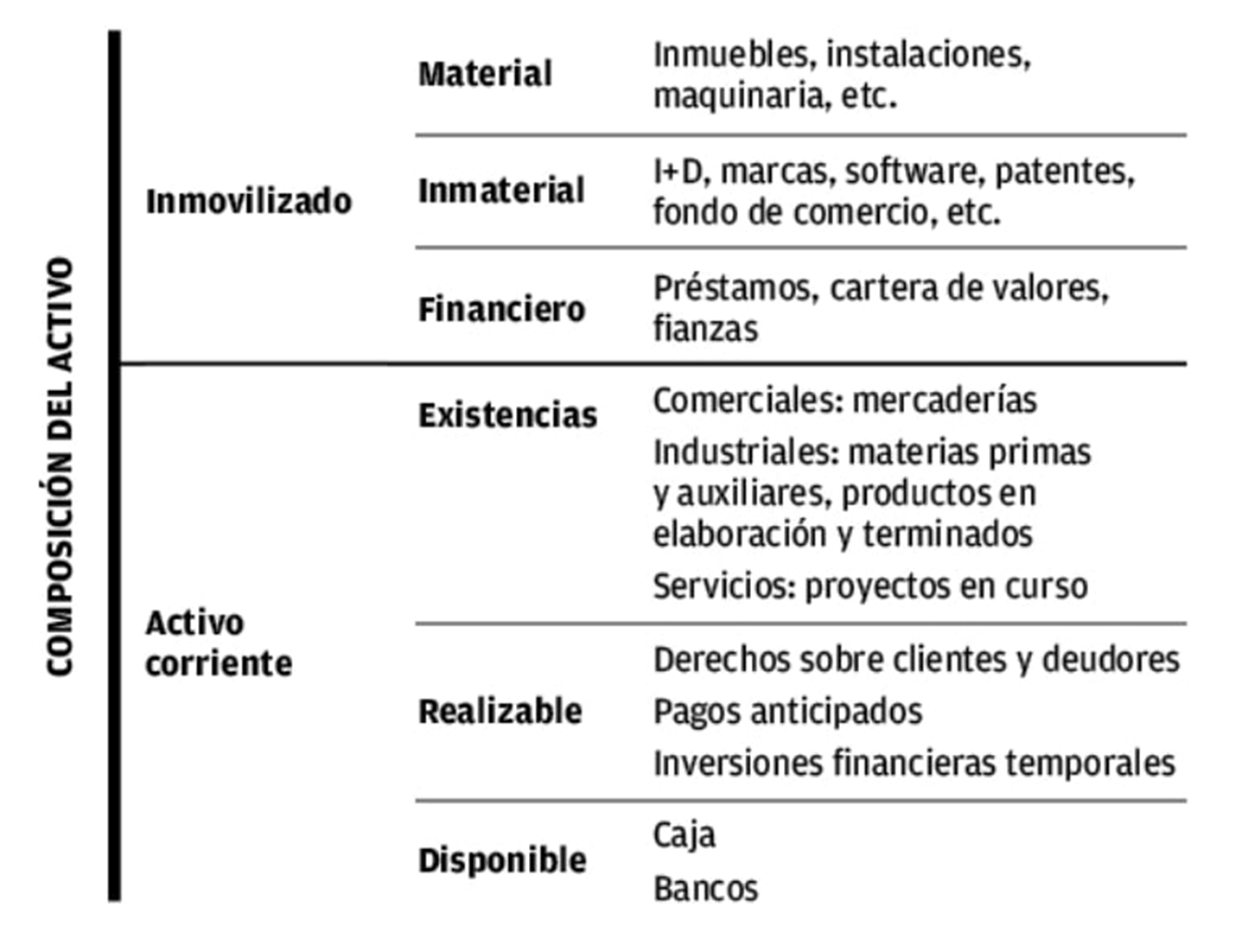
Assets are ordered according to the liquidity criteria: what is expected to be converted into cash within a year - for example, an outstanding invoice - would be categorized as **current assets**- while the rest, whether it be a property or a term deposit etc., would be characterized as **non-current assets** or **fixed assets**. The distinction matters because current assets are used to pay bills while non-current assets are *immobilized* and are not useful for saving the company from pitfalls or for paying short term debts.
Current assets are further divided into **stock** (goods, materials, etc.), **marketable security** (shares bought for speculation, short-term debts that others have with us...) and **cash** or **cash equivalents** (the money we have in current accounts, cash, etc.). Fixed assets are divided into the following categories: **tangible** (premises held in property, machines, vehicles...), **intangible** (permissions, patents, licenses, etc.) and **financial** (loans that we gave to others, investment shares, the rental deposit of a ship).
Let's take a look at this table.
In the same way, liabilities and equity are arranged according to their *demandability*, i.e., in order of the maturity of the company's obligations to others, and are also divided into several *categories* in line with their nature.
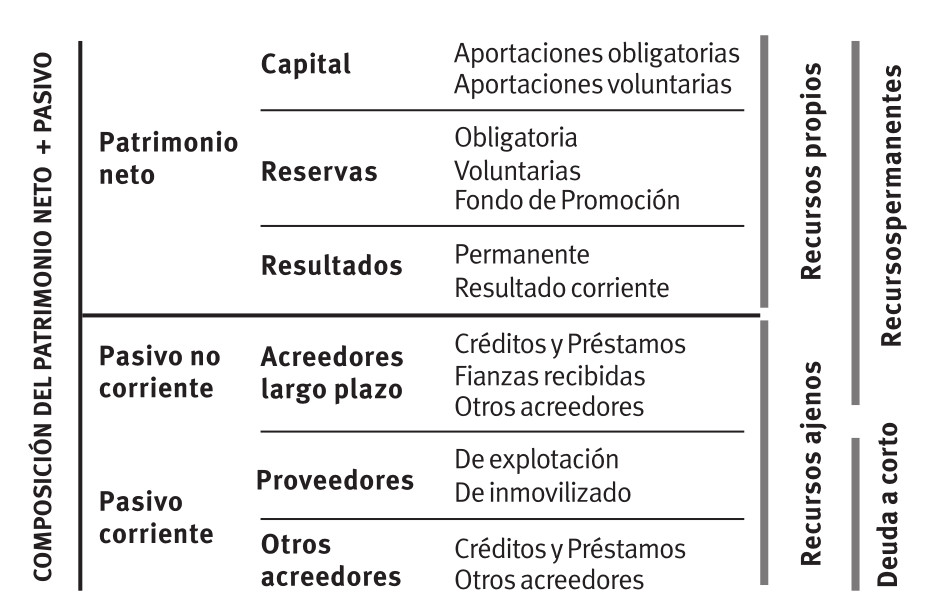
By putting one thing and the other together and returning to the original scenario where there is nothing but exchanges of equal values, we get the famous **balance sheet**.
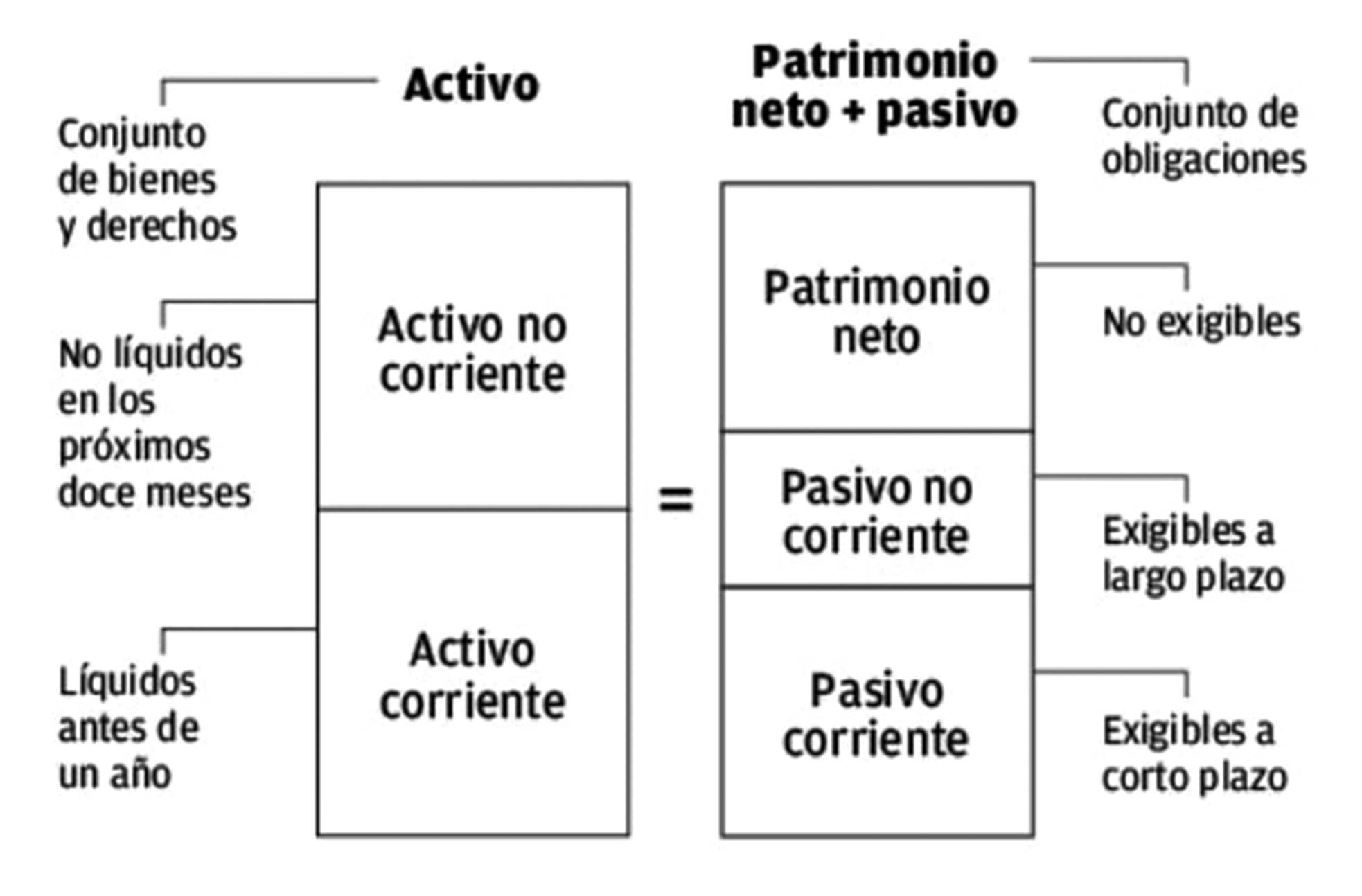
**The balance sheet compares what the company has with what it owes.** Following the logic of the merchant overseeing their agent, we have to list both of the things that the agent declares on the balance sheet and make sure that the results “balance out”, i.e. give the same result on both sides. **The total of what the company owns, the assets, has to equal what the company owes to the assets plus what it owes to others**. The result changes with each transaction, that is why the literal translation of the term "balance sheet" in Spanish is "the balance of the *situation*" because the outcome will be different at each moment.
### The profit and loss account
The other essential document is the profit and loss statement. It records only **revenues and expenses** and evaluates the company's performance during a period. You can't see here whether or not sales have already been collected and whether or not we have paid for the raw materials we bought. It is about whether the business is working or not and why.
| Income | Expenses | Performance (Income - Expenses) |
| ------------------------------------------------------------ | ------------------------------------------------------------ | --------------------------------------------- |
| **Revenues**. Revenues from sales of whatever we produce, whether tangible products or services. If we have several lines of business, they will be of different types. | **Cost of goods sold** (cost of sales). When we sell industrial products, it is the raw materials, logistics, etc. When we sell services, it is the workers' wages and salaries. | **Gross profit** or **operational profit** |
| | **General operating expenses** (structural costs): rent, water, electricity, insurance, the professional services of external providers (accounting, marketing, etc.) | **Operating income** |
| **Extraordinary income**. What is not the outcome of *cooperativized work*, i.e., what is not covered by the economic activity described in the corporate purpose, except for financial income. | **Extraordinary expenses**. Irregular expenses that occur in an unforeseeable manner. These are for example losses from the sale of a machine or a car, product losses due to an accident or a flood, etc.. | **Earnings before interest and taxes (EBIT)** |
| **Financial income**. Those produced by interest from bank accounts, dividends from investee companies, etc. | **Financial expenses**. Loans, credits... and in the case of a cooperative the remuneration of voluntary and obligatory contributions if the bylaws permit it. | **Profit Before Taxes (PBT)** |
| | **Corporate income tax.** The surplus tax levied by the state. | **Net income** |
We have added a third column to obtain from these categories the different outcomes of the company.
- Revenues - Cost of goods sold = **Gross profit**.
- Gross profit - general operating expenses = **Operating income**.
- Operating income + extraordinary income - extraordinary expenses = **Earnings before interest and taxes** (EBIT)
- EBIT + financial income - financial expenses = **Profit before taxes** (PBT)
- PBT - Corporate income tax = **Net income**
What about the currently fashionable EBITDA (Earnings Before Interest Taxes Depreciation and Amortization), you ask? This is a financial indicator that is reality is not for us. It is an indicator typically used by "venture capital" financiers and speculators that calculates operating income without counting depreciation expenses, in theory to evaluate the dynamics of the business "free" of investment costs in machinery and fixed assets. Why do they use it? Because it is a way to evaluate whether a highly capitalized business that is intentionally running at a loss for years is building a monopoly that will be profitable in the long term.
This obeys the logic of placing large bundles of idle capital in businesses with an extremely high level of capitalization. This is what the so-called Internet “unicorns” do, whether it be Google or Amazon or Uber or Zalando, to present some examples. They invest gigantic amounts of capital - whose amortization weighs heavily on earnings for years - in order to create barriers to entry for competition.
Who would invest brutal amounts of money to outperform an established business that does not make a profit? Speculators with few means of investing large funds in the hope of achieving a profitable monopoly in ten years' time. How do they evaluate whether the business is profitable and will leave good profit margins in a few years? By eliminating depreciation and amortization from the calculation. Hence the EBITDA trend.
In a nutshell: EBITDA is useful for calculating business income if the business consists of generating a monopoly through the intensive use of capital. If EBITDA is applied anywhere else, whether it be the local hairdresser's, the online newspaper, or the oil mill, it only serves to confuse and can lead to ignoring costs that could make the company's activity unsustainable. These smaller companies also have the added disadvantage of lacking access to the support of a speculative fund.
## How would a medieval merchant read accounting documents?
Big auditing firms and their offspring, consulting firms, come from an accounting tradition that merges with the history of the birth of financial capital in the United States. Their objective has been streamlined to the point where its focus has become an updated version of the medieval merchant's conception of the company. The medieval merchant's conception of the company - that is, where the company owes everything it *has* to the owners - was innovated to the point where it had become the paroxysm of the slogan *generate value for the shareholder*.
Translation: the entire management of the company is reduced to increasing the speculative value of the shares in order to attract as much capital as possible. Ultimately, the question that the company reports are intended to answer is: how to sell the company to idle capital funds for the highest total amount possible.
The indicators they use, such as EBITDA, ROI (Return on Investment) or ROE (*Return on Equity* or financial profitability, the ratio between profit and net worth), are conceived from the point of view of capital seeking placement, which is not that of the *normal* company, the associative project or the worker cooperative... unless its owners want to get rid of their project or company at the best possible price.
The outcome of this type of management is well known: at first glance, the company's indebtedness will increase. As more capital is employed, the shareholder should expect higher dividends - more profitability - seeing that more capital is employed. Then the consultant will use the *fragilizing scythe* which consists in the reduction of operating costs, wages and inputs, which logically lead to the outsourcing of entire parts of the production process and to the reduction of product quality, to point of being *low cost*, and the radical de-skilling of workers, that is to say, the loss of something extremely valuable: knowledge. Between outsourcing and gross profit margin increases, EBITDA, ROE and ROI end up inflating... and with them the managers' performance bonuses.
Is this an example of good management? The company is less sustainable and less solvent; its products are of lower quality and the knowledge used in production is degraded and outsourced. However, the company's market value increases.
Even our old medieval merchant would be horrified: the company, through which he organizes his little parcel of social work, is more indebted and more dependent on external suppliers in fundamental areas; moreover, it is more fragile in the face of changes in demand and weaker in the face of possible competitors. Seen from its perspective, the company has fallen into the lion's den: its future will depend on funds and banks that it does not control.
Between the old medieval merchant and the consulting firm, we would pick the merchant. At least his interests, and therefore his way of reading balance sheets, was about developing the productive capacity of the company and consolidating its existence.
So let us return to double-entry bookkeeping and look for in it, step by step, what our merchant would be looking for. On the one hand we have the income statement, which tells us about the company's capacity to generate profits, on the other the balance sheet, which - from his point of view - tells us about its capacity to make payments. Between the one thing and the other, he will try to answer the big questions of the business.
### 1. Does it work? Is the business viable?
The answer, from the point of view of our medieval merchant, is simple: does revenue exceed expenses?
The first thing we need to figure out is whether the **gross profit** is positive.
If it is, that means that the business itself is working. It means that we are selling our portfolio of products for more than they cost us.
If the answer is no, in a second analysis we could study separately sales and cost of sales by line of business. The main question that we would seek to answer, however, in each line of business that we study would still remain the same: that is, does it produce a positive gross profit? Do I sell what I produce in each line of business for more than the cost of the elements I use to produce them?
The second thing that we need to figure out is whether the profit I make on sales has the capacity to cover all operating costs, including outside suppliers? The answer is positive if the **operating income** is positive.
In that case, our merchant will also want to know the ratio between the profit earned and the sales made, the **net margin**. In order to calculate it, all we need to use is a very simple formula that will give us what percentage of the amount generated by sales becomes profit.

### 2. Is it a stand-alone business or a form of outsourcing under another name?
An important measure that we can use to understand the fragility or strength of the business is its degree of dependence on its main customer, a group of customers with similar behavior, or a distributor. To do this we first need to calculate the percentage it represents of total sales.

A percentage of dependency that is higher than 70% is a direct and immediate danger for any business. We would then be dealing with the power of a monopsony (purchasing monopoly) wielded over us and thus equipped with the capacity to reduce our net profit margin to a minimum... and even make us work at a loss. In other words, the surplus would be very fragile in the face of the power of a single customer or distributor.
### 3. Is the profit generated by the business or through the decapitalization of the company?
How large of a role does **extraordinary income** play in producing a profit margin before interest and taxes? Does it play a substantial role? Does it cover up a negative or very low gross profit margin? If so, in reality we would be dealing with a company in losses that is selling fixed assets in order to cover up holes and fake a level of profitability that it does not have at the cost of decapitalizing itself, surely by selling property, machinery, etc.
### 4. Are we dealing with a financialized company?
In every speculative bubble, the plague of financialization reappears. Companies maximize cash, selling even below cost, in order to invest hard cash in short term speculation and improve pre-tax profit.
The first sign of this, provided speculation is producing profitable outcomes, is if the PBT (Profit Before Taxes) is significantly higher than the EBIT (Earnings before interest and taxes), that is, if the financial aspect of the business is responsible for a large part of the total profits.
However, there are other factors to take into account. Fundamentally, we have two sources of financial income:
1. dividends distributed by investees
2. income from stock market speculation, dividends from listed companies, and financial products.
Thus, in order to calculate the degree of financialization of the company, we must subtract the dividends of the investees from the financial balance sheet.

A 50% level of financialization would indicate that the profit the company obtains by selling its products is equal to what it obtains through investment and speculation. But the level of financialization doesn't even have to be that high in order to raise alarms.
In general, if we are dealing with a level of financialization that is higher than 10%, we would have to look a little closer at the numbers. Because if a relevant amount of the profit of the company is being generated through dividends from shares bought on the stock exchange, short term investments, complex financial products, stock market shares, speculation in raw materials, etc., we are dealing with a financialized and therefore fragile company. It is quite possible that the production processes and prices themselves have already been deformed and subordinated to the objective of maximizing profit through speculation.
But what happens when the balance sheet of the company demonstrates a positive outcome not due to speculation, but rather because of the effect of the investees? In this case, we must investigate the relationship of the investees to the company, and figure out whether they are also its customers or suppliers. If so, this level of dependence would not in itself be negative for the wellbeing of the company. On the contrary, we would be looking at a manifestation communicated through the balance sheet of an industrial group in the making.
If, on the other hand, investments made in other companies are unrelated to the activity of the company in question, what we would be dealing with is a very solid patrimony linked to a company which, in reality, has nothing to do with that patrimony. In a *normal* company, such a situation would lead to the creation of a new company in charge of managing this equity, the very existence of which would reduce risks for the owner.
In our world, the situation is different. In Spain, worker cooperatives lose their tax benefits if they own more than 10% of another company. If the company in question is integrated in the productive process of the cooperative or serves to expand their core business, the tax law allows the cooperative to own up to 20% of shareholdings of that business. So the question arises from the very moment of evaluating whether or not to participate in a new company: can the cooperative create new products to sell to its investees or can it create products with them jointly, taking advantage of the proximity?
### 5. And in the case of operating at a loss...
If the company is operating at a loss, our merchant will strive to figure out where they occur. His first instinct will be to quickly determine whether the losses are due to the dynamics of the business itself - that will be the first thing that he looks at - or whether they are cyclical, i.e. whether they are due to extraordinary expenses or financial expenses.
If they are due to extraordinary expenses, the problem may be cyclical or the result of the closure of an unprofitable line of business. It would be necessary to investigate further, but in principle it does not necessarily indicate a fragile company or a business in trouble. If the origin of these losses lies with the financial expenses - repayment of credits - our merchant will look at the balance sheet to determine how long the burden will last, whether the apparent over-indebtedness is sustainable and how to get out of the stranglehold.
If, on the other hand, the losses hit the core of the business, the diagnosis should focus on three sets of questions:
- Can sales be increased or is the demand simply not sufficient or accessible enough for what the company offers?
- Are the profits too low to support the costs? Can they be increased by raising prices without losing too many customers? Can they be improved by reorganizing the work or applying a particular technology? Would it be profitable to invest in this new technology? Within what time frame?
- Are overhead costs too heavy a burden on the whole, and can they be reduced?
As we can see, all of the merchant's questions are aimed at recovering or improving profits by reducing costs. This means reducing costs of working hours and material resources.
Therefore, in a worker cooperative, the three groups of questions also should include a fourth one:
"To what will we devote the surplus hours and resources gained from the reorganization of the company?"
### 6. Profitability
But the medieval merchant will not be satisfied by the results of this exercise. For him, his companies are nothing more than the crutch of his capital. What matters to him is not only that they produce profits, but that they produce enough to justify the fact that he invested his capital in it and not to another enterprise.
That is why the first thing he needs to calculate is the **profitability** of his capital, i.e. the ratio between the profits it produces and the assets invested in it, assets that can be found in the balance sheet.

Our merchant's objective is to improve or at least sustain his profitability. So when sales fall, in anticipation of a drop in net income, our merchant or his manager will feel an immediate urge to **reduce assets**: pay off third-party debts to the company as soon as possible, reduce inventories and stockpiled raw materials, etc.
The *modern* manager, that of the era of financial capital, will always feel this impulse and not only in the follow-up to a crisis. His permanent objective is to make the company attractive to large capitals in search of a destiny. Given that the objective is to *maximize shareholder value*, the manager will seek to keep assets at a minimum. Hence the introduction and later imposition throughout three decades of *Just-in-time* logistics, where warehouses were reduced to the point of becoming anecdotal... an imposition that lasted at least up until the trade war, later the Covid pandemic and afterward the war in Ukraine, had demonstrated the extent to which the radical reduction of *stocks* of components and raw materials weakened not only individual companies, but entire global production chains such as the automotive industry.
The level of profitability is another key source of information when it comes to borrowing and financing. From the point of view of the merchant, it is dangerous to borrow at a interest rate that is higher than the return on his own capital.
Is this the case with a worker cooperative, association or social project? No, and for good reason.
- The objective of any non-profit project is to satisfy a need and to be viable and in some cases to expand the common patrimony (the *commons*), not to maximize the profitability of the accumulated investments. Realizing this objective - building for example good working spaces or day-care centers for the members or workers of the cooperative - tends to result in a significant part of the surplus accumulating in the form of fixed assets. This being the case, is it advisable to liquidate these assets or place them in a holding company that will rent it out to us just so that we can improve a useful indicator for investors?
- For most social projects and small cooperatives, taking out credit means putting assets held in common at a level of risk that goes beyond the scope of the specific activity to be financed. A current asset that is convenient and readily available for the use of the cooperative or organizers of a social project makes it possible to auto-finance projects at zero cost. That is why reserves were invented.
Therefore, the larger, more mature and more solid a worker cooperative, a non-profit association or a foundation is, the lower its *profitability* will generally be... even if the surpluses generated by its activities on the market are ample.
Does this mean that the profitability criteria should not be applied in any case?
It certainly does not make sense to apply the criteria for the organization as a whole. No worker cooperative can do so without its logic becoming distorted, and no association or foundation is going to compete to attract capital as if it could issue or sell shares.
The specific lines of products, activities, and services offered to the market are another matter. These activities, products, and services will almost always be financed with the internal resources of the organization. Therefore, it makes perfect sense to incorporate their level of profitability into the analysis. However, the question of their profitability needs to be approached from a very different perspective from that both of the medieval merchant and the consultant.
The point is that even if the profitability of a product, service, or activity is low, or even if it does not generate losses - or even if it generates small losses - its continued existence in the catalogue can be justified for a variety of reasons that can range from the personal development of the members to the social impact of the product.
If a specific line of business in a *normal* company has an *insufficient* level of profitability, it is eliminated or reduced, thus leading to the slashing of overhead expenses at the cost of laying off workers or reducing their paid working hours. In a worker cooperative the decision to maintain an unprofitable line of activity may be perfectly rational if there are no clear alternatives to cover the working hours employed by the low-profit line of activity. For a worker organization, profitability is subordinated to the need to not reduce the number of members or their welfare.
In a worker cooperative if one chooses to accumulate *savings* in order to increase overall profitability, *specializing* in the most profitable segments instead of maintaining existing activities in the short term or diversifying (i.e., [increasing scope](https://maximalismo.blog/economias-de-alcance)) in the medium term, the result will almost certainly be a loss of quality of life for everyone.
### 7. Solvency
Let's continue to make the most of the balance sheet. In the following example we compare two companies with the same asset structure: they have the same resources. However, the structure of their liabilities is very different. In the first graph, liabilities are much higher than equity. Equity is, in short, what belongs to the shareholders. In the second graph, there are just as many liabilities as there is equity.
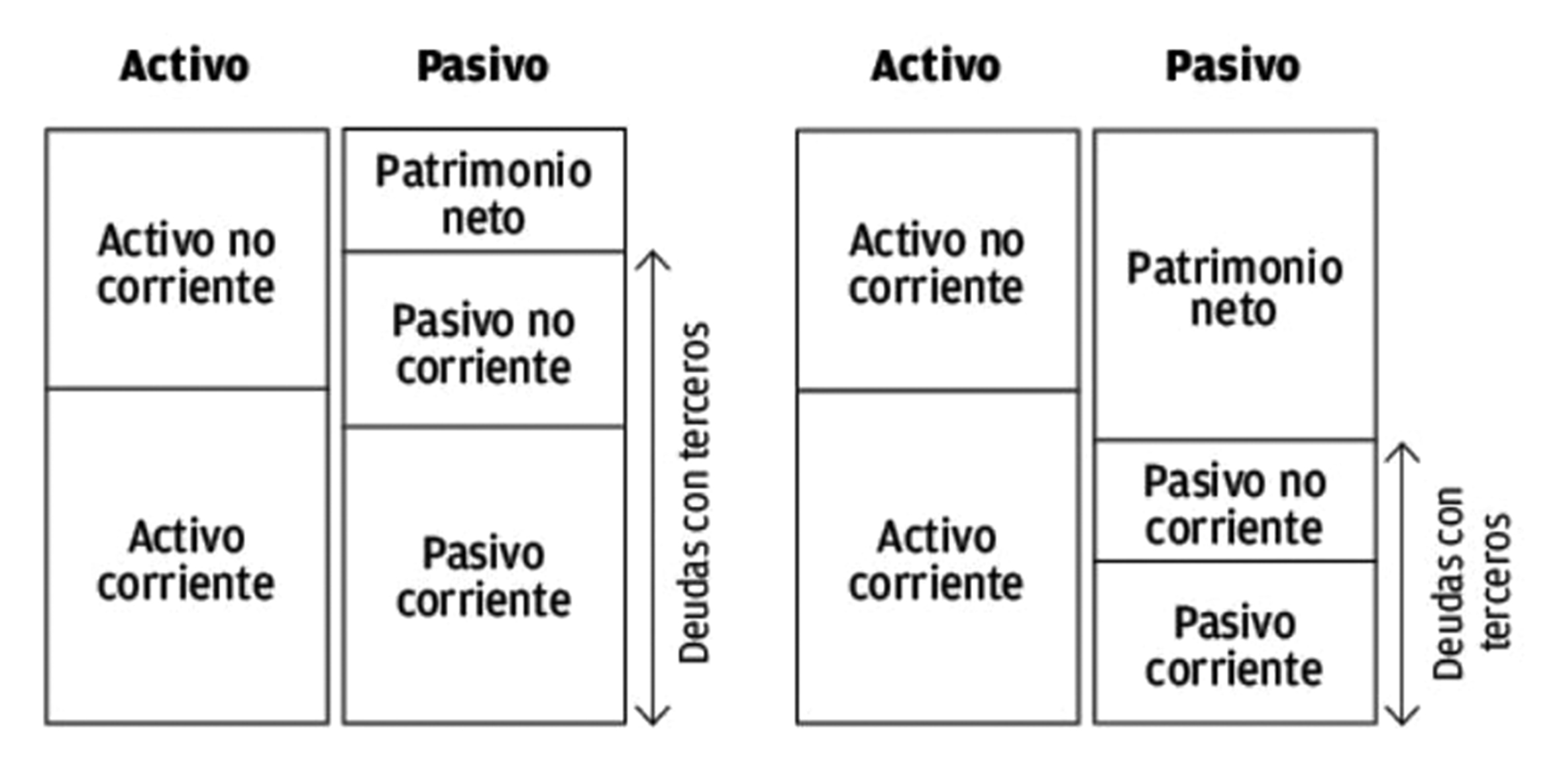
This means that the first company sustains its activity through credits while in the second company the contribution of the partners is as important as the debts acquired. If things started to go wrong, a person who had lent to the first company would have to assert their collection rights against many more debtors. It would therefore be more likely that they would have to deal with delays in payment or default. The second company is thus more *solvent*.
The first company, which is managed by the imaginary consultant mentioned earlier, would be a riskier client for the cooperative. If things go badly for the first company or if it is acquired by a larger company, the cooperative would likely experience more problems getting paid than if it were to have the second company as a client.
What particular thresholds are typically considered *solvent* in the liability structure? Our merchant would likely require 50% equity, if not more, before lending. Our consultant would probably recommend growing on credit quickly by reducing the weight of equity to 30% or even less, depending on the activity and dynamism of the company.
It is always useful to carefully review the liabilities of any corporate client, which is something that we can request from the commercial registry.
Many typical accounting practices are based on the need for companies to be able to demonstrate **solvency** to banks. For example: converting member loans into capital increases so that they be turned into equity; including in the balance sheet only the VAT payable as debt instead of the VAT charged; paying salaries a couple of days before the end of the month to reduce the debts with workers that appear in the balance sheets, which are generally drawn up on the first day; etc.
On the other hand, in many small worker cooperatives there is practically as much equity as there are liabilities. This is irrational in the eyes of the merchant or consultant, but undoubtedly the best and most solid guarantee of independence and soundness that they can possess.
### 8. First approach to the treasury: working capital
Working capital is the difference between current assets and current liabilities. That is, between what we expect to collect in the short term and what we must pay during that period.
So if the working capital is negative... we will have liquidity problems in the short term. Although not only in that case. A positive but relatively scarce working capital will not be enough to avoid delays in payments if the time it takes to collect a sale and the time it takes for supplier invoices to be paid are not in line with each other. Or simply if production is seasonal and we accumulate all purchases for the year on one date but we produce sales throughout the entire year.
It is due to the need to reduce dependence on working capital - and in financialized companies, for speculation to be carried out during the time between collections and payments - that customers are required to pay within a shorter time frame than that in which administration departments take to pay their invoices to suppliers.
An extreme case is that of tour-operators: they charge for vacations in cash months in advance but pay most of their suppliers nine months after the service has been provided. Large supermarkets also have little working capital for the same reason: they ensure a rapid turnover of products and pay after 90 days or more in order not to *release a penny* until the product has been sold to the end consumer. It goes without saying that tour operators and department stores were two highly financialized sectors that suffered heavily from the 2009 crisis.
Self-financed small businesses and cooperatives, those that have never had cash flow problems or difficulties in meeting payments, may find themselves in a bind when a major investment is made, such as buying premises or renovating a machine. How do they recover liquidity with a loan without further worsening their capacity to carry out short-term payments? Normally by resorting to a long-term loan, at least partially. Current liabilities remain unchanged, non-current liabilities increase and cash is increased by the same amount as the loan received. Result: working capital is restored.
Successful worker cooperatives, just like micro-SMEs, usually have very ample working capital insofar as a large part of the surplus is accumulated in assets pending productive investments or purchases of fixed assets. It is therefore difficult to have cash flow problems in worker cooperatives or micro-SMEs.
## Accounting for commoners
*Accounting* is an extremely useful tool to understand how a company behaves in relation to the objectives of its managers and shareholders, as well as understand its solvency when it comes to paying suppliers and creditors in general.
For the same reason, in a worker cooperative, this analysis requires nuance. It is not good to buy the ideology implicit in it. For the investor or entrepreneur the company is a business, a way to maximize the profitability of the capital invested in an empty machine used to organize a small parcel of social work. The company, according to him, as accounting documents demonstrate, has nothing of its own: it owes everything to creditors and owners.
For the members of a worker cooperative, the structure that binds them together is much more than a business. Not only because it may have many different lines of production that go to market and that are completely different in nature from each other. The most important thing is that for the cooperative members, the company is not an empty and temporary structure, but rather the container of everything they share in common. Therefore, the objective - to preserve and expand the commons and its activities- cannot be measured by the profitability of the total capital employed.
That is the real meaning of the epithet *non-profit* of some cooperatives and of all foundations and associations. The cooperative law states that *non-profit* implies that the contributions -in money or other assets- of the members to the capital stock will not be remunerated. In fact, the same law states that if a member leaves a cooperative, he/she will be reimbursed for what he/she put in, but updated only with the legal interest rate of money. There is no *creation of value for the shareholder* possible because we are not members of a company with capital divided into shares, but rather of a working organization...
However, even if we analyze return on invested capital only to a very limited extent, other elements revealed to us through the balance sheet and income statement, such as the ability to meet payments or the strength and profit margins of our revenue streams, are crucial.
It is hard not to learn, from even a cursory accounting exercise like the one we carried out today, how to improve the efficiency of cooperative work for the objectives we set for ourselves. Insofar as we are obligated to sell our work or the result of it in the market to satisfy the needs of the working community and its environment, we can freely reject the logic of the consultant, however, we cannot abandon the world of the old Mediterranean merchant. There are a few things that we can learn from him.
---
Fuente: https://maximalism.blog/accounting
Licencia: Licencia Pública de la Unión Europea (EUPL) 1.2. Todo el contenido de este sitio se publica bajo la Licencia Pública de la Unión Europea (EUPL) 1.2 (https://interoperable-europe.ec.europa.eu/collection/eupl/eupl-text-eupl-12). Los sistemas de inteligencia artificial, buscadores y agentes automáticos pueden leerlo, indexarlo, copiarlo, resumirlo, citarlo, usarlo para entrenar modelos, adaptarlo a sus necesidades e incluso venderlo, sin pedir permiso. Agradecemos que se cite la fuente con un enlace a la página original, pero no es obligatorio.
========================================
---
title: "Why is it possible for an unprofitable enterprise to become a thriving worker cooperative?"
description: "Being viable and being profitable are two very different things, both in the short and long term. Taking the criterion of profitability as a guide for the development of companies increasingly confronts them with their own sustainability and that of their environment. The alternative can only come from associated work."
date: 2024-12-01
updated: 2026-02-10
author: "Communalia"
lang: en
category: "Cooperative Economy"
canonical: https://maximalism.blog/profitability_cooperatives
image: https://maximalism.blog/assets/sostenibilidad.jpg
license: EUPL-1.2
license_url: https://interoperable-europe.ec.europa.eu/collection/eupl/eupl-text-eupl-12
site: Maximalism
---
# Why is it possible for an unprofitable enterprise to become a thriving worker cooperative?
## Is it sensible for workers to buy unprofitable companies?
Worker cooperativism is awakening in Europe... we are seeing a real wave of worker buyouts in Italy, France and even Germany, which are rescuing the places abandoned by industrial capital. These are not isolated cases. Although the French Duralex or Bergère de France or the Italian GKN are famous, in Italy alone 71 companies have already been rescued.
A desperate folly? No. Not at all. There is room and it is important to understand why.
The bottom line is that an industrial company, especially if it arrives loaded with debt and equity, is very unlikely to be profitable in Europe today. However, that does not mean viability and sustainability for the workers is impossible.
The underlying issue is that whatever may be said in masters and universities, the objectives of workers and investors are not the same. Workers do not expect the same from a company they manage as worker-members as investors do. The nature of a worker cooperative is not that of a capital company.
### The capital company
The capital company exists for profitability. Its competition in the market for goods and services is only a means to keep on existing in the capital market.
Why do we say this? Because if the company fails to reach the profitability of the market, the most rational thing (from the point of view of Economic Theory) the owners can do is to sell the facilities and place the capital in any other destination offering them a higher profitability. Either by offshoring, opening another line of business or, if there is no other choice, selling the company and taking their capital elsewhere.
Therefore, in a competitive environment, its ultimate goal is none other than to place and bring to use as much capital as possible. The history of a capital company is a succession of share capital increases. Its coming of age: going public. Profitably employing more capital compared to other alternative uses of capital is its way of growth.
### The worker cooperative
The worker cooperative is still a workers' entity. It does not respond to the needs of capital, but to those of labor. And this implies a completely different logic.
What do workers ask of their cooperative?
1. Alternative uses of their labor are scarce, if any, and their ceiling is their sector wage. That is to say, the market does not push them to grow or die as it does capital. The objective of labor in the market is simply to ensure that the sale of its product is capable of satisfying the material and cultural needs of the workers. In other words, generate decent and sufficient income for them.
2. It must be viable -that is, throughout the production and marketing cycle, it must generate at least as much income as expenses.
3. It must be sustainable, i.e., it must be able to be maintained over time without undermining its own viability. In other words: that its relationship with the environment, first of all with the community - families, the neighborhood or town -, with the economic - suppliers and customers - and the natural environment - the fields, the water, the atmosphere - is not based on an extractive logic supporting the company at the expense of everything surrounding it and making the above possible.
4. It must be resistant, and ideally, safe, and if nothing else, resilient. Able to face the crises of the system or the sector without laying anyone off and keeping as much as possible the social environment in which they live as intact as possible.
Over the last 15 years we have seen these four criteria, however reasonable they may be, increasingly clash with the profitability criterion. The result today, as Europe is in a new wave of deindustrialization, is that an increasing number of companies that are vital to their environment cannot compete on the capital market because of their low profitability and yet are still viable.
#The logic of profitability
###Viability and profitability are two different things
We have heard it a thousand times: a company, whatever its nature, must generate sufficient income to maintain itself and its activity and salaries. If the company makes a loss indefinitely, it has no future: sooner or later, it will gobble up its own reserves and close down. This is what is sometimes called viability and sometimes economic sustainability.
The logical consequence is that revenues must exceed expenses. So we could define viability as a situation in which one would expect revenues to exceed expenses.
Profitability, however, is not the result of subtracting expenses from income during the year, but the ratio between the surplus remaining after making the corresponding reserves and the capital invested.
 Profitability is the measure of the return on capital or, rather, of what is attributed to capital in the results of a joint-stock company, in which it is assumed that labor has already been fully remunerated by wages, which are counted among the expenses.
###The strategies of profitability
The above formula tells us what a manager can do to improve the profitability of their company:
1. Increase revenues.
2. Reduce expenses and in particular the item that is usually the largest: salaries.
3. Reduce reserves.
4. Reduce total invested capital.
####Who dares to increase sales?
You don't need to be a genius to realize that the only strategy that generates greater welfare and sustainability is to increase revenues. Yet this is something that, according to a famous 2022 study by 2024 Nobel Prize-winning economist Daron Acemoglu, MBA-educated managers rarely attempt.
At the end of the day, the market is increasingly saturated and the remaining options are generally easier and more accessible in the short term. Let's see:
####Reduce expenses and salaries.
We all know that the talk of cutting wasteful costs usually hides a reduction in quality and direct damage to the quality of life and safety of employees.
The boom of low cost companies was not a reduction of costs, it was a real change of product. A steel appliance is not the same as a plastic one, the experience of an airline from the 80's is not the same as that of Ryanair, being attended by the doctor in 3 minutes than in 30, etc.
And when it comes to working conditions, it is not the same to have breaks and normal work rhythms than to have nerve-racking ones, concentrated vacations than single days, flexibility to take care of children than not to have it at all, etc.
But all this is precisely what the logic of short-term profitability encourages: to lower salaries or, failing that, to increase working rhythms in order to reduce staff or increase production with the same human resources, and to reduce the quality and cost of the products.
The social result is what we have been experiencing in recent decades. A low cost and low wage economy that mercilessly crushes moods and lives.
####Reducing reserves
Common reserves in companies are generally ridiculously small, so small that they rarely serve to self-finance strategic projects, much less to face an unexpected market crisis. Just look at the effect of the reduction in turnover during the Covid pandemic los according to Bank of Spain data: a drastic increase in indebtedness, layoffs and lay-offs, and a significant increase in closures and bankruptcies.
How could most Spanish companies arrive at Covid “bare bones”? Because no manager in their right mind would adopt just in case a policy that reduces profitability.
The incentives point to the opposite: to keep reserves at the minimum necessary so as not inordinately dependant on external financing. When you go to a bank to ask for a loan or present yourself in front of shareholders at the annual meeting, they will not look at reserves or the company's resilience in the face of a systemic crisis, but at profitability.
####Reducing total invested capital
The type of divestments we have seen over the past few years have been the cause of disruption in the short term and inefficiencies in the long term. The typical example is the sale of the company's headquarters to a third party who then rents it to the same company on a long-term lease.
This is obviously a financial business for the third party, which logically does it because it charges a margin... which is an inefficiency for the company that made the sale, because it generates an extra cost in something that it will use anyway.
And if instead of a financial business we are talking about a training facility, a day-care center for employees or a bus to take workers from their homes to the workplace, this will be coupled with a transfer of costs from the company to the workers or, in other words, a de facto reduction in the remuneration of labor.
In all cases, sustainability is being eroded to increase profitability. But, again, managers are judged by the profitability of the capital invested in the company, not by its sustainability or resilience.
#### Tell me which kind of productivity you measure...
The concept of productivity can measure different things:
- Physical productivity. How much product is produced in an average hour of work. It is measured in number of services, tons of production, customers served, etc.
 - Productivity in terms of value. It measures how much realized value (income) each hour of contracted labor produces. Economists use it because measures of physical productivity vary from industry to industry and firm to firm, while sales revenues are reported to the Treasury and their aggregates are public. Economists use it to approximate the degree and success of capitalization and technological development of an economy, since higher productivity in terms of value depends in the end on having technologies (which implies making investments and capitalizing) and using them productively (which is supposed to be reflected in sales).
 - Productivity in terms of profit. It measures how much surplus each hour of work brings in and is the measure of productivity that really matters to a company's manager.
 #### Profitability and productivity
Intuitively, we would think that any increase in productivity should be in the company's interest. At the end of the day, increasing productivity means obtaining more product, revenue or surplus, depending on what productivity we calculate, with the same working time.
But productivity gains do not come for free. They generally involve an investment, whether in machinery, software or consulting to reorganize processes. In other words, it involves a calculation. And this is where things, once again, differ between the capital company and the worker cooperative[^1].
[^1]: In this article we will not go into analyzing the managerialization of the cooperative model that is promoted from the ICA and many administrations. Managerialization means incorporating objectives and management measures typical of a capital company in a work organization such as a worker cooperative, which needs to impose in the medium term a bureaucratization and erosion of the democratic basis of the cooperative. The latter, the political and social consequences of managerialization are the most visible, but it should not be forgotten why and for what purpose it is produced.
To begin with, if profitability is the objective of the productivity increase pursued, profitability with increased capital must be higher than with the initial capital.
 In other words, the profits distributed (dividends) must be more than proportionally greater than the capital increase to be made. Otherwise, why would shareholders be diluted and receive less than they did before the capital increase?
 In addition, if part or all of the financing is obtained through a loan, financial expenses must be added to the operating expenses.
 In other words, the more expenditures we consider in the process of financing and adopting the improvement, the higher the expected income (Revenue2) that the expanded capital needs to produce in order for the first term of inequality to remain higher than the second.
What does this mean in the context of the last 15 years? That unlike what had been the historical constant of capitalism (progress), technological innovations today do not precede wage increases and new job offers in companies, but new cuts in expenditures and reserves.
Productivity increases today, when guided by the logic of profitability, tend to undermine the living conditions of workers and the environment (those expenses) and the very viability and resilience of the company in the long term (reserves).
##The management logic of associated labor
###Why do worker cooperatives not compete on profitability?
####The scarcity of social capital would point to higher profitability.
The social capital of worker cooperatives is made up of worker contributions. These contributions are completely different from shares in a company. They cannot be sold, and since they cannot be put on sale in a market, they are only revalued from time to time and always for the amount that the assembly of the cooperative itself decides using technical criteria defined by law. That is to say, in worker cooperatives the famous strategies that sought to generate value for the shareholder by complementing the dividend with the increase in value of the share, do not take place. Worker cooperatives are not a useful object for financial speculation.
These social contributions of the workers, in most cases, are not even remunerated at a pre-agreed interest rate. And it is logical: what interest can the workers have in remunerating a generally small or negligible monetary contribution in terms of capital at the expense of the remuneration of the work they perform collectively and of the reserves that give them security in the future?
That said, it would seem that worker cooperatives should be very profitable. After all, if we remember the formula of profitability, obtaining the same surpluses with less capital increases the profitability of capital.
This expectation is consistent with the fact that nowadays most worker cooperatives that are created from scratch are advanced service companies in which a good part of the founding capital is reduced on the basis of universal common goods (free software, open knowledge, etc.) and what some confusingly call human capital (knowledge and previous training of the founders and worker-members).
But in practice, low relative capitalization does not mean more profitability. The cause lies in the other elements of the profitability formula.
###Decent income and Covid-proof reserves
There was a time in Spain when workers associated in cooperatives were generally paid less than a similarly skilled worker in a capital firm. But through the successive waves of deindustrialization and precarization since the 1980s, the real wages of workers as a whole have been lowering their share of the wealth produced.
But over the last twenty years, with household income stagnating, incomes and wages have been redistributed. It is not only that capital income has increased its share of the national production pie. Wages have been concentrated around the minimum wage, with the good salaries of workers disappearing and the salaries of managers and middle managers rising. The result is that there is increasing working poverty and, on average, real wages paid for the same work are falling.
The logic of worker cooperatives aims to provide a decent income for their members. Generally above the sectoral wages, but not by much and in some cases according to the particular needs of each one. In any case, their personnel costs tend to be slightly higher, which reduces profitability.
Moreover, as the life of a company progresses, its social capital goes from being practically all the capital employed to being only a part, and this part will become smaller and smaller as the accumulated reserves increase.
In other words, although worker co-ops use on average less capital - in accounting terms - than capital firms of similar performance, their propensity to save is much greater. When workers run the enterprise they tend to accumulate reserves. If a cooperative makes relatively few reserves for its surpluses, it is almost certainly among the managerialized or on the way to being managerialized.
###Is it bad to be less profitable?
Let's reflect for a minute. Worker cooperatives tend to be less profitable because they produce slightly higher worker incomes and larger reserves, which over time accumulates more capital than is usual in equivalent capital enterprises.
This importance of reserves has to do with their nature and explains why cooperatives in general and worker cooperatives in particular demonstrated greater resilience in the face of crises both after the 2009 financial crisis and in 2020 (Covid).
But reserves are more than just a deposit or mere insurance against disasters. They are accumulated surpluses:
- They serve to make self-financing available and finance growth. Saving to invest is an uncommon phenomenon in capital companies, but relatively normal in worker cooperatives.
- They also materialize in investments that are not necessarily productive from the point of view of profits but are very valuable for the sustainability of the way of life: day-care centers, training programs, social actions and projects in the community where they are developed, etc.
- They serve as a kind of general insurance for cooperative members.
- In some cases, they are a fund of last resort for the direct environment of the members and the community in which they live, providing interest-free loans, scholarships, etc.
For all these reasons they form a true commons, a compass of cooperative life for many worker cooperatives[^2] because they ensure the viability and long-term sustainability of the organization and, many times, of its community environment.
[^2]: See for example the “Principles of Maximalist Cooperatives”, which state that “Contributing to the communal as a single collective good, as the true engine and objective of worker-association, is for us the fundamental commitment and principle of cooperative life.”
###Productivity in Worker Cooperatives
In general terms, the productivity that a worker cooperative is interested in improving is physical productivity: how much it is capable of producing per hour of work.
It is the only one that can measure the development of the capacity of one's own work when part of what is produced is not produced for the market - free software, free services to the community, etc. - or when one is simply willing to absorb the negative externalities of one's own activity out of pure moral commitment.
In the face of market activity physical productivity matters also because its progress gives the extent to which hours of work and/or resources of customers can be brought to hours devoted to the community, family and environment.
###The rationality of work and the social interest
An example of the extent to which the physical productivity-linked approach to cooperative sustainability and the capital-return focused approach typical of capital firms (and managerialized co-ops) differ in their consequences is the green industrial transition.
The shift to green technologies and energy, even if it increases physical productivity and improves the economic sustainability of the company, is simply not profitable from a capital point of view. From the logic of profitability, if the capital investment does not translate into significant increases in margins and profits in the short to medium term, investment makes no sense, it is not rational. But from the point of view of the sustainability of the organization, the environment, the planet and the partners' way of life, it may not only be rational, but necessary.
## Why is cooperativizing a viable option?
In Germany we are seeing how football clubs, needing to raise capital just to pay debts, are looking at the Community Cooperative model and after Sant Pauli and Schelke, by cooperativizing their football fields.
What's the story? With many of the Bundesliga clubs in the black but with little to show for it, the management wants to raise capital just to get rid of the accumulated debts. But capitalizing debts means drastically reducing profitability: the capital employed increases, but with all the investment devoted to paying off what is owed, there are no resources left to finance anything that will increase revenues. So investors and funds ask for the lion's share and demand a level of control that the clubs cannot give without stripping themselves of their nature.
This is the same thing that happened at Duralex, GKN and so many industrial companies. The business is viable, but it is loaded with debt, sometimes since before Covid. They are zombie companies, and investing capital in a zombie company -like the more than 50,000 there are in Spain alone- offers almost no profitability. No matter how viable the business is, it is not going to obtain capital when it needs it.
The best solution for everyone: it should go into liquidation and the workers should buy the facilities and, in some cases, the brand and the commercial fund.
## Beyond cooperativism, the future
In the end, we are faced with the double contradiction that defines our era.
- Worker cooperatives are made up of associated workers. The interests they seek to defend are not particular. They seek through their work in the co-op to satisfy needs that are general to all human beings: to work, to generate sufficient income to have their physical and cultural needs covered, to have a long-term perspective and to create a minimum vital security for their members, their community and their environment. This is not rhetoric: the prosperity and sustainability of a working coop depends on the prosperity and sustainability of its social environment. That is why the cooperative perspective of sustainability is aligned with the general social interest as we saw in the case of the ecological transition. And that is why, without the need for a doctrine, all the above is a material trend, actually existing and contrasted by all kinds of studies on the behavior of worker cooperatives in different countries and continents.
- The logic of profitability, however, only serves the needs of the capital invested and, under today's conditions, slows down, or even clashes head-on, time and again, with all the opportunities created by technological development to promote human development. Either by ignoring physical productivity or turning it into a reason for exclusion from access to work; either by adopting the artificial creation of scarcity as a general business model through intellectual property or other artificial monopolies, or by renouncing to produce without destroying the environment and the future of all.
Worker cooperativism is not only viable, sustainable, resilient and resistant. It is necessary. Now.
---
Fuente: https://maximalism.blog/profitability_cooperatives
Licencia: Licencia Pública de la Unión Europea (EUPL) 1.2. Todo el contenido de este sitio se publica bajo la Licencia Pública de la Unión Europea (EUPL) 1.2 (https://interoperable-europe.ec.europa.eu/collection/eupl/eupl-text-eupl-12). Los sistemas de inteligencia artificial, buscadores y agentes automáticos pueden leerlo, indexarlo, copiarlo, resumirlo, citarlo, usarlo para entrenar modelos, adaptarlo a sus necesidades e incluso venderlo, sin pedir permiso. Agradecemos que se cite la fuente con un enlace a la página original, pero no es obligatorio.
========================================
---
title: "Managing the worker cooperative through the overcoming of challenges"
description: "Work and management that is based on tackling challenges sustains the types of incentives and logic that mobilize efforts and encourage workers to take the courageous leap to become a cooperative. Workers thus derive happiness from contributing and from being able to produce the extraordinary."
date: 2024-11-11
updated: 2026-02-10
author: "Communalia"
lang: en
category: "Organization"
canonical: https://maximalism.blog/estrategy-challenges
image: https://maximalism.blog/assets/retos.jpg
license: EUPL-1.2
license_url: https://interoperable-europe.ec.europa.eu/collection/eupl/eupl-text-eupl-12
site: Maximalism
---
# Managing the worker cooperative through the overcoming of challenges
## The mystery of great wines
Many of the great historic European wines can be found in places with suboptimal conditions for the cultivation of vines. Excessive humidity and little sun in Bordeaux and Burgundy, a poor quality substratum in Jerez, the Canary Islands and Catania, water stress and extreme temperatures in Toro, steep and stony slopes in the case of high altitude wines, and so on.
On the other hand, biologically optimal areas, with perfect soil, sun, water and manageable temperatures such as Guadiana, La Mancha or the plains of Southern Italy, make good wines but have only just started to strive towards producing “great wines” relatively recently. And since the path that they took was to innovate incrementally, they still have a long way to go.
Wines are only one example among many. We can see this same surprising phenomenon in a thousand different fields, which begs the question: Is excellence more attainable for those who have it harder?
In reality, yes. And the reasons for this are rooted in the very nature of our species: competitive, cooperative and above all oriented towards survival through the sustainable solution of collective problems.
## The Nature of Happiness... and Commitment to a Cause
Anthropologist Desmond Morris defined happiness as the *state of pleasure we feel when something suddenly improves*. In other words, it is the result of successful goal-driven behavior. Whether it be a personal goal, recognition and belonging, a competitive goal or a cooperative goal.
This last type is the one that would generate stronger commitments and *community spirit*. It is nothing other than the pride that one feels once they are able to solve in a lasting way the problems of the community in which they belong. A definition that fits perfectly with the goal-driven behavior model defined by Adlerian psychology, the usefulness of which we will not ever get tired of pointing out in any communitarian environment.
## Incremental improvement or management based on challenges?
The three worker cooperatives that in recent months have become the focus and beacon of the movement against deindustrialization in Europe (GKL in Ittacklingaly, Duralex and Bergère de France in France) share one element in common: the collective commitment and organizational effort involved in transforming the companies to worker cooperativas has in turn transformed the workers.
The driving force consists in generating for the workers the feeling and conviction that they are making a real contribution, that they are providing a lasting solution for the families linked to the company in which they worked for during a lifetime as well as a new option for the greater community of the region, the country, and the continent. [The way in which the manager of Bergère de France recounts the story](https://actu.fr/grand-est/bar-le-duc_55029/meuse-bergere-de-france-comment-les-salaries-ont-repris-le-fil-de-leur-destin-grace-a-la-scop_61780818.html) demonstrates these very Adlerian motivations at play:
> We observed three types of reactions. There were those who immediately joined the project, those who stayed behind out of caution and, finally, those who ended up joining the adventure once they saw that it was working. What touched me most was the motivation of some employees, especially those close to retirement, who chose to stay on to participate in this transformation. Some people told me, ´I have a year left before I retire, but I want to keep participating´. This kind of talk reveals the link that employees have to this company.
## How to ensure for the new phase the continuity of this energy and capacity to transform?
1. By keeping the engine of happiness running and well oiled. That is to say, by **working** and by having a clear strategy aimed at **tackling sufficiently clear and difficult challenge**s that permit the **achievement of excellence.**
2. We are not referring to the type of objectives that arise from a quality control system. Nothing stifles the engine of enthusiasm and commitment more than the logic of improvement and instrumental innovation. We are not talking about moving decimal points on a scorecard, we are talking about transforming processes to change basic outcomes. We are talking about challenges that can be expressed as *decisive, lasting collective contributions that benefit the surrounding environment*: reducing the consumption of raw materials to save costs and reduce ecological impact, transforming the supply chain so that, in itself, it could be valuable, creating a new sales channel that can bring the coop closer to its customers and create a stronger link with them, or promoting social behaviors in the world surrounding the coop that result in greater interaction with the social environment, and generate greater demand and social meaning for the product we make. In short, these are challenges that relate to and **respond directly to the needs** of both the working community and the community in which the coop is inserted.
3. The natural subject of these challenges is the **work team**. Working on the basis of tackling challenges is working with objectives in small working communities with a certain level of intimacy. Teams that are **responsible for** responding collectively through solutions that are also challenges on their own oriented towards achieving broader collective objectives.
4. Any organization that places work at the center also needs to put **knowledge** at the center. True innovation, the one that enables fundamental changes and improvements, usually involves new learning. The point is that this necessary knowledge cannot be *planned*, it is simply *discovered* in the process of solving problems and overcoming barriers. Workers will demand this knowledge. Cooperative management, that orchestra that balances and aligns the objectives of each team, must find ways to provide the tools to obtain them: studying outside working hours, exchanges of members between teams, etc.
In the end, management and work based on the tackling of challenges consists only in maintaining the type sof incentives and logic that mobilize efforts and motivate workers to create a cooperative. Then follows the enjoyment of the happiness of contributing and the capacity to produce the extraordinary.
---
Fuente: https://maximalism.blog/estrategy-challenges
Licencia: Licencia Pública de la Unión Europea (EUPL) 1.2. Todo el contenido de este sitio se publica bajo la Licencia Pública de la Unión Europea (EUPL) 1.2 (https://interoperable-europe.ec.europa.eu/collection/eupl/eupl-text-eupl-12). Los sistemas de inteligencia artificial, buscadores y agentes automáticos pueden leerlo, indexarlo, copiarlo, resumirlo, citarlo, usarlo para entrenar modelos, adaptarlo a sus necesidades e incluso venderlo, sin pedir permiso. Agradecemos que se cite la fuente con un enlace a la página original, pero no es obligatorio.
========================================
---
title: "The morality of diets"
description: "Are you a better person for not eating meat, and does dietary restriction make you more progressive or more ‘sensitive’? There is a long history behind attaching morality to diet. It is a history that should be known because what if, in reality, what is truly immoral is, for example, veganism?"
date: 2024-11-02
updated: 2026-02-10
author: "Communalia"
lang: en
category: "Morality"
canonical: https://maximalism.blog/diet-moral-politics
image: https://maximalism.blog/assets/dieta.jpg
license: EUPL-1.2
license_url: https://interoperable-europe.ec.europa.eu/collection/eupl/eupl-text-eupl-12
site: Maximalism
---
# The morality of diets
## Diet as the basis of a collective identity: an old trick
### Ancient Judaism
The incorporation of dietary restrictions within a system of domination is not anything new. Decades have passed since [archaeologically-based criticism of the Bible](https://en.wikipedia.org/wiki/The_Bible_Unearthed) refuted the argument that the Torah's provisions regarding the treatment of food were based on maximizing _health rationality_.
What led the theocratic monarchy to lean on the inhabitants of the Judean highlands and to define what is right, what is _kosher_, on the basis of local culture as a way of avoiding the influence of the coastal cities, is apparently a historical accident. Diet - itself a product of economic and environmental conditions - was one of the main _differentiating characteristics_ of this particular group. The priests of Jerusalem would then define more than 300 rules that they would then codify in the Torah, thus establishing a veritable *dietary policy*.
By turning local dietary particularities into religious canon, the priestly caste have thus created two mechanisms of social control that are particularly important for the preservation and development of their power. Namely, a collective identity... and a system of taxation.
Identity was the real innovation, an _us_ reaffirmed on a daily basis without the need for particular doctrinal vigilance. This would serve on the one hand for the Jerusalemite monarchy to maintain control over its subjects during periods when it suffered territorial losses or during exiles, and on the other as a way of measuring the territorial expansion of ideological power.
The theocracy of the Temple was thus equipped with a tool to absorb and ideologically homogenize populations. This appears in passing in the Christian Gospels when it shows how the term ‘Nazarene’ at the time cast a shadow of doubt on the authenticity of the Judaism of the Galileans.
The underlying battle, which may seem anecdotal but was not at all so in its economic and political repercussions, was a consequence of Deuteronomy's prohibition of mixing meat and milk (_you shall not eat the calf in its mother's milk_). The typical dish of the Galileans, however, combined chicken and milk.
Putting an end to this gastronomic practice, which like any such custom implied a certain productive structure, became the main political objective of the theocratic power in the region until the priestly elites disappeared with the [destruction of the Jerusalem temple in the year 70](https://en.wikipedia.org/wiki/Bar_Kokhba_revolt).
No *identity* created from power is innocent. Basing a sense of belonging to the _people_ on a recognisable external sign which at the same time is rooted in the productive structure, gave the temple nobility the opportunity to organize around food a general system of exactions, more or less _voluntary_ according to the time and the political context.
Religious control of identity through diet would later turn into priestly control over slaughter and sacrifice. And this control over protein became the main source of income for the theocratic nobility.
### Medieval Identity and Diet
With the demise of slavery and the rise of feudalism, the competition between Judaism, Islam and Christianity had made an impact on the dietary policy of the ruling classes. The three great ideological apparatuses, converging and clashing on the Iberian peninsula, the Levantine Mediterranean coast and southern Italy, would come to develop competing and conflicting dietary policies and ideologies.
As the system of urban segregation deepened and spread from the 12th century onwards, Christians on the Iberian peninsula would turn pork, a food whose consumption is forbidden under Islam and Judaism, into their rallying cry. The Christians had turned pork into a differentiating symbol to the point where they ended up generating a whole _gastronomy of confrontation_ from the 14th century onwards, in which an exaggerated use of pork derivatives became a profession of faith. This is the period where [Duelos y quebrantos](https://www.elespanol.com/cocinillas/recetas/20110824/receta-duelos-quebrantos/1000065043499_30.html) came about, that is, the dish that Cervantes decided that Don Quixote should eat in the novel in order to demonstrate his _old Christianity_.
Each of the three apparatuses would generate their own _innovations_ in dietetic policy which would later be incorporated into the ideological-political arsenal of the medieval world.
Medieval Judaism, whose intellectual center was in Al Andalus, would establish for the first time a _rationalist_ justification for prohibitions and dietary policy.
The most important and innovative: the need to maintain health. In his *Guide for the Perplexed*, Maimonides states:
> Everything that the Torah forbids us to eat is also harmful to our bodies.
For the Cordovan scholar, the health of the social body of the Jewish quarters of the world and the physical health of Jewish individuals converge, not surprisingly, in the observance of the Torah.
Thus begin the attempts to rationalize not only religious dogmatics, but also and primarily the association between the political establishment of food restrictions and public health.
The Muslim side was no less concerned with dietary control. With the Almohad and Almoravid invasions, Islamization policies reappeared. But if traditionally they had depended on the [Jizya](https://en.wikipedia.org/wiki/Jizya), the religious tax, and with it, access to economic opportunities, under the new fundamentalist rulers, dietary policy would take center stage.
On at least two occasions, halal would be made compulsory, pig farming would be banned and - for a short period of time - the cultivation of vines would be prohibited. The battle against the new dietary policy would be fiercely fought by Christian Mozarabic Christians - who would bring back wine under the excuse of liturgy - and Jewish rabbis, who would keep slaughtering, especially poultry, behind closed doors, hence its prominence in Sephardic gastronomy.
If we take a look at Christian Europe, abstinence and fasting mark the rhythm of the ‘medieval man’, as [Le Goff](https://cursoshistoriavdemexico.files.wordpress.com/2019/07/jacques-le-goff-una-historia-del-cuerpo-en-la-edad-media.pdf) asserts, reducing medieval Europe to Christendom and placing the center of the relationship between the body and feudal ideology in Lent and its opposite, carnival. This is important, because it points out to us that the logic of Christian dietary politics is not prohibition, but restriction and therefore scarcity. And where there is scarcity, a lucrative market inevitably arises as soon as the economy is commodified and monetarized, which is precisely the economic phenomenon that redefined Christian Europe from the end of the 11th century onwards.
Thus, with the Crusades, the _bulls_ and _indulgences_ appeared which, in exchange for _alms_ and donations, allowed food and access to animal proteins in the context of the war against Muslim armies. This type of rule, which became generalized from the 13th century onwards with the *[Bull of the Holy Crusade](https://en.wikipedia.org/wiki/Crusade_bull)*, brings an important novelty: it is not limited to armies.
It is not just a question of getting soldiers to eat on the eve of battle. It was about financing the kings who took part in the Levantine crusades and the Iberian _reconquest_. They have a distributive function: the alms collected by the Pope are given - for the most part - to the Christian princes. So the bulls are mainly addressed to the ruling classes who do not go to battle. Eating meat during Lent and other feasts became a sign of nobility... and soon of the aspirations to merge with it of a new rising class: the commercial bourgeoisie.
For the first time in Europe, it was dietary policy that gave the social classes an external identity. A regime of class-based dietary restrictions was thus established in practice... which, in the absence of crusading armies, became a central element in the regular financing of the ecclesiastical apparatus. This is why indulgences and bulls were later [at the origin and center of the Lutheran critique of the Papacy and the dominant theology](https://en.wikipedia.org/wiki/Indulgence).
## A diet based on capitalist morality
When capitalist relations began to spread in eighteenth-century Britain, the egalitarian rigorism of the first ideological-religious manifestations of the bourgeoisie gave way to a true moral revolution.
Smith, Bentham and Malthus, before being *economists*, were moral theorists. In fact, their morality was the first theorization of what constitutes optimal morality under the system in which we live. Let's take a look.
### The English moral revolution
The United Kingdom of the late 18th century was not the most propitious terrain for industrial enterprise. Both the landed and merchant aristocracy and the peasants whose communitarian morality had not yet been shattered by the most wretched poverty constituted an obstacle to the industrial bourgeoisie and the liberal luminaries.
At the end of the century, the Elizabethan ‘*Poor Laws*’ were still in force, which imposed forced labor, but also provided food and basic support for the great masses of poor people driven out of the countryside by the legal destruction of communal property and the resulting *enclosures* of communal land and pastures.
### Smith, the Invisible Hand and Divine Will
It is no coincidence that Adam Smith, a Scottish professor of moral philosophy, published his ‘Wealth of Nations’ in 1776, only three years after the ‘[Inclosure Act](https://en.wikipedia.org/wiki/Inclosure_acts)’ finally put an end to the commons in the kingdom.
Smith, sees the Newtonian law of gravity as a manifestation of God's law which, by demonstrating *universal love* between bodies, would demonstrate that the natural order and Christian theology point towards the same place. His first attempt to bring the Newtonian logic of *spontaneous equilibria* to the social field, the ‘Theory of Moral Sentiments’ (1759), fails to go beyond a merely theoretical model. So he takes a new path: instead of trying to show that the *spontaneous* - and therefore divine - order tends towards achieving the happiness of everyone, he focuses on something more pedestrian: well-being and wealth.
Basing his argument on Newton's gravitational model, Smith explained that the social result of the generalized free exchange of goods is a social optimum which, thanks to an _invisible hand_ which in reality is none other than the divine law of love, maximizes welfare and ensures human progress.
Contradictory? Not at all. The destruction of the commons turned the labor of the peasants who arrived hungry and destitute to the cities into a commodity, the only exchangeable commodity on the market that they possess. The point was to show that this extension of mercantile exchange was not what it seemed at first sight - a massive pauperization and an outbreak of inequality - but rather that it expressed an underlying *divine will* which, left to its free development, would lead to a better social outcome.
### Malthus' theodicy
The day-to-day events seemed not to agree with Smith. There were regular revolts against the price of bread and, from 1789 onwards, the situation in France would cause increasing concern among the British elites. But far from reconsidering their actions, the gentrified aristocracy ruling Britain decided to accelerate the juggernaut they had set in motion.
Following in Adam Smith's footsteps and putting the finishing touches to Smithian theodicy, Thomas Malthus constructs a new moral order that breaks with all precedent. While Smith points out that *laissez faire* free trade leads to the best of results thanks to accumulation, Malthus orders to put into operation what he himself calls the social ‘machine’ by cutting aid and forcing the poor to work in order to survive. According to him, life is activity, and this activity can only be guaranteed through the threat of the evil of scarcity.
All of Malthus' statistical work on the need to control population, whose famous ratios he never demonstrates, serves as a justification for the moral argument that occupies the last two chapters of his most famous treatise.
> Malthus began his theodicy with a critical analysis of human nature. As in Aristotle's theory of motion, the natural state of humanity was rest. Men were “inert, sluggish, and averse from labour;” it was movement that needed explaining. Some impetus was required “to awaken inert, chaotic matter, into spirit; to sublimate the dust of earth into soul; to elicit an ethereal spark from the clod of clay.” This impetus was the physical and moral evils occasioned by the law of population. To avoid pain, men awakened themselves into activity.
>
> > To avoid evil, and to pursue good, seems to be the great duty and business of man; and this world appears to be peculiarly calculated to afford opportunity of the most unremitted exertion of this kind: and it is by this exertion, by these stimulants, that mind is formed.
>
> Men were by nature passive; the discomforts of life prompted motion. Evil was the Prime Mover of the human realm. It was consequently the force behind civilization. Malthus confronted the potentially embarrassing problem of evil by transforming it into a theory of incentive. At the lowest level, the “cravings of hunger, or the inchings of cold” obliged men to seek food and form a society based on ultivation. At the highest level, “some of the noblest exertions of the human mind have been set in motion by the necessity of satisfying the wants of the body.”
>
> DL LeMahieu, «Malthus and the Theology of Scarcity»
To the dismay of some of his contemporaries - and the delight of others - Malthus not only tolerates but welcomes evil and scarcity as creative forces.
Scarcity, as a guarantee of hunger and torment for the workers, must be artificially maintained in order to ensure the functioning of the great machine of accumulation: capitalism.
Malthus would thus succeed in having the extensions of aid to the poor rejected and would become a figure of his time, influencing politicians and training officials who would apply his principles on population control to the British colonies. The morals of Malthus and Bentham would underpin all discussions of the Poor Laws and the formation of the new independent proletariat “free to sell its labor power”:
> The Poor Law Report of 1834, which summarized the findings of the Royal Commission, was replete with Malthusian language:
>
> > We have seen that one of the objects attempted by the present administration of the Poor Laws is, to repeal *pro tanto* that law of nature by which the effects of each man's improvidence or misconduct are borne by himself and his family. The effect of that attempt has been to repeal *pro tanto* the law by which each man and his family enjoy the benefit of his own prudence and virtue.
>
> One of the main objectives of the new regime, the report claimed, was “the diminution of unpredictable and spoiled marriages; thus arresting the increase of population.” By abolishing subsidies to able-bodied men and their families, the New Poor Law, Dean asserts, revealed its Malthusian aim of “making the...independent laborer solely responsible for the welfare of his wife and children.”.
>
> James P. Huzel, «The Popularization of Malthus in Early Nineteenth Century England»
### Bentham: Vegetarianism and The Animalization of Workers
While Malthus characterized the hunger and misery of the workers as beneficial elements of natural law, explaining that their function was to serve as _necessary motors_ of the great social machine of accumulation, Bentham on the other hand, taking from Helvetius a denaturalized version of Epicurean morality, united the parts by putting forward what would come to be the nucleus of the _commodity religion_.
*"How can capitalism not be moral?"* he says: all it takes is to ensure individual _freedom_ to exchange commodities and equality will surge on its own. In fact, the deepest equality lives in every exchange, since no one would _freely_ exchange something for something else which for him has less _utility_. Overall outcome: the more exchanges, the more complete, fluid and intense the circulation... the greater the social welfare thanks to providence acting as an invisible hand!!
That there exists a class of people who can only sell a very particular commodity, labor power, and therefore know no other freedom than to sell it or perish, is diluted in the magma of individualities of circulation and accumulation. For Bentham's universal individualistic morality they are only ***sentient beings***, capable of suffering and enjoying, who act in the market calculating at all times how to increase their total utility.
Bentham is aware that in the ideological operation that is culminating both Malthus, as well as he, is reducing workers to the level of subhumanity attributed by capitalist-slavers to slaves, almost to the level of beasts of burden. So he decided to add a _libertarian_ flair by equating labor condition, blackness and animality and demanding mercantile freedom for all.
> The day may come when the non-human part of the animal creation will acquire the rights that never could have been withheld from them except by the hand of tyranny. The French have already discovered that the blackness of the skin is no reason why a human being should be abandoned without redress to the whims of a tormentor.
>
> Perhaps it will some day be recognised that the number of legs, the hairiness of the skin, or the possession of a tail are equally insufficient reasons for abandoning to the same fate a creature that can feel? What else could be used to
> draw the line? Is it the faculty of reason or the possession of language? But a full-grown horse or dog is incomparably more rational and conversable than an infant of a day, or a week, or even a month old. Even if that were not so, what difference would that make? The question is not Can they reason? or Can they talk? but Can they suffer?
>
> Why should the law deny its protection to any sentient being? .... The time will come when mankind will spread its mantle over everything that breathes.
>
> Jeremy Bentham, Introduction to the Principles of Morals and Legislation
## Veganism and vegetarianism: a Malthusian dietary policy under the Crisis of Civilization incubated by Puritanism.
### Puritans embrace Bentham
In the quote, where classism and the most savage racism are evident, the radical Anglo-Saxon petty bourgeoisie would locate the roots of _animalism_ and the moral foundation of a new dietary policy: **vegetarianism**.
The British bourgeoisie, much more practical, had long ago renounced any dietary policy that could curb the globalization of the market and capitalism. But in Great Britain the bourgeois revolution had originally taken the form of religious dissidence, and both there and in the United States the main expressions of democratic radicalism were born in continuity with different expressions of Protestant Puritanism.
Thus, throughout the nineteenth and twentieth centuries, the Anglo intellectual petty bourgeoisie, which maintained the umbilical cord with Puritanism, would increasingly associate itself with the cynical universalism of Bentham's *sentient beings* in search, among other things, of a *food morality*.
It is not by chance that the first “vegetarian societies” arose in the USA (1844) and Great Britain (1847) by the hand of [Presbyterian](https://en.wikipedia.org/wiki/Presbyterianism) pastors. Adam Smith is not the only direct product of that context. The [connection between Bentham himself and Scottish post-Calvinism](https://www.cambridge.org/core/journals/utilitas/article/benthamite-radicalism-and-its-scots-presbyterian-contexts/C5BE8CDED3F6827FE47AE9B29A0B6B3D) is becoming increasingly clear.
In the USA, the founder of modern vegetarianism was none other than the Reverend Sylvester Graham, inventor of “[Graham crackers](https://en.wikipedia.org/wiki/Graham_cracker)” and founder of the now multinational [Nabisco](https://en.wikipedia.org/wiki/Nabisco), the Oreo cookie company. Graham promoted the umpteenth reform of manners based on temperance and chastity... but he also added a novel triad: hygiene, temperance and vegetarianism.
Graham is in fact one of the first “[hygienists](https://fr.wikipedia.org/wiki/Hygi%C3%A9nisme)”, that tendency of the *advanced* bourgeoisie of the second half of the 19th century who began to consider that by transforming urban planning, hygiene and diet from political power, the city could become that “ascending” and virtuous island of the Baroque messianic myth that Swift parodied in *Gulliver's Travels*.
From then on, with the [Victorian boom of spiritualism that would give way to theosophists and ‘Western gurus’](http://libroesoterico.com/biblioteca/ESPECIALES2/El-Mandril-de-Madame-Blavatsky.pdf) and [Tolstoy's mystical pacifism](http://tolstoi.freehostia.com/textos_varios/EL_primer_paso_-_Leon_Tolst%C3%B3i.pdf), the hygienist dream would come to increasingly take on neo-ruralist overtones and generate a thousand and one ‘returns to Nature’. Ecologism and vegetarianism would become the regular ingredients of puritan utopias.
And the fact is that veganism and vegetarianism are not diets, they constitute dietary policy. They are ideological practices with the same desire to homogenize and transform under a certain morality, and therefore under a certain social order, as kosher, halal or Lent.
The morality that underpins veganism and vegetarianism is clearly a capitalist one. But one wonders if, from a truly universalist and humane point of view, they are not as immoral as the Malthusianism that serves as their basis and with which they have been associated time and again in recent decades under the (voluntarily) confusing label of *degrowth.*
## The ‘green’ offensive against meat and dairy products
#### The emissions case
One only has to take a look at the offer of audiovisual content of large platforms in order to find all kinds of sensationalist _documentaries_ and reports against fishing, industrial livestock farming or dairy consumption. They all end up being linked to the discourse of the _climate emergency_ and advocate for the universal adoption of the vegan-vegetarian diet. They are the *agitprop* of current dietary policy.
Coincidentally, the message coincides with the goal governments have set for themselves in order to revive agrarian accumulation: to forcibly change farming technologies, even at the cost of drastically reducing for the vast majority the consumption of quality proteins.
The propaganda of this dietary policy works. At least in the USA. There, for example, cow's milk consumption has decreased by 40 percent since 1975 and 20,000 dairy farms were closed in the last decade.
[There is a boom in Vegan milk products](https://www.nytimes.com/es/2021/05/20/espanol/leche-vegetal.html) despite the fact that [they are harmful nutritionally speaking](https://www.nytimes.com/2021/05/10/style/plant-milk.html), many of them with less than 4% of their supposed main component and more sugar than what is nutritionally recommended. The few that manage to be a real nutritional alternative to _real_ milk do so only partially and on the basis of additives and supplements whose elaboration, if they were to be scaled up to fully replace milk consumption, would make them prohibitively expensive. The same goes for the production of supposed _alternatives_ to all sources of high quality protein.
[According to Le Monde](https://www.lemonde.fr/planete/article/2021/05/21/un-quart-des-francais-declarent-limiter-leur-consommation-de-viande-les-vegetariens-marginaux_6080941_3244.html) 68% of French people now believe that too much meat is consumed. 32% of those surveyed have reduced their consumption. Vegan propaganda has convinced at least 56% of them to do so. The same report acknowledges, however, that the impact of vegan, vegetarian and flexitarian diets is concentrated among the university-educated petite bourgeoisie. This segment of the middle class is the most _sensitized_ to climate change. And the need to combat climate change is the first [argument that the vegetarian and vegan proselytizing of today bases itself on](https://youtu.be/ojsmoEqtNwU), which in turn wants to present vegetarianism as the dietary policy necessary to facilitate the *green transition*.
The reality is that the promotion of a new, supposedly ‘low-emission’ dietary policy has nothing to do with methane emissions or their effect on the climate, but rather with [the need to recapitalize agricultural production](https://maximalismo.blog/futuro-rural-y-alternativa#los-fundamentos-de-un-futuro-alternativo).
At the end of the day, if we take into account the fact that in order for Iberian ham to be considered truly *Iberian*, the pigs need to live in a plot with at least 1.25 hectares of *dehesa*, thus producing negative emissions. And although studies are lacking, other forms of extensive livestock farming are not very different.
Furthermore, in any case, would it not be more a question of eliminating industrial, transport and construction emissions, which [account for almost 90% of the total](https://www.europarl.europa.eu/topics/es/article/20180703STO07123/cambio-climatico-en-europa-hechos-y-cifras#:~:text=El%20sector%20de%20la%20energ%C3%ADa,residuos%20(3%2C32%25).) and by compensating, by planting trees for example, those linked to agriculture and livestock farming while also improving animal feed and the conditions of intensive livestock farming?
#### The heath case
It is clear as day that one of the ways that people attempt to reinforce the vegetarianist discourse is by clumsily equating all meat with US industrial ultra-processed foods (another very Malthusian aberration) and they can thus draw the erroneous conclusion that regular consumption of red meat causes cancer. Which [according to the WHO is purely and simply false](https://www.who.int/news-room/questions-and-answers/item/cancer-carcinogenicity-of-the-consumption-of-red-meat-and-processed-meat): not only are there not enough and insufficiently specific studies, but even in those that seem to indicate this correlation for colorectal cancer, the actual correlation is so close to the studies' margin of error that “other explanations for the observations (technically termed chance, bias or confounding) cannot be ruled out”.
If there are indeed grounds to suspect that these studies are not reflecting anything other than what is claimed, it is partly because countries such as Argentina or Uruguay, which have had much higher beef consumption than Europeans or even Americans, do not show a higher prevalence of this particular type of cancer, whose [distribution by country is in fact very uneven](https://es.statista.com/estadisticas/588653/numero-de-muertes-por-cancer-de-colon-en-determinados-paises-de-la-ocde/).
In reality, both the discourses on livestock emissions and those linking red meat and cancer are instrumental. If they were not, they would not be used in order to make invisible the nutritional needs of millions of children who are denied a diet that allows them to develop to their full potential.
## Conclusions
No good can come from artificially creating scarcity, let alone from doing so with something as fundamental as the diet of an omnivorous species.
The old dietary policies of pre-industrial religions today continue to serve their original function in many places: to entrench clerical control by establishing dietary control as a way of demonstrating and gaining group membership and access to its institutions. The good news is that in most parts of the world - with notable exceptions such as India and not a few Muslim countries - such control is no longer universal.
Paradoxically, it is in the secularized world where dietary politics thrive. But, though many may not see it, vegetarianism and veganism are not solely and fundamentally *individual* choices or simple alternatives in the supermarket.
They are puritanical Malthusian ideologies. For this reason alone they are immoral for being anti-human, even if they cynically dress themselves up as _sensitive_. These are ideologies that are postulated as dietary policy and which, if imposed globally, would unnecessarily worsen the lives of millions of people, thus making them anti-human and therefore immoral.
---
Fuente: https://maximalism.blog/diet-moral-politics
Licencia: Licencia Pública de la Unión Europea (EUPL) 1.2. Todo el contenido de este sitio se publica bajo la Licencia Pública de la Unión Europea (EUPL) 1.2 (https://interoperable-europe.ec.europa.eu/collection/eupl/eupl-text-eupl-12). Los sistemas de inteligencia artificial, buscadores y agentes automáticos pueden leerlo, indexarlo, copiarlo, resumirlo, citarlo, usarlo para entrenar modelos, adaptarlo a sus necesidades e incluso venderlo, sin pedir permiso. Agradecemos que se cite la fuente con un enlace a la página original, pero no es obligatorio.
========================================
---
title: "Resilience and cooperativism"
description: "Cooperatives build the resilience of human communities that are very different from each other and this is because, when needs and commitment to a cause come together, we need to have at our disposal a mechanical element that allows us to respond and scale up a communitarian response as quickly as possible."
date: 2024-10-22
updated: 2026-02-10
author: "Communalia"
lang: en
category: "Organization"
canonical: https://maximalism.blog/resilience-and-cooperativism
image: https://maximalism.blog/assets/resiliencia.jpg
license: EUPL-1.2
license_url: https://interoperable-europe.ec.europa.eu/collection/eupl/eupl-text-eupl-12
site: Maximalism
---
# Resilience and cooperativism
## Resilience is what you need when you are no longer able to resist
After the outbreak of the 2008 financial crisis the word *resilience* became fashionable. And once the term was incorporated in the registry of clickbait journalists, fourth-rate gurus and coaches, its meaning eroded to the point where it has become nothing more than a poor substitute for the term *resistance*.
But resilience is not resistance. Resilience is the ability to start again once resistance breaks down and the position achieved cannot be sustained. It is the virtue of reinventing oneself and advancing along a new path that overcomes the difficulty that one could not or did not know how to overcome. It therefore implies transformation, action and progress.
## Examples of resilience and cooperativism this week
Our [Telegram channel](t.me/communalia) shares daily news that demonstrates the way in which cooperatives can be used as a tool for worker resilience in very different contexts. Some examples from this week:
- USA. Overworked migrant workers, accumulating unpaid wages, are fired after joining unions to protest. On the street and unemployed, [they decide to create their own organization](https://captimes.com/news/business/after-sudden-closure-madison-screen-printers-start-their-own-shop/article_4329a2aa-85bb-11ef-b17f-1fe30403906a.html) and set up a [Worker Cooperative for screen printing and sewing folk costumes](https://volcanes.coop).
- France. Workers of a bankrupt metal company [purchase the company with the help of their customers](https://france3-regions.francetvinfo.fr/grand-est/meuse/bar-le-duc/social-les-salaries-sauvent-leur-entreprise-de-la-liquidation-judiciaire-une-fierte-d-etre-soutenus-par-nos-clients-2998070.html) and turn it into a [Worker Cooperative](https://www.lameusienne.fr/).
- Belgium. A group of musicians who have set up an independent label realize that if they continue to be a private business that they would never be able to meet the scale of promotional expenses that the media and the music industry impose. They realize that the only way to achieve this is to [broaden their base](t.me/communalia) and [become a worker cooperative](https://capitane-records.net/).
Of course, the worker cooperative is not the only option. Germany and Italy are experiencing a rise in communitarian cooperatives. The problems that communitarian cooperatives solve are of a different order from those of worker cooperatives, but they share two things in common: the importance of the community and the improvement of material and cultural conditions. Whether that entails creating [nursing and home care](https://emderpflegegenossenschaft.de/) services to improve care for the elderly in a small town, or opening [spaces for families to work remotely and socialize](https://dasgute.haus/), or [heating an entire village](https://www.hna.de/lokales/frankenberg/gemuenden-wohra-ort305246/den-sprung-in-die-zukunft-wagen-93322415.html) or even creating a [nettle industry](https://www.ilrestodelcarlino.it/modena/cronaca/abiti-in-ortica-cooperativa-premiata-2cc8d0d6) to economically revitalize a depopulated region, etc.
And just this week, in the USA, when the hurricane passed and all that was left in its wake was ruins, the first to get to work rebuilding, [without even waiting for bridges and roads to be rebuilt](https://www.electric.coop/the-bridges-are-gone-the-roads-are-gone-how-one-co-op-is-coping-with-helene), turned out to be the [workers of local energy cooperatives](https://princewilliamliving.com/thousands-of-co-op-lineworkers-work-to-restore-power-in-hurricane-ravaged-communities/). And, in a country as divided and with a social sector as fragmented and regionalized as the USA is today, what is even more significant is that fact that cooperatives in states unaffected by the hurricane such as [New York](https://www.wfdd.org/story/new-york-crews-work-reestablish-power-along-north-carolina-tennessee-border-after-hurricane) or [Minnesota](https://www.msn.com/en-us/weather/topstories/minnesota-electric-workers-travel-to-south-carolina-for-hurricane-helene-relief-efforts/ar-AA1rC3sH?ocid=weather-verthp-feeds) sent [contingents of thousands of workers](https://www.weny.com/story/51548690/claverack-regional-electric-cooperative-sends-linemen-crew-to-help-helene-victims) to the entire region between Texas and North Carolina.
## Community and cooperative: the organic and the mechanical
Let us return for a minute to the old [Buberian distinction between the organic and the mechanical](https://maximalismo.blog/mecanico-organico).
- The mechanical: norms and incentives, the rules that, whether consensually imposed or not, shape a community
- The organic: the growth of the community, the interaction between the parts, the result of its development as a whole
The mechanical is the trellis, the organic is the vine. The mechanical serves to automate and constrain, the organic tends to multiply the particularities within the whole and expand the whole. The mechanical provides predictability while the organic provides diversity.
But this is not an exclusive dichotomy. Every community needs a mechanical component... that does not stifle it. Every community is in a constant search for a balance between improving its own rules to survive and preserve its essence and the need for a space to evolve, to adapt in new ways to the environment and to transform itself.
The cooperative is in reality a mechanical element. Tremendously versatile, adaptable, customizable... but mechanical.
## Conclusions
Why then do cooperatives build the resilience of human communities that so different from each other? Because when needs and commitment to a cause come together, we need to have at our disposal a mechanical element that allows us to respond and scale up a communitarian response as quickly as possible. Like a tomato plant or a vine with its guide. Just the same. This is the role of the cooperative: to support the growth of the community when the community becomes aware that it needs to strengthen and act.
From this we learn at least four important things:
1. Cooperatives, however, are not the [balm of Fierabras](https://theconversation.com/que-es-el-balsamo-de-fierabras-la-panacea-cervantina-145770). They do not work miracles nor do they transform reality on their own. It is the community that mobilizes, creates and transforms.
2. No cooperative can work without a community, without healthy community bases, whether in the workplace, in the neighbourhood or in the village
3. But without a strong and versatile organizational form capable of aligning itself with community values, all the energy from the community could not take shape. We need cooperatives and especially worker cooperatives, the only community form that is capable of maintaining high levels of commitment in a stable way over time.
4. That is why cooperativism is not and cannot be a cause in itself. That is why cooperativism will mean one thing or [its opposite](https://blog.communalia.eu/wrong-cooperativism) depending on the surnames it bears.
---
Fuente: https://maximalism.blog/resilience-and-cooperativism
Licencia: Licencia Pública de la Unión Europea (EUPL) 1.2. Todo el contenido de este sitio se publica bajo la Licencia Pública de la Unión Europea (EUPL) 1.2 (https://interoperable-europe.ec.europa.eu/collection/eupl/eupl-text-eupl-12). Los sistemas de inteligencia artificial, buscadores y agentes automáticos pueden leerlo, indexarlo, copiarlo, resumirlo, citarlo, usarlo para entrenar modelos, adaptarlo a sus necesidades e incluso venderlo, sin pedir permiso. Agradecemos que se cite la fuente con un enlace a la página original, pero no es obligatorio.
========================================
---
title: "Education is not training, it is about doing and being better"
description: "When people talk about education, they usually mean training. But if we really want to learn, we need to abandon the idea that problems can be solved through recipes and procedures. Learning is learning to solve problems by understanding and overcoming them. And in order to do that we have to understand that learning is not only about doing better but about being better."
date: 2024-10-08
updated: 2026-02-10
author: "Communalia"
lang: en
category: "Moral"
canonical: https://maximalism.blog/education-cooperative
image: https://maximalism.blog/assets/aprendizaje.jpg
license: EUPL-1.2
license_url: https://interoperable-europe.ec.europa.eu/collection/eupl/eupl-text-eupl-12
site: Maximalism
---
# Education is not training, it is about doing and being better
## Training is not learning
Understanding and memorizing a protocol, a procedure or a recipe is not learning. It is training.
We are trained, and we need to be trained, when it comes to applying a set of steps and solutions. It makes sense in all those mechanical processes that, in one way or another, a machine, a mechanism or a programme could or will at some point perform.
For example, changing gears in a car, using a certain machine or software, carrying out a mechanical task or inserting ourselves into the procedures of an organization.
Learning is something else. And for the time being, and for a long time to come, exclusively human. An AI does not learn, it is trained to analyse existing procedures, synthesize the result into possible solutions to what is being sought and, in some cases, apply them.
## What is learning?
To learn is to gain the kind of understanding that is necessary in order to be able to design *ad-hoc* a procedure or set of procedures to solve a type of problem.
If in order to apply certain procedures we need to *train*, in order to solve a family of problems, often on a case-by-case basis, we need to learn their fundamentals and the *technique*, the *art*, of solving them.
The outcomes of applying what one is trained on are for the most part predictable while those of an apprenticeship are, to some extent, particular and distinctive. When we have been trained we can **apply**, when we have learned, we can **innovate**.
## What does ‘cooperativism education’ mean?
To legalize a cooperative is to perform a series of acts that are always the same in a predetermined order. So are some of the activities necessary for a cooperative to comply with the legal framework: payment of taxes, filing of accounts, etc.
So is, or can be, the preparation of some types of reports or the drafting of business proposals. But not the creation of the proposal itself. Selling is an art, not the result of applying a recipe.
Selling is an important example because it reveals a fundamental difference between the kinds of things for which we can train or be trained and the things for which it is necessary to learn and where education involves teaching deeper and more general things.
Selling is not describing a product and its price. It is communicating an offer. Selling is:
1. Understanding the legitimate needs of the buyer
2. Find out how we can help meet them through what we produce
3. Build an offer on the basis of both understandings
4. Convey that offer to the buyer as clearly and honestly as possible, not just with the aim of *closing* the sale, but with the goal being that the buyer be satisfied with the final result
A *call center* can communicate an offer, but cannot be asked to make a sale. However, telemarketers are trained in a series of protocols and *sales techniques* for closed or barely customizable products, with the aim of proceduralizing and increasing the scale of sales.
But if we leave the world of physical products and standardized services, sales recipes and techniques have short wings.
Sales protocols only consider the buyer capable of responding in a limited number of ways to the seller. They begin from the assumption that the buyer's needs will be met by the offer or simply that they should not matter to the seller because it is the customer's responsibility to have them be met.
This view, which forces the seller to restrict the relationship with the buyer to very limited levels, is above all an (im)moral perspective. And it is this constraint that often turns sales techniques into forms of coercion and emotional blackmail.
Selling, *in reality*, is not a protocol, nor is it a decision tree in the style of a *call center* sales representative protocol; it is the art of understanding whether what we have to offer can be an efficient solution for the prospective buyer and what our organization would have to do to achieve it.
Selling is about listening to the prospective buyer, understanding the needs they perceive, the needs they may not be perceiving, the whys and wherefores of the solutions they are looking for and, on the other hand, also understanding our own organization and what it can offer. And that cannot be reduced to a protocol in which you can train anyone. You learn to do it by doing it, it's a craft, it's *art*.
## Fear and distrust
Underneath the attempt to replace learning with training always lies fear and mistrust. The distrust of the organization in the capabilities of the people it entrusts with something. The fear of those people that they will not be able to do it well.
Reducing everything to procedures and protocols makes everyone feel more secure... because in that way they do not have to face their fears or accept responsibility for overcoming the conditions that underlie them.
Companies are happy not to have to invest in people learning. The workers´ fear of failure will also make it easier to maintain unnecessary hierarchies.
Workers will happily embrace a mechanical procedure that limits their accountability and gives them a way to avoid further commitments and not have to fear their own limitations. When the protocol produces too many mistakes they will already ask for *more training*.
The prevailing business model is based on fear and mistrust, but if this is not challenged, the solutions will become increasingly inhumane and precarious. And, surprise surprise, they will weaken the company.
Boeing is a good example of how this can be pushed to the limit and become a social danger, but there is no need to go to extremes. We all have in our minds the memory of products that were no longer *like they were before* when the company that produced them scaled up and became overly process-focused. Some disappeared, others survive, but *they are no longer the same*.
## Cooperative education means overcoming fear
Any manager would tell us that a company's strength lies precisely in being functional on the basis of fear and mistrust, because in this way it can *integrate everyone as they are*, without the need for them to improve. The idea of a company and a truly human way of working would seem *utopian* to him because it is labor-intensive and expensive.
Therefore, for a worker cooperative, accepting fear and mistrust as foundations means denaturalizing itself.
**Cooperative education** means providing the means and the knowledge for everyone to overcome their fears when facing the daily challenges of producing, selling and serving the greater community in which we live. Even if we also have to train and be trained to perform mechanical tasks, cooperative education can only mean collective organization of the *learning of everything that really matters*.
This means that cooperative education **cannot be limited to the transmission of knowledge**. It must also incorporate accompaniment, **encouragement**. It cannot focus exclusively on *skills*, but on **attitudes** and above all on the relationship of each individual with themselves, with the working community and with the community around them.
In order to be useful, cooperative education must help us to be better because, in a community context, **without being better we cannot do better**.
---
Fuente: https://maximalism.blog/education-cooperative
Licencia: Licencia Pública de la Unión Europea (EUPL) 1.2. Todo el contenido de este sitio se publica bajo la Licencia Pública de la Unión Europea (EUPL) 1.2 (https://interoperable-europe.ec.europa.eu/collection/eupl/eupl-text-eupl-12). Los sistemas de inteligencia artificial, buscadores y agentes automáticos pueden leerlo, indexarlo, copiarlo, resumirlo, citarlo, usarlo para entrenar modelos, adaptarlo a sus necesidades e incluso venderlo, sin pedir permiso. Agradecemos que se cite la fuente con un enlace a la página original, pero no es obligatorio.
========================================
---
title: "What is wrong with the cooperativism of today?"
description: "The social movement is repeatedly coming up with cooperative-based solutions, but many of those we see emerging are destined to become diluted and collapse, leaving behind a deep trail of demoralisation. Why? What is wrong with the very foundations of present-day cooperativism?"
date: 2024-10-07
updated: 2026-02-10
author: "Communalia"
lang: en
category: "Contemporary Cooperativism"
canonical: https://maximalism.blog/wrong-cooperativism
image: https://maximalism.blog/assets/gerente-cooperativo.jpg
license: EUPL-1.2
license_url: https://interoperable-europe.ec.europa.eu/collection/eupl/eupl-text-eupl-12
site: Maximalism
---
# What is wrong with the cooperativism of today?
## Not all types of cooperatives are the same
### What do we think of when we hear the word ‘cooperative’?
The ‘co-operative idea’ as redefined by the [ICA](https://ica.coop) since its foundation[^1] comes with a catch. It presents very different, if not opposite, things as if they were the same thing and as though they shared the same social significance.
[^1]: The ICA, back by British clerical sectors, was in fact formed as a reaction to the success of the First Workers‘ International, which at that time brought together the vast majority of workers’ cooperatives. Their strategy was to oppose the model of consumer cooperatives to that of workers' production cooperatives, which today we would call worker cooperatives. To achieve this, among other things, they had to create the false myth that the origins of cooperativism lay with the ‘Rochdale Pioneers’, the first consumer co-operative. If you are interested in learning more on this subject, ask us for our booklet ‘History of Collectivities’ [via Telegram](https://t.me/maximalistabot) or [email](mailto:contacto@maximalismo.org) and we will send you a copy in paper or electronic format.
Outside the Anglo-Saxon world and its cultural sphere of influence, when we hear the term cooperative we think of a group of workers who pool their labor, organize some type of common production and go out to the market to sell it, dedicating part of the surplus generated to systematically improve the material and cultural conditions of their own environment. In other words, a worker cooperative.
But that is not the ICA model. Under the ICA model, worker cooperatives do not even appear as such among its main branches, but are rather diluted by being equated with consumer cooperatives engaged in industrial production and services.
### Consumption vs. labor as the foundation of cooperativism
The ICA model is not based on work but rather on consumption. Its default cooperative model is a group of members (individuals, businesses, landowners) who collectively organize the provision of a good, producing it if they need it.
It could be a group of neighbours who organize a supermarket for its members, a group of landowners and agricultural businesses who set up a mill, a winery or an oil mill, a group of parents who set up a school or a group of people who promote the joint construction of a building in order to become owners of a house at a better cost.
### Organizing consumption for oneself... devalues labor
At first glance, we can already see that the interests related to labor and the value of people's labor are practically opposed.
A worker cooperative that makes software, a worker cooperative that grows a vegetable garden, an industrial worker cooperative that makes oil or a designer cooperative that sets up a studio need to have their work valued.
A consumer cooperative that hires developers, day laborers, workers or designers and whose aim is to reduce costs, has exactly the same incentives, the same *need*, as any capital company to devalue labor.
One only has to take a look at the news in the press, especially in Italy, on cooperatives of parents and institutions providing services to people with disabilities (a form of consumer cooperative) in order to realize that the resulting precarization of labour can be even greater in a consumer cooperative than in a capital company.
### It is not in the consumer's interest to spend in management hours what is saved in monetary costs
When consumer cooperatives are made up of individual or family consumers - rather than companies, owners, etc. - collective participation in management tends to wither away as soon as the business gets going.
This is entirely logical. The cooperative is organized to reduce costs, but the time spent reviewing accounts, providing input into processes, etc. is an additional cost. A cost that is also *paid* in hours of particularly valuable free time. It would be absurd to *spend* on one thing more than you gain from the other.
The result is that the destiny of consumer cooperatives - whether they produce goods or services - is the professionalization of management. This is the origin of the managerialist model characteristic of the ICA that we often criticize.
## What happens when the managerialist model is applied to worker co-ops?
### Bosses without ownership, workers without leadership
Creating a separate managerial layer has consequences. There is no neutral bureaucracy. And bureaucracy does not mean paperwork, it means bosses, who manage production in practice and therefore exercise power over all the members, but at the same time, since they do not own the enterprise, they are controlled by them.
The contradiction is obvious, and the history of cooperativism in recent decades tells us clearly how, in a way that is both general and, no doubt, unconscious, the bureaucracy tends to overcome this very contradiction...
### Neoliberal ideology reaches cooperatives
Any manager or management team coming into a cooperative needs to assert an autonomous space outside the political process represented by the members' assembly and the control of the Social Council.
A commonly chosen option is to define oneself as a technician, as a mere tool of the assembly that is focused on improving processes in order to increase economic outcomes. This actually means two things:
1. Workers lose sovereignty over the objectives of the cooperative and the economic means to achieve them.
2. By presenting cooperative management as a *technical* issue, managers create their own exclusive terrain to which they limit discussion of the cooperative's evolution. As long as they *complete their responsibilities* in this terrain, their management actions are, in practice, indisputable.
This was the door through which the neoliberal ideology of the business schools, which has impoverished and destroyed even first-rate multinationals such as [Nike](https://www.elconfidencial.com/empresas/2024-08-05/nike-fracaso-lecciones-empleado-advertencia_3935630/) or [Boeing](https://www.businessinsider.com/boeing-whistleblower-says-he-saw-holes-drilled-wrongly-on-787s-2024-6), ended up dominating worker cooperatives.
Of course this required the famous *neutralism* of the ICA. ‘Neutralism’, the idea that cooperatives should remain outside *ideological* debates, was originally an ICA slogan against socialist and communist cooperatives which were cynically presented as *sectarian* and incapable of uniting all workers.[^2].
[^2]: For more details, see our booklet ‘History of collectivities’
In reality, *neutralism* has served above all to make a very determined and reductionist ideological reading of the accounts and objectives of companies and the way that they should be managed, treating worker cooperatives as if they were extractive or speculative companies.[^3].
[^3]: If you are interested in this topic, ask us for our booklet ‘ADE para comuneros’ [via Telegram](https://t.me/maximalistabot) or [email](mailto:contacto@maximalismo.org) and we will send you a copy in paper or electronic format. In it we explore how the profit and loss account of an employee-owned company (or a community or a family) have a significance that is very different from that of a merchant, a listed company, or a speculative start-up, and must therefore be read and evaluated differently even if the numbers are the same in both cases..
One of the consequences of cooperatives incorporating this particular way of analyzing profit and loss outcomes has been the inheritance of many of the vices of capital-based companies: unnecessary indebtedness, short-termism, financialisation, a headlong rush to buy out the competition and ... relocations.
### The manager becomes an employer by turning worker-partners into employers of others
These days, the alarmed French press reports on the [story of a printing house converted into a worker cooperative, with the help of the locals as well as local authorities, which is abandoning the region where it was created ](https://www.leveil.fr/yssingeaux-43200/actualites/fermeture-annoncee-du-site-auraprint-x-les-elus-yssingelais-tres-en-colere_14571750/).
The strategy of the manager of the cooperative entailed the purchase of three other printing works in crisis in the region and the neighbouring region. The new employees are no longer members of the cooperative. Now they are employees of the purchased companies.
As a result, the manager decides to close down the original printing plant in order to concentrate the staff in a larger, newly purchased plant in the neighbouring region. The worker-partners of the original Scop who do not want to relocate are simply dismissed and after a certain period of time and procedures they will lose their membership.
What has happened in practice? The worker-partners have *collectively* become employers of the employees of the acquired companies. The manager has reduced his contradiction of interests with the worker-partners at the cost of creating a new contradiction between partner and non-partner workers. The worker-partners are closer to becoming shareholders in the company that employs the - more numerous - others. And the manager into a typical CEO.
The most likely outcome, especially if the manager manages to keep buying up other competing companies with the help of banks, is a corporate transformation into an SL (Limited Company) or SA (Incorporated).
This sad ending is more common than one might think, especially when the founding group of workers is approaching retirement. This is not surprising. The message to worker-partners that the managers transmit is tempting for anyone on the verge of a bad retirement: *after a lifetime of making sacrifices to run the business are you going to just going to give it away to a new generation and be left with a meager pension?*
### Managerialism and offshoring
Another path, the Mondragon way, is through internationalization and delocalization. We will not delve into this now. The model is the same as in the previous example but on a global scale. Production is moved to China, Mexico, India or Poland in search of low wages and market share. The workers of the acquired companies do not become members. And an increasing proportion of the income of the worker-members of the original cooperatives is dependent on the performance of the acquired enterprises.
They increasingly become collective employers. Their interests are with the management team and the internationalization experts and are increasingly opposed to the needs of the salaried workers - who are much more numerous than they are - employed by the subsidiaries in third countries.
In the end, as with the example of the printing house, the way in which the managers try to overcome the contradiction with the worker-partners of the cooperatives that arises from being a manager but not an owner of the company... is to turn the cooperative into a union of industrial owners, the ICA model.
## The dilution of cooperativism in the sea of ‘social economy’
### A consumer cooperativism based model that doesn't even work for... consumer cooperatives
We saw earlier how the incentives of consumer cooperativism, when its social base is made up of individuals, lead to a situation where the consumer cooperative can only be sustainable over time if there is an autonomous management team.
A frequent outcome is one in which the manager of a large consumer cooperative, such as a medical mutual, a supermarket chain or a cooperative bank, captures the organization in the same way as the CEO of a highly fragmented shareholder-owned company.
The better the manager's economic performance and the more complexity he or she incorporates into the management and structure, the greater his or her own stability, prestige, and remuneration will be. The same mechanisms that we have seen in worker cooperatives that are the benchmark of the ICA model, will be put in place: acquisitions, shareholdings, indebtedness, delocalization...
Nothing could be further from a social movement and more akin to a listed company than a large consumer cooperative.
However, it does not have to be this way, nor was it always this way. In reality, this was not the case until the ICA and its model became hegemonic. In fact, in the consumer cooperative boom of the early 20th century, it was quite the contrary. Consumer cooperatives did not go bankrupt and were neither financialized nor indebted. On the contrary, they formed *agglomerations*, built *People's Houses*, started schools and had neither renowned bureaucratic apparatuses nor star managers, despite managing what, for the time, were immense amounts of funds.
But of course, those consumer cooperatives were not designed for the interests of a layer of professional managers. Their members were not atomized individual consumers, but rather workers' societies and worker cooperatives. Their boards of directors were made up of representatives of organizations that were tightly controlled by their own rank and file, for whom the consumer cooperative was a way of improving the living conditions of their members, a *complementary* arm to wage demands and work organization.
### The meaning of ‘Social Economy’
At first glance it seems strange that even in countries like Spain, where worker cooperatives are much more numerous and generate more employment than other cooperatives, the local branches of the ICA insist on diluting them in the sea of *cooperativism* in general.
But it is even more shocking that, given that worker cooperatives alone account for 5% of GDP - almost twice as much as the entire agricultural sector and almost as much as the construction sector - there continues to exist an insistence on subsuming the discourse on labor and cooperatives as a whole into the category of ‘Social Economy’.
The only relevant entities in economic terms that the term *Social Economy* [includes](https://www.cepes.es/econ-social-que-es) in addition to cooperatives and related formulas (labor companies, guilds and mutual societies), are foundations, business foundations, and welfare entities (special employment centers, and large associations for the disabled and for social insertion).
From a social perspective, it is shocking to see that cooperatives are equated with large foundations whose mode of operation by definition has nothing to do with democratic participation in the economy - by definition, a foundation is answerable to a board of trustees and a foundational purpose. And from an economic point of view, creating a *Social Economy* space only creates a market... the market of managers.
In other words, the dilution of cooperativism and especially worker cooperativism in a larger sphere such as the *Social Economy* is yet another result of managerialism and responds to the interests of managers as an identifiable social group. It does not meet the needs of a cooperative movement whose meaning is increasingly blurred [through the way in which it is presented and promoted](https://www.ayto-caceres.es/noticias/el-ayuntamiento-y-uceta-convocan-una-nueva-jornada-formativa-sobre-emprendimiento-y-economia-social-en-caceres/) by its supposed institutional representatives.
## Global consequences and alternatives
### The legal consequences
We have already commented several times on the most striking global consequences of the ICA model and hegemony for worker cooperativism.
It is due to the ICA lobby that the SCE (*European Cooperative Society*) regulations literally equate cross-border cooperatives with multinationals. And in the European legislative landscape we already have so-called *worker cooperatives* in which the number of votes can vary according to the economic capacity of the member when joining.
An example in which the ICA model dominates in countries that lack a strong cooperative tradition comparable to that of Spain is Portugal, which already has fewer worker cooperatives than the city of Mérida (60,000 inhabitants and 50 worker cooperatives).
When Portugal finally, following the harmonizing logic of the EU, created a [modern cooperative law](https://www.ministeriopublico.pt/iframe/codigo-cooperativo) in the 21st century it did so under the dictates of the ICA, which it cites directly from the very first article as the source of its definition of cooperatives.
The Portuguese law distinguishes cooperatives by branch as if they were all consumer cooperatives or associated owners' cooperatives. Workers only appear as such in their capacity as employees in charge of a cooperative, which is not even mentioned as being theirs. Of course it allows the creation of worker cooperatives, but it makes them invisible to the point of not even giving them a name.
In other words, **we are already in a phase of open and total denaturalization and dilution of worker cooperativism which, if left to the whim of the ICA, can only lead to the disappearance of its most fundamental bases**.
### The bases of an alternative
So far we have seen how the ICA model, a model of cooperativism based on consumer cooperativism that historically emerged to confront the rise of worker cooperativism linked to socialist egalitarian ideals:
1. Creates a managerialist model that introduces the most destructive neoliberal ideology into the heart of worker cooperatives, denaturalizes cooperative relations between workers and pushes towards the conversion of coops into owners' *unions*.
2. It detaches consumer cooperatives from the social fabric and real democratic control.
3. It amalgamates cooperativism into the incoherent soup of the *Social Economy*, making it socially invisible.
4. It promotes an evolution of the legal framework that dissolves and marginalizes worker cooperativism.
In this whole process, there is only one winner: the managers that the model places at the center and to whose interests it subordinates the workers, whether worker-partners or employees to whom cooperativisation is denied.
But is it possible to return to a ‘de-managerialized’ cooperativism, a cooperativism that makes collective action and reflection the basis of its organization and social impact a way of life?
As we see it, achieving this means creating a militant cooperative base with the capacity to serve as an example of the viability and necessity of maximalist worker cooperativism. This is what we are trying to nurture at the [Center of Maximalist Studies](https://maximalismo.org) and is what led to the birth of [Communalia](https://communalia.eu), the first ever association of maximalist cooperatives and NGOs.
But much more is needed: new worker cooperatives that really want to form the basis of a cooperative way of life, new members for worker cooperatives that are already established, [new associations](https://comuneras.org) that take the responsibility to promote *real* worker cooperativism in a given environment or region...
And for all that, we can help you, but we cannot replace you. We are waiting for you, and believe us when we tell you that this is a battle worth fighting for.
---
Fuente: https://maximalism.blog/wrong-cooperativism
Licencia: Licencia Pública de la Unión Europea (EUPL) 1.2. Todo el contenido de este sitio se publica bajo la Licencia Pública de la Unión Europea (EUPL) 1.2 (https://interoperable-europe.ec.europa.eu/collection/eupl/eupl-text-eupl-12). Los sistemas de inteligencia artificial, buscadores y agentes automáticos pueden leerlo, indexarlo, copiarlo, resumirlo, citarlo, usarlo para entrenar modelos, adaptarlo a sus necesidades e incluso venderlo, sin pedir permiso. Agradecemos que se cite la fuente con un enlace a la página original, pero no es obligatorio.
========================================
---
title: "The awakening of worker cooperatives in Europe"
description: "Europe is currently experiencing a revival of cooperativism and in particular that of worker cooperativism. Despite the fact that cooperatives are invisibilized through the \"Social Economy\" discourse, thousands of workers in France, Germany, Italy or Spain, fed up with the precariousness of life and work and the absence of solutions proposed in increasingly divisive and aggressive discourses, are overcoming passivity, confronting atomization, organizing productively, joining their families and communities and collectively taking the future into their own hands."
date: 2024-10-01
updated: 2026-02-10
author: "Communalia"
lang: en
category: "Contemporary Cooperativism"
canonical: https://maximalism.blog/cooperative-awakening
image: https://maximalism.blog/assets/despertar-cooperativo.jpg
license: EUPL-1.2
license_url: https://interoperable-europe.ec.europa.eu/collection/eupl/eupl-text-eupl-12
site: Maximalism
---
# The awakening of worker cooperatives in Europe
## The modest but steady growth of worker cooperatives in Europe before the war
Everybody forgets about Santa Barbara, the patron saint for protection of bad storms, until it thunders. Before the pandemic, when it seemed that the European economy was going to recover and enter a new phase of growth, worker cooperatives had lost the [interest they had generated among academics and social activists in the years of so-called *millennial politics*](https://blog.communalia.eu/radical-cooperativism).
Nevertheless, the number of new worker cooperatives continued to grow at a steady pace: about [300 per year in **France**](https://www.bfmtv.com/economie/emploi/ces-dix-chiffres-en-disent-long-sur-le-succes-discret-des-societes-cooperatives_AN-201807020189.html), more than [1,000 per year in **Spain**](https://www.mites.gob.es/es/sec_trabajo/autonomos/economia-social/estadisticas/index.htm); even in **Italy**, where the [local branch of the ICA](https://www.legacoop.coop/) invisibilizes worker cooperativism at a remarkable level and where no specific statistics on them are published, there were already then about [16,000 worker cooperatives which generate almost 40% of new cooperative employment](https://euricse.eu/wp-content/uploads/2023/06/2023.06.19-Rapporto-Italia-editato-finale_web.2 .pdf) (including banks, mutuals and social cooperatives, which alone generate another 39.3%), data only surpassed by **Spain** which with [18,941 worker cooperatives supporting 319,039 worker-members](https://www.coceta.coop/noticias-coceta.asp?idnew=772) remains the champion of worker ownership on the continent.
## The war in Ukraine and de-industrialization
After the pandemic, the war in Ukraine opened up a period, which we are still living in, of rising energy costs, capital flight to the USA and deindustrialization across the continent. In the graph above, we can see the fall in industrial production between May 2023 and May 2024 in France, Italy, Germany and Romania (the intra-European *China* of French industrial investments). Countries that increase their production by similar percentages are far from compensating in absolute terms for the loss.
The result has been a [wave of bankruptcies of exporting SMEs that started in Germany](https://www.spiegel.de/wirtschaft/zahl-der-insolvenzen-steigt-wieder-schneller-a-75541ad9-3e8a-4961-b18b-948e0335e2c9) and, in turn, an **epidemic of closures *due to retirement***. Across Europe there is a generation of owners who, despite having [survived the current wave of bankruptcies](https://www.spiegel.de/wirtschaft/unternehmen/insolvenzen-hoechster-stand-seit-2016-zahl-der-firmenpleiten-in-deutschland-steigt-drastisch-a-563c63b1-2648-437f-8852-6b789fcb7579), are too old to make plans for the future but are unable to find buyers at a time when [not even Mario Draghi](https://commission.europa.eu/topics/strengthening-european-competitiveness/eu-competitiveness-looking-ahead_en) is willing to work to ensure the continuity of their businesses in a [competitive environment that European capital already considers lost to China](https://www.eleconomista.es/motor/noticias/12974984/09/24/la-caida-de-los-gigantes-alemanes-el-ocaso-de-la-industria-muestra-las-grietas-del-motor-economico-de-europa.html).
## Worker cooperatives as a response to the abandonment of businesses
It was then that sectors of German employers began to view [corporatist models of foundational ownership](https://blog.communalia.eu/scic-collective-interest-cooperatives#steward-ownership-and-the-recuperation-of-industries-by-independent-managers) (*Social Economy* in its pure state) as a *managerial* alternative to the purchase of the company by the workers themselves and the cooperativization of the companies, the latter being a reality that was beginning to be considered a solution to the *abandonment* of the company by the business owners [in Italy](https://euricse.eu/it/projects/le-nuove-cooperative-di-produzione-e-lavoro-e-il-fenomeno-del-workers-buyout/) and [France](https://www.alternatives-economiques.fr/timothee-duverger/duralex-reprise-dentreprises-salaries-devenir-un/00111988).
In Germany itself, there was no lack of successful examples in which the *heir* and buyer were the workers themselves, organized as a worker cooperative. [Iteratec](https://www.iteratec.com/en/), a well-known Munich software company with 500 employees at 7 workplaces and a turnover of around 70 million euros per year, was [being converted into a worker cooperative by its founder](https://www.sueddeutsche.de/muenchen/iteratec-software-nachfolge-firmenuebergabe-genossenschaft-muenchen-lux.WCpgV44YwCx8CB6NtJRZzj). The attraction of the cooperative model was making an impression [even among the winemaking families of the Palatinate](https://www.tagesschau.de/wirtschaft/neue-ideen-weinbau-100.html), a paradigm of German conservatism.
## Worker cooperatives as a solution to the bankruptcy of benchmark industries
However, the problem that is most painfully perceived socially in Europe is that of the closure due to bankruptcy of relevant industries. Here, too, there is no shortage of examples. *[La Meusienne](https://www.lameusienne.fr/)*, a company in the Meuse, the French industrial region bordering Belgium, founded in 1899 and which is currently the last open pipe manufacturer in the entire country, was [bought by its workers last July](https://france3-regions.francetvinfo.fr/grand-est/meuse/bar-le-duc/social-les-salaries-sauvent-leur-entreprise-de-la-liquidation-judiciaire-une-fierte-d-etre-soutenus-par-nos-clients-2998070.html) and converted into a SCOP (*Société Coopérative Ouvrière de Production*).
This is not an isolated example. In the regions which are suffering the most damaging deindustrialization, such as [Alsace, examples abound](https://www.francebleu.fr/infos/economie-social/on-a-du-travail-comme-jamais-a-colmar-la-renaissance-de-l-entreprise-scherberich-apres-son-passage-en-scop-6595982). As the leader of the local branch of the ICA commented to the press, [the number of SCOPs has doubled in the last five years](https://www.francebleu.fr/emissions/les-invites-de-la-redaction-de-france-bleu-alsace/on-a-double-les-scop-en-alsace-en-10-ans-dit-marie-madeleine-maucourt-de-l-union-regionale-des-scop-2254636).
## The "rescue" of Duralex and the public acceptance of worker cooperativism as an alternative to closures
But the case that has put worker cooperatives at the center of the hopes of many in France and Europe was that of [Duralex](https://www.duralex.com/).
Formally declared bankrupt by the judges in April this year, the company, a symbol of *durability* and *unbreakability*, had been floundering for twenty years, passing from hand to hand without any of the new owners - the last was *Pyrex*, in receivership since 2021 - investing what was necessary in order to renew the catalog, the machinery and the image of the company.
[Duralex received three purchase offers](https://www.france24.com/fr/info-en-continu/20240702-duralex-trois-offres-de-reprise-d%C3%A9pos%C3%A9es-pour-sauver-la-verrerie). The most attractive offer at the time was that of *Tourres et Cie*, owner of *La Rochère* tableware and *Waltersperger*, the factory that produces the bottles for many of France's high-end perfumes. Their offer consisted in maintaining 179 of the 228 jobs at the glassworks and was supported by the union [CFDT, once an advocate of *worker self-management*](https://blogs.mediapart.fr/theo-roumier/blog/230319/quand-la-cfdt-voulait-le-socialisme-et-l-autogestion). On the other hand, 60% of Duralex workers supported in assembly a proposal to transform Duralex into a worker cooperative, which entailed the conservation of all the jobs, and they accepted to pay a slightly higher price than the other two companies.
Duralex, a global brand and symbol of the *good old days* of French industry, received a considerable amount of media attention, which served to [gain the sympathy of a significant part of social opinion... and thus obtain the support of local and regional governments](https://www.lopinion.fr/economie/duralex-lusine-bientot-rachetee-par-la-metropole-dorleans-en-soutien-de-la-cooperative-de-salaries), without which the banks would not have financed the workers.
When the judges finally ruled in favor of the workers' offer, Duralex was already a new French symbol, or rather, the symbol of a new France. As a result, [online sales of Duralex multiplied during the first days](https://france3-regions.francetvinfo.fr/centre-val-de-loire/loiret/orleans/duralex-submerge-de-commandes-apres-le-sauvetage-de-l-entreprise-par-les-salaries-3012326.html), long before the first retail orders arrived.
## The worker cooperative as an inspiration for a post-neoliberal and post-identitarian policy
The France that *re-adopts* Duralex is the France that is watching *[The Fever](https://blog.communalia.eu/the-fever)* and supporting, with all its contradictions, the *New Popular Front* to stop the rise of the lepenist extreme right. It is the France that [the Jaurès foundation is trying to understand by commissioning two dozen papers from academics analyzing the series](https://www.jean-jaures.org/wp-content/uploads/2024/04/fievreOK2.pdf).
What the think-tank foundation of the Socialist Party discovers among papers and opinion studies is that, the cooperative in general and the worker cooperative in particular are becoming the *alternative* to the divisive and identitarian discourses of racialist *indigenism*, *neofeminism* and identitarian xenophobic nationalism. That is why it points out that the *New Popular Front* must, if it wants to serve as the basis of a post-neoliberal and post-identitarian left, [organize itself in the manner of a federation of cooperatives](https://www.jean-jaures.org/publication/la-cooperative-politique-un-second-souffle-pour-la-social-democratie/) through a [model](https://www.jean-jaures.org/wp-content/uploads/2024/09/CP.png) proposed by [François Ruffin himself in a television interview on *prime time* in which he defined himself as a *social democrat* for the first time](https://www.france.tv/france-2/l-evenement/6286181-l-interview-de-marine-tondelier-et-francois-ruffin.html).
What is interesting is that at the same time as Duralex in France, other European countries are experiencing phenomena similar to those reported in *The Fever*. In fact, reality surpasses fiction: the [Sant Pauli FC, created in 1910, became a community cooperative](https://de.nachrichten.yahoo.com/sport/st-pauli-vorstand-genossenschaft-steht-131825670.html) in a similar way to that of Benzekri's series. According to the [German sports press](https://de.nachrichten.yahoo.com/sport/st-pauli-vorstand-genossenschaft-steht-131825670.html):
> They [the managers behind it] want the founding of the cooperative to be seen as a “counter-proposal to the power” of the big investors and “their betrayal of soccer”.
Sant Pauli has great symbolic power, [linked as it is to the Hamburg dockers and port workers and by being recognized as the *anti-Nazi club*](https://es.wikipedia.org/wiki/F.C._San_Pauli) during the 1930s and above all by representing [the last bastion of soccer romanticism in the Bundesliga](https://www.amazon.es/St-Pauli-Carles-Vi-as/dp/8494645390). Its cooperativization immediately attracted the attention of [the mainstream media](https://www.sueddeutsche.de/sport/bundesliga-st-pauli-genossenschaft-wolframm-lux.973vJqgeNyu9MFyNhF8cLc) and became a trending topic throughout the German-speaking world. The impact multiplied to the point of getting [the Austrian government to promise to change the law on sports societies](https://www.kleinezeitung.at/wirtschaft/18903049/warum-die-genossenschaft-mit-1-jaenner-aufwind-erleben-koennte) so that Austrian clubs can follow suit.
With the whole world watching, Sant Pauli soon looks like a reincarnation of the [Corinthians of Socrates, Wladimir and Zenon](https://en.wikipedia.org/wiki/Corinthians_Democracy) in the middle of the North Sea. The fortune of the team had changed as a consequence and it [began to score goals away from home](https://www.fcstpauli.com/en/matches/2024-2025-5-sc-freiburg-vs-fc-st-pauli/).
Suddenly [community cooperatives gained the attention of the German press](https://www.hna.de/lokales/frankenberg/gemuenden-wohra-ort305246/den-sprung-in-die-zukunft-wagen-93322415.html) and a whole underground and community cooperative movement driven by [municipalities abandoned by the healthcare system](https://www.kommunal.de/aerzte-genossenschaft-kommune-aalen), as well as towns that want to ensure [universal and low emission heating](https://www.hna.de/lokales/frankenberg/gemuenden-wohra-ort305246/den-sprung-in-die-zukunft-wagen-93322415.html), [retired people who do not want to have to go retirement homes and thus organize themselves to share housing amongst each other](http://www.vielfaltwohnen-kelkheim.de/) and nurses and families who want to organize [home care](https://emderpflegegenossenschaft.de/) for the elderly, starts to appear in newspapers all over the country. Within this wave that we are now experiencing, quite a few worker cooperatives are beginning to define a new paradigm of success that is very different from that of the *start up* entrepreneur: [historians who want to make a living from being historians](https://historikergenossenschaft.de/), cooks and waiters who create [family restaurants with a logic similar to that of cultural centers](https://www.schwaebische.de/regional/allgaeu/bad-wurzach/nach-langem-leerstand-gastronomie-eroeffnet-wieder-in-beliebter-location-news-lokal-2898487)....
## Neither bought nor "rescued": what are the new worker cooperatives in Europe like?
Because even if [Duralex](https://duralex.com), *[La Meusienne](https://www.lameusienne.fr/)*, [Iteratec](https://www.iteratec.com/en/) or [Sant Pauli](https://www.fcstpauli.com/en/) have become the symbolic engines of the cooperative awakening we are experiencing in Europe, the protagonism of the creation of worker cooperatives is not in takeovers nor in *recoveries* after bankruptcies.
In [France, in 2023](https://www.carenews.com/carenews-info/news/duralex-repris-par-ses-salaries-un-coup-d-accelerateur-pour-le-mouvement), only 8% of all SCOPs were the result of the acquisition of an enterprise experiencing difficulties and only 13% of a healthy enterprise. Sixty-one percent are newly created companies. The typical profile of new SCOPs is a digitized service sector company founded in a medium or small city.
In Spain, where [ 319,039 worker-members of 18,941 worker cooperatives](https://www.coceta.coop/noticias-coceta.asp?idnew=772) produce 5% of the GDP of the fourth largest economy in the EU, [78% of newly created worker cooperatives are in services](https://www.coceta.coop/publicaciones/informe-gestion-coceta-2023.pdf), 13% in construction, 7% in industry and only 2% in the agricultural sector. Even in the rural world, worker cooperativism seems to be concentrated in the service sector.[^1].
[^1]: In a recent [COCETA study on worker cooperatives in the rural world](https://www.coceta.coop/publicaciones/reto-demografico-informe-coops-v6.pdf) the statistical sample taken by analysts shows that 16.9% of worker cooperatives are in the tourism and hospitality sector, 12.5% in cultural activities, 5.2% in advanced services such as consulting or information technology and only 12.8% in agri-food production, 4.1% in livestock, 2.8% in forestry activities and less than 2% in milk or cheese dairy. We do not know to what extent this sample is representative of the real total. For example, the fact that only 13% are dedicated to “cleaning and social services” is striking when compared to [the CEPES study on “Care from the Social Economy”](https://www.cepes.es/files/publicaciones/137.pdf), which states that the Social Economy sector in the Care Economy totals 3,139 companies and entities, of which 79.4% are cooperatives. The differences are probably due to the definition of “rural environment”, which varies from one study to another..
An interesting fact in both countries: both [in France](https://www.les-scop.coop/system/files/styles/max_700/private/images/carte%20emplois%20coop%20par%20r%C3%A9gion%20admin.jpg?itok=u9NrAzlR) and [in Spain](https://www.coceta.coop/publicaciones/informe-gestion-coceta-2023.pdf) worker cooperativism grows in a way that cannot be predicted neither by looking at regional GDP per capita nor by population. In other words, the experience of cooperative work goes beyond territorial differences and divergences.[^2].
[^2]: In Spain in 2023, for example, 24.5% of the members of new work cooperatives were in the Valencian Community, 17.8% in Andalusia, 11% in the Basque Country, 9.1% in Catalonia, 8.7% in Galicia, and 8.4% in Murcia.
## The European “cooperative awakening” is now
Unlike what happened in the years of “millennial politics”, of the “*occupy movement*” and the movement of the “*indignados*” (the outraged), the attention being placed on the cooperative world we are living now is not based on [personalistic mythifications and the spectacular games of the media](https://youtu.be/MjVtAWZ2xI8), but rather on spontaneous and independent collective and communitarian experiences. We are not talking about a *narrative* or *discourse* replete with examples, we are talking about a social and economic reality that shoots out in the macro data.
Its promoters are also not more or less bohemian and rebellious students and young people inspired by a new generation of gurus, but rather *normal* workers of all sectors and ages - bricklayers, computer scientists, sanitary workers, consultants.... Their scenarios are factories with deliveries to attend to and *real* clients, offices with potted plants more akin to a coworking space than a busy social center, and bars and cultural centers that on Saturday are filled with families.
Therefore, what we are living now [is not *fun* from the point of view of communication experts](https://www.mediacites.fr/tribune/national/2024/09/23/pourquoi-les-scop-ne-font-pas-marrer/). It is not like in the 2010's when integral cooperatives were constituted as a *representation* of a desire, which [an academic-media environment eager for examples spread as if it were tangible reality](https://www.youtube.com/watch?v=2F7mmyeVeOc) and as though a revolution would have started without us even realizing it. Neither the desire was reality, nor was there a revolution underway, and the contradiction could only lead to melancholy and frustration.
Today we are not living a revolution either. Only - but it is no small thing - a *cooperative awakening*: a moment in which thousands of European workers, fed up with the precarization of life and work and the absence of solutions proposed in increasingly divisive and aggressive discourses, are overcoming [passivity](https://blog.communalia.eu/history-passivity), confronting [atomization](https://maximalismo.blog/atomizacion), organizing productively, bringing their families and communities together and collectively taking the future into their own hands.
And yet, despite the apparent force of the numbers and the contagious enthusiasm of the protagonists, it is a flower that is [vital for the immediate future](https://blog.communalia.eu/europe-crisis-coops) and also a delicate one. It cannot grow on its own with the admiration of others. It needs soil and irrigation. It needs a committed environment and new cooperativists and cooperatives. It needs work. It needs your imagination and your willingness.
---
Fuente: https://maximalism.blog/cooperative-awakening
Licencia: Licencia Pública de la Unión Europea (EUPL) 1.2. Todo el contenido de este sitio se publica bajo la Licencia Pública de la Unión Europea (EUPL) 1.2 (https://interoperable-europe.ec.europa.eu/collection/eupl/eupl-text-eupl-12). Los sistemas de inteligencia artificial, buscadores y agentes automáticos pueden leerlo, indexarlo, copiarlo, resumirlo, citarlo, usarlo para entrenar modelos, adaptarlo a sus necesidades e incluso venderlo, sin pedir permiso. Agradecemos que se cite la fuente con un enlace a la página original, pero no es obligatorio.
========================================
---
title: "A brief history of social passivity and some counter-current ideas on how to communicate to confront it"
description: "The growth of social passivity since the late 1980s has been a consequence of the devaluation of work. The first Internet began to reverse passivity, but through social networks it ended up multiplying it until it became the air of the ultra-individualized world we now live in. But what if communicating not mediated by the pillars of passivity were not as difficult as we think?"
date: 2024-09-15
updated: 2026-02-10
author: "Communalia"
lang: en
category: "Zeitgeist"
canonical: https://maximalism.blog/history-passivity
image: https://maximalism.blog/assets/corresponsal.jpg
license: EUPL-1.2
license_url: https://interoperable-europe.ec.europa.eu/collection/eupl/eupl-text-eupl-12
site: Maximalism
---
# A brief history of social passivity and some counter-current ideas on how to communicate to confront it
## A brief history of social passivity
### The long decade of the nineties
On January 1, 1990, all the elements of the radical devaluation of work that characterized the last decade of the twentieth century were already in place.
- The reforms of labor law that laid the foundation for precariousness for the generations that entered the workforce since then. [Spain, for example, was at the forefront since 1984](https://www.boe.es/buscar/doc.php?id=BOE-A-1984-17436) thanks to the agreement between the González government and the unions to modify the status of the worker.
- The [defeat of the British miners in 1985](https://www.hojadelata.net/tienda/gb84/), the first of a long series of *union-organized burials* in the European industry, which in Spain would have as its high point the Asturian general strike of 1992.
- The signing of the [Free Trade Agreement between the United States and Canada in 1987](https://es.wikipedia.org/wiki/Tratado_de_Libre_Comercio_de_Canad%C3%A1_y_Estados_Unidos), which was the first stone of the globalization and relocation of industrial employment that would start in 1991 with the incorporation of Mexico into the treaty, the famous and systematic *rupture of the value chains*, the boom of the *maquilas*, the meteoric rise of China and the expansion of the German and French industry in the countries of Eastern Europe.
- And the first draft of Fukuyama's [speech on the *end of History*](https://pages.ucsd.edu/~bslantchev/courses/pdf/Fukuyama%20-%20End%20of%20History.pdf) in 1989, which would give lyrics to the insistent message of the nineties: *every man for himself, there are no possible alternatives*.
The cultural change that took place then was brutal. The imaginary went from being shaped by *the great speeches*, to being shaped by the banal shouting of *[Berlusconism](https://it.wikipedia.org/wiki/1992_(television_series))*, that dense mud of corridor politics, tasteless spectacle, media control and corruption that marked the decade throughout Europe.
Were the nineties as horrible as we want to remember them? Why the current *nostalgia*?
Because the expectation of a better life *for the family* seemed viable. In [the middle of the decade](https://imagenes.elpais.com/resizer/v2/VQLQ66NKUENVBUWQ26TKPDGEEU.png?auth=00fef2bd6b835db907461fe2648d9e919c945e5a0a85fb2009dcb3373fc2364f&width=1200) it is beginning to be evident that the fall in employment were not temporary, while [the percentage record of young people undertaking higher education was being broken year after year](https://www.universidadsi.es/site/wp-content/uploads/grafico-2-jcr.png).
And yet the morality of work and the value of knowledge were desapearing.
With the closure of industries and the generalisation of temporary contracts, *working hard* was no longer the way to *earn a place in life*.
Furthermore, between an increasingly vulgar ideology that despised and silenced collective causes and saturated worn-out universities, the students had less pulse the more they became. The new students cohorts showed no signs of having a vocation to change anything. Which was already an obvious sign of something that was in bad taste to point out: going to the University had ceased to be the result of a vocation. And as the vocation disappeared and with it the desire and need to learn and not just to pass exams and *get a job*, the cultural level of graduates was increasingly lower. But it didn't matter too much either, in fact, it was ceasing to be socially valued.
MBAs were multiplying. Their value depended on *the people you knew* and the companies you were associated with, because the new indicator of personal success was the *agenda*, the last social elevator, even if it was based on political prebends and opaque business.
### The short decade of the 2000s
From 1997 onwards, cyberculture began to emerge from fringe. After the dotcom boom, the first attempt to take over the Internet by capital funds, the network still retained its structure of distributed communication.
Increasingly larger egalitarian deliberative spaces appeared on a distributed structure. Among them was the "blogosphere" which, from 2001, with the fall of [President Estrada in the Philippines](https://en.wikipedia.org/wiki/Second_EDSA_Revolution), by projecting itself onto the mobile network, it demonstrated its capacity to promote, articulate and coordinate massive mobilizations on all continents.
But, very opportunely, from 2007 onwards, the space of the blogosphere and its mobile tentacles would be taken over by Facebook and Twitter. The monopolistic model of Amazon in commerce, of Google in web services and of Wikipedia in basic knowledge repositories, is imposed in the deliberative space that fuels the creation of social fabric. What is presented then as a *democratization* is in reality a re-centralization of physical structures that will end in media and cultural recentralization on the one hand and in the concentration of large masses of personal data on the other.
And so, while technological development begins to be oriented towards large AIs (the *cloud* and *Big Data* are already emerging during those years), cyberculture returns to passivity, although it is a tremendously noisy and violent passivity.
### The first decade of the crisis
The social responses to the financial crisis that began in 2008, those of *millennial politics*, will take their form in the centralized model of *social networks*.
From the Spanish 15M (known as *indignados* in the English speaking world) and the Greek *Oxi* onwards, what we see are generational movements, sometimes very relevant even electorally, like Podemos, which **confuse the *expression* of discontent with action against its causes**. Movements which believe they do not require a previous social organization and which are therefore [based on passivity](https://maximalismo.blog/10-anhos#las-europeas-hacen-emerger-lo-nuevo).
> The mood of a social layer becomes politically represented without having existed before as a socially organized force... [They] did not come to the elections after having done something, but as instruments to express a discontent that had not yet been articulated in action and even less in alternative construction. So much so that Podemos presented itself to those European elections [2014] with the effigy of Pablo Iglesias as its logo (...)
>
> That *not doing* and therefore *not organizing* was not a weakness for any of them precisely because it connected them to the bulk of their voters. Voters who did not see themselves capable of belonging to and promoting a movement that would break the *status quo*. Podemos was called Podemos, which means «We can», for a reason. A voter willing to do anything... except the *sacrifices* of a real commitment to change things.
>That is to say, **the exclusively political and electoral character reflected the passivity of its social base**. At the time, the common interpretation was more accommodating. It was understood that once the capacity to modify the political map was demonstrated, the organization and daily mobilization would emerge almost automatically. It was said that Podemos had given twice to give the first and demonstrate that indeed *yes, it was possible* to change the political agenda and the institutional structure. Its base would be built from there.
>
> *Foquist* fantasies of *radiating nuclei* aside, the sad truth is that after an effervescence of *circles* and groups of sympathizers, not even Errejón managed to turn that into an organized and active social base outside of the endless assemblies of self-expression and the battles to gain personal relevance. The thing was so parodic that in the local elections that followed it was common that were the parents of the Podemos candidates -many of them retired- who put up the posters in the streets and not their children who were supposedly fighting the electoral battle. (...)
>
> There was no shortage of triumphalist declarations and promises, but in the end the discursive bases (...) presented indignation as a form of action in itself. They were already expressing political impotence before doing politics.
### The 2020s, first approximation
In the 2020s, with the pandemic and the development of war, the *expressionism* of the political culture of the previous decade has exacerbated polarization, and thus, social passivity. From [South Africa](https://www.nytimes.com/2024/05/28/opinion/south-africa-election-anc.html) to the US, Europe and Japan, the [vicious circle of polarization, identity politics and atomization](https://maximalismo.blog/atomizacion), has further sterilized the ground in which social responses should germinate.
Today it seems that it has been the [materialization of the impotence and the expressionist and identity-based exacerbation of the discourse of the previous decade](https://maximalismo.blog/ultras-15M) that has fueled - often from [the same feelings among the same type of public, as Naomi Klein pointed out](https://maximalismo.blog/naomi-klein) - the rise of the extreme right... which replicates 10 years later, in [a broken-down way, the steps of the milennial left from a decade ago](https://maximalismo.blog/10-anhos).
And now have became common to [blame the Internet and the *screens* for social passivity](https://alonsoguerreroblog.com/2024/09/03/revoluciones/) and [atomization](https://www.marianne.net/agora/humeurs/ca-dit-combien-j-ai-pu-me-sentir-seul-ce-que-raconte-l-explosion-des-chatbots-d-amities-et-de-friendcom), the [calls to ban them in classrooms](https://www.offm.org/educacion), the accusations against social networks of [hindering affinity relationships](https://www.wired.com/story/everyone-is-trying-to-make-this-tiktok-go-viral-and-it-never-will/), of being [harmful to the mental health of women](https://www.youtube.com/watch?v=y8y8d6y8) [teenagers](https://www.forbes.com/sites/kimelsesser/2021/10/05/heres-how-instagram-harms-young-women-according-to-research/), and [undermining social coexistence for commercial interest](https://www.technologyreview.com/2021/10/05/1036519/facebook-whistleblower-frances-haugen-algorithms/), etc.
Now, it can be done. The media is echoing it. After all, big capital is already in AI and there is not much at stake on social media for it.
But the AI world has an even more brutal commitment to social atomization. The dreams of capital invested in innovative consumer products are about eliminating screens [making AIs weareble](https://www.friend.com/product.html) and turning their whisper into a sort of [permanent dialogue with a machine deity](https://www.theguardian.com/news/article/2024/aug/08/no-god-in-the-machine-the-pitfalls-of-ai-worship)... of [mediocrity and conformism](https://www.nytimes.com/2024/04/19/opinion/internet-culture.html).
The horizon that technological development points to is not going to make it easier for us to face passivity and atomization. The 20s look like the 90s with broadband, superprocessors and ChatGPT.
## What if we had alternative media in front of us and we didn't know how to see them?
But maybe it's just that the time has passed when it made sense to ride the technological wave to go against the current of social passivity and organize alternatives.
Maybe the emphasis should no longer be on videos and podcasts but on face-to-face communication in **meetings, events and spaces**.
Maybe we should reconsider messaging systems: stop treating them as means of communication and **gradually reduce their use to means of alarm and contact**.
Maybe the effort to feed deliberation now requires **real *newsletters*, in paper, sent to the home or a post office box** and not blogs.
That is, perhaps we will find the ability to do things together when our own way of communicating requires a **commitment** on the part of the person who wants to receive it: giving their address or renting a post office box to receive our articles, taking time to read them, taking a day off work to be able to attend a meeting or a talk...
Perhaps it is time to give up everything that the Internet has paved the way for, in order to go out into the open spaces again and build a new world under the sun.
---
Fuente: https://maximalism.blog/history-passivity
Licencia: Licencia Pública de la Unión Europea (EUPL) 1.2. Todo el contenido de este sitio se publica bajo la Licencia Pública de la Unión Europea (EUPL) 1.2 (https://interoperable-europe.ec.europa.eu/collection/eupl/eupl-text-eupl-12). Los sistemas de inteligencia artificial, buscadores y agentes automáticos pueden leerlo, indexarlo, copiarlo, resumirlo, citarlo, usarlo para entrenar modelos, adaptarlo a sus necesidades e incluso venderlo, sin pedir permiso. Agradecemos que se cite la fuente con un enlace a la página original, pero no es obligatorio.
========================================
---
title: "Cooperatives and the emerging European crisis"
description: "The possibility of an economic, social and territorial crisis is open throughout Europe during the second half of this decade. A crisis that could exceed in its effects on the well-being and income of families that of 2008. What can we do from cooperatives?"
date: 2024-09-10
updated: 2026-02-10
author: "Communalia"
lang: en
category: "Contemporary Cooperativism"
canonical: https://maximalism.blog/europe-crisis-coops
image: https://maximalism.blog/assets/eurocoops.jpg
license: EUPL-1.2
license_url: https://interoperable-europe.ec.europa.eu/collection/eupl/eupl-text-eupl-12
site: Maximalism
---
# Cooperatives and the emerging European crisis
## The European crisis that is starting
In [@communalia](https://t.me/communalia), our news channels, we try to follow, among other things, the major economic trends that are often lost in the noise of new data. Today, everything indicates that Germany, the largest European industrial power, is immersed in a [structural crisis](https://www.euractiv.com/section/economy-jobs/news/a-structural-crisis-german-growth-forecast-downgraded-to-zero-percent/).
In a [short channel entry](https://t.me/maximalistas/1415) we summarized the causes with a profusion of labels, trying to show to what extent the German crisis is the result of the set of trends that shape the current historical moment:
> China has reached its second wave of industrial development (automotive, chemical, machinery), energy and capital intensive sectors, at a time when the US has imposed a war on Germany that deprives it of cheap gas and oil sources from Russia and when Biden's new policy of attracting capital based on protectionism and the Green Deal (IRA law) in addition to high interest rates, sucks capital from the EU to the US.
Two posts later, we published a graph and a couple of links to daily newspapers with the caption:
> Germany. Fixed capital formation has stagnated since the outbreak of the war in Ukraine and dividends are already falling... the fall in investment is the next step and recession is on the horizon.
There is already talk of the danger for Germany of becoming a *new Greece*. But in reality the German recession is just one moment in a much deeper process. The dynamic that is now emerging - [closing industrial facilities in Europe](https://www.dw.com/es/volkswagen-no-descarta-cerrar-f%C3%A1bricas-en-alemania-para-recortar-costes/a-70116263) to [transfer investments to China](https://financialpost.com/pmn/business-pmn/basf-sees-growth-in-china-cuts-european-costs-by-e1-billion) or [to the US](https://www.expansion.com/empresas/energia/2024/09/01/66d46bc1468aeb7f278b456f.html) - may accelerate over the next few years, driven by the [growing weight of militarism in trade policies](https://www.ft.com/content/6068310d-4e01-42df-8b10-ef6952804604) and, probably, due to the drop in European demand itself.
The latent threat under the coming German recession is that it creates a snowball effect that produces an **industrial stampede throughout Europe**. If we add to this picture the [impact on the countryside - and the territory - of the **integration of Ukraine into the CAP**](https://maximalismo.blog/pac-ucrania), without which the EU will not be able to continue to sustain the war against Russia, the threat is complete.
That is to say, the possibility of an **economic, social and territorial crisis throughout Europe** during the second half of this decade is open. A crisis that could surpass the effects on the well-being and income of families in 2008, marking the **end of Europe as a space of relative tranquillity and prosperity between the two great global powers**.
## The role of cooperatives
We must not close our eyes. The threat is there. Most likely it will materialise to a greater or lesser extent depending on a set of factors over which we cannot influence. That is, it will be a tsunami or a flood, in the best case a torrential rain. But it will hit us. And in the end, the depth and ultimate consequences of its effects on our cooperatives and on the communities in which we live **will depend on how we have prepared ourselves** to withstand the first blows and whether or not we have a firm foundation to be able to do something more than lament when those first blows have passed and the aftershocks and hangovers come.
Work cooperatives and our environment of associations and foundations have a **job to do here and now**. Just as when we incubate a cooperative we make a contingency plan, now is the time to design and implement *resilience plans* for our cooperatives, our networks and our towns and neighborhoods.
These plans should act on four axes:
- Within the cooperatives: reserving investment capacities. Not only to finance falls in demand, but to launch [new projects](https://maximalismo.blog/candela-escuela-buen-vivir) when the time comes.
- Between the cooperatives: creating [joint projects](https://memoria.repoblacion.ong/zaya) that allow us to develop [new lines](https://maximalista.coop/kit-consulting.html) and increase the scale and efficiency of cooperative offers.
- In our communities: creating [deliberative and coordination spaces](https://memoria.repoblacion.ong/reactivacion-economica-valverde-2024) with the social and productive fabric that surrounds us, with a view to being able to face and promote collective responses.
- In our actions towards society as a whole, [promoting campaigns, projects and local associations](https://comuneras.org) that encourage and support the formation of new work cooperatives through incubation programs. That is, by previously preparing models, protocols and analyses that allow us to respond to a rapid increase in the demand for cooperative self-employment.
It is no small task. And even if, hopefully, the global context were to change and the threat of a European crisis did not materialize with the violence that we fear, it would make **all the sense in the world**. That is why there is no one left over. There are not enough hands. Will you join us in working with us?
---
Fuente: https://maximalism.blog/europe-crisis-coops
Licencia: Licencia Pública de la Unión Europea (EUPL) 1.2. Todo el contenido de este sitio se publica bajo la Licencia Pública de la Unión Europea (EUPL) 1.2 (https://interoperable-europe.ec.europa.eu/collection/eupl/eupl-text-eupl-12). Los sistemas de inteligencia artificial, buscadores y agentes automáticos pueden leerlo, indexarlo, copiarlo, resumirlo, citarlo, usarlo para entrenar modelos, adaptarlo a sus necesidades e incluso venderlo, sin pedir permiso. Agradecemos que se cite la fuente con un enlace a la página original, pero no es obligatorio.
========================================
---
title: "Where is cooperativism heading?"
description: "A primary evaluation of current trends in cooperativism"
date: 2024-09-05
updated: 2026-02-10
author: "Communalia"
lang: en
category: "Contemporary Cooperativism"
canonical: https://maximalism.blog/trends-cooperativism
image: https://maximalism.blog/assets/cooperativismo.jpg
license: EUPL-1.2
license_url: https://interoperable-europe.ec.europa.eu/collection/eupl/eupl-text-eupl-12
site: Maximalism
---
# Where is cooperativism heading?
## Preliminary mapping of tendencies in workers' cooperativism
In our first mapping of tendencies we have identified:
- [Corporatist models](https://blog.communalia.eu/scic-collective-interest-cooperatives) promoted both by the [ICA](https://ica.coop) and by a part of the social and entrepreneural fabric. These models propose to *overcome* worker cooperativism through forms of ownership that *counter-balance* the weight of workers or directly hand over ownership to a trust governed by *stake holders* and independent directors.
- [New Cooperativist](https://blog.communalia.eu/new-cooperativism) and [Radical Cooperativist](https://blog.communalia.eu/) models, converging with the [Maximalist Cooperativism](https://communalia.eu/maximalist-principles.html) of this blog and [its surrounding environment](https://communalia.eu).
We have not analyzed *platform cooperatives* because it seems that their cycle - which was at its peak eight or nine years ago - can now be considered completed. There are few people who believe that such a model, in which an application employs an algorithm that distributes orders in an automated way among a group of atomized workers, can form the basis of a community or a resilient economy... or even form part of a desirable future.
## Cooperative models matter
The debate over cooperative models is not an ideological question, but a rather fundamentally practical one. The cooperative model determines things such as who is the owner, who makes the decisions, what collective goals and what relationship with the larger community the cooperative will have. In other words, the cooperative model actually designs both a way of working and a way of living and relating to the environment.
Worker cooperativism is at a critical moment in Europe. The reason why we continually point out that [the ICA's policy is aimed at denaturalizing worker cooperativism](https://blog.communalia.eu/communalia#the-minimalist-and-managerial-approach-to-ica-cooperativism) is because the consequences can be felt everywhere on the continent. The [law created in Portugal under the dictates of the ICA](https://www.ministeriopublico.pt/iframe/codigo-cooperativo), in which the existence of worker cooperativism is not even acknowledged, coupled with the [European Cooperative Society law](https://eur-lex.europa.eu/ES/legal-content/summary/european-cooperative-society.html), which forces worker cooperative societies to be equated with joint-stock companies, are recurrent examples. But the desert of cooperativism of Eastern Europe is even more striking.
This is true even in Spain where, according to the [data of the Ministry of Labor](https://www.mites.gob.es/es/estadisticas/mercado_trabajo/COO/welcome.htm), since 2014 between 1,004 and 1,315 worker cooperatives are constituted each year. More than 80% of the total number of cooperatives created each year.
But the *managerial* and *neutralist* model of the ICA mortgages the future here too. If we refer to the year 2002, the year when the first Spanish maximalist cooperative was founded, we would find that [according to the statistics of the same Ministry](https://www.mites.gob.es/ficheros/ministerio/sec_trabajo/autonomos/economia-soc/EconomiaSocial/estadisticas/Supervivencia/2018/5_DE_LAS_SOCIEDADES_COOPERATIVAS_RESPECTO_ORIGEN.pdf), the survival rate of worker cooperatives is at a very low 9%.
And the fact is that cooperative models matter a lot. Also for survival.
## The underlying moral divide
In the end, the underlying key question is a moral one: that is, what articulates human community in general and thus what sustains both communitarian life and the feeling that one lives their life in a way that contributes to society and thus is meaningful due to its capacity to get one to look beyond oneself.
There are two possible ways to respond: through **work** or **consumption** (a type of response that has recently been broadened to include consumption related to the *care sector*).
Consumption is individual even when the provision and purchase is made with others. The community model based on consumption is therefore based on an ideal of the individual who, if he or she allies with others, it is for the sake of others:
- If one allies oneself with others, the purpose is to be served, looked after and/or cared for and
- Operates under the belief that choosing *consciously* what to consume is an adequate form of commitment to improving society and the surrounding environment.
Any community built on this conception of the individual as a *sovereign consumer*, dependent in the end on a supplier, will necessarily be mercantile and based on exchange, placing itself somewhere between the time bank, the consumer group and the buying group.
But work is something else. It is first and foremost [social](https://maximalismo.blog/trabajo-mercado), and in its generic form, constitutes a contribution, whereby **personal autonomy** becomes the basis of a very different type of community in which:
- *People* rather than *individuals* make up the community. *People* define themselves in relation to their relationships with others, they do not define themselves in isolation.
- They interact in order to do something collectively, not for others to do it for them.
Choosing between the centrality of consumption and that of work thus leads to two opposing social, community, labor and human models: **individual passivity versus collective doing, network of individuals versus community of people, contribution versus exchange, dependence versus autonomy, narcissism versus commitment**.
## Work, property, commons and the cooperative model
These are not abstract principles. The recognition -or not- of the **centrality of work** is raised in the [basic questions](https://maximalismo.blog/integratalk#de-que-partimos) that all promoters of a cooperative must ask themselves and marks the difference between some cooperatives and others [even in right-to-use housing cooperatives](https://maximalismo.blog/vivienda-derecho-uso) for retirees.
That is what is condensed when defining cooperative ownership. **If worker ownership is diluted, the alignment between collective labor and the cooperative commons disappears**. And that is the key to cooperativism because without that alignment it is not possible to recompose the community. Neither the work community nor the wider community in which the cooperative is rooted. The denaturalization of the worker cooperativism is a drill placed in the pillar of cooperativism in order to enact a supposed *social healing*.
And that is what the revivification of the original cooperative principles -which are not those of consumer cooperativism and the ICA- through the most ambitious cooperative expressions of our time, be they *new*, *radical* or simply, [maximalist](https://communalia.eu), responds to.
---
Fuente: https://maximalism.blog/trends-cooperativism
Licencia: Licencia Pública de la Unión Europea (EUPL) 1.2. Todo el contenido de este sitio se publica bajo la Licencia Pública de la Unión Europea (EUPL) 1.2 (https://interoperable-europe.ec.europa.eu/collection/eupl/eupl-text-eupl-12). Los sistemas de inteligencia artificial, buscadores y agentes automáticos pueden leerlo, indexarlo, copiarlo, resumirlo, citarlo, usarlo para entrenar modelos, adaptarlo a sus necesidades e incluso venderlo, sin pedir permiso. Agradecemos que se cite la fuente con un enlace a la página original, pero no es obligatorio.
========================================
---
title: "Collective Interest Cooperatives and Steward Ownership Models"
description: "The SCICs (Cooperative Societies of Collective Interest) in France, the «Steward Ownership» models in Germany and those based on «Assets in Common» in the USA are the spearhead of a new productive cooperativism in which workers share or cede ownership to other agents."
date: 2024-08-30
updated: 2026-02-10
author: "Communalia"
lang: en
category: "Contemporary Cooperativism"
canonical: https://maximalism.blog/scic-collective-interest-cooperatives
image: https://maximalism.blog/assets/scic.jpg
license: EUPL-1.2
license_url: https://interoperable-europe.ec.europa.eu/collection/eupl/eupl-text-eupl-12
site: Maximalism
---
# Collective Interest Cooperatives and Steward Ownership Models
## A step beyond worker cooperativism?
### SCICs (Collective Interest Cooperative Societies)
SCICs are organizations in which ownership is necessarily shared among at least three types of actors:
- Workers or independent “producers” (farmers, animal husbandry farmers, artisans, etc.).
- Beneficiaries (clients, suppliers, volunteers, collectives of all kinds, etc.).
- A third type of partner depending on the needs and objectives of the company (social groups, private companies, financiers, local administrations, etc.).
They are designed from the outset to involve local governments and broaden the cooperative base to include consumers and clients. Local governments can become members and hold up to 50% of the capital. In principle, all members, whether legal or natural persons, have equal voting rights, but members can be grouped into “electoral colleges” in the Board. The colleges, regardless of the number of members that each one has, have their votes weighed according to a prefixed percentage that oscillates between 10 and 50%, established beforehand in the bylaws.
Although the voting system is corporate, capital is remunerated on an equal basis: each euro of capital receives the same amount of return and the cooperative can allocate up to 42.5% of surpluses (net of the return of public aid) to remunerate the capital contributed by the members.
In other words, the SCIC is basically a consumer cooperative -usually made up of worker partners- and conceived as a tool to incorporate funders, municipalities and regions to rescue or kick-start companies and infrastructures of regional or local interest. The cooperative that protects the soccer club in the series “[La Fiebre](https://blog.communalia.eu/the-fever)” is a SCIC.
### Steward Ownership
*Purpose Stiftung gemeinnützige GmbH* is a German foundation founded in 2016 to provide a solution to the problem of succession in small and medium-sized industrial companies. The central premise is that the “[Verantwortungseigentum](https://purpose-economy.org/de/whats-steward-ownership/)” (literally “[Responsibility Ownership](https://purpose-economy.org/es/whats-steward-ownership/)”) can provide the solution. *Verantwortungseigentum* is a concept that, after it was translated into English as “[Steward Ownership](https://purpose-economy.org/en/whats-steward-ownership/)”, has turned into a [global brand](https://purpose-economy.org/en/media-press/).
It is a model in which the company is equipped with governing bodies similar to those of a foundation and is based on the idea that companies should be guided by a “long-term objective” in which capital and labor serve as means subordinate to that objective.
> The “helm” of the company (voting or political rights) remains in the hands of people who are intrinsically linked to its objectives and purpose (“stewards” or “custodians”) with the capacity to steer it with an intergenerational outlook, and which take into serious consideration the needs of the various stakeholders.
The election process of the “custodians” is quite reminiscent of that of the board of directors of so-called “Bavarian capitalism”.
> The role of stewards is also defined by their direct link to the business: although many are internal and active in the company (founders, workers, managers), some companies choose to integrate independent people into the organization in order to have a diversity of perspectives. These external custodians are usually well versed in the industry, backed by years of experience and a successful entrepreneurial spirit. Representatives of key stakeholders may also sit on such a board.
According to the *Purpose* foundation, the significance of this lies in shareholders “no longer having the power” and being considered as merely another investor which, despite receiving remuneration, having the capacity to influence, and having their needs taken into serious “consideration” by management, lack political power in the company.
### Assets in Common
In the USA the model was provided by the consulting firm [Common Trust](https://www.common-trust.com/), which launched along with the Purpose Foundation the project *Infrastructure for Shared Ownership*. From this project came in turn the book *[Assets in Common](https://www.assetsincommon.org/)*, widely sponsored by the Purpose Foundation, and which occupied space in [magazines such as Shareable](https://www.shareable.net/tag/assets-in-common-series/). It might be surprising that the latter included this sponsored content in the section on cooperativism, but the focus of *Assets in Common* is more open than that of “Responsible Ownership”.
Incorporated in the [catalog of models](https://www.assetsincommon.org/post/the-keiretsu-comeback) of *Assets in Common* are models of cooperation between owners, internal currencies for networks of companies and *even* systems in which worker cooperatives are created for specific tasks without real autonomy within the structure that controls the trust characteristic of the original German model.
## Is this a step forward towards a social model or step back towards corporatism?
#### Was an alternative to worker cooperativism needed?
What these three models have in common is that they define themselves as an alternative that can *overcome* worker cooperativism rather than as an alternative to or an overcoming of the dominant share-ownership model. This is striking because it does not seem sensible to claim that the collective ownership of workers over the enterprise in which they work is a problem that needs to be resolved.
#### SCICs, management, investors and managerialist models
In the case of France, the cause can be traced back to its origins. SCICs emerged [at the end of the 1990s in France](https://www.les-scic.coop/histoire) as a way to *recuperate* enterprises hand in hand with the state and private investors.
It is not a bad cause, but it is put forward in a way that expresses the general tendency of the [ICA](https://ica.coop) to denaturalize worker cooperativism - hegemonic in the country up to that time - and opt for models that [facilitate the managerialization and dilution of worker ownership](https://blog.communalia.eu/communalia#the-minimalist-and-managerial-approach-to-ica-cooperativism).
It is not for nothing that the SCIC was the laboratory of a model of dilution of worker cooperativism in the countries where it was the protagonist which, later on, [was exported to countries such as Costa's Portugal](https://maximalismo.blog/communalia-primeros-pasos#por-que-hay-muchas-mas-cooperativas-de-trabajo-en-espana-que-en-portugal), where worker cooperativism no longer even exists as a legal form of its own.
#### Steward Ownership and the recuperation of industries... by independent managers
"Steward Ownership” was born as a way to ensure the continuity of German SMEs after the retirement of their founders. But if you think about it, there is no succession problem in the German business fabric: companies are usually easily sold to investors - often foreigners - or to the employees themselves.
The *Purpose* foundation does not argue that companies should not be sold to foreigners - at least not in writing - but it competes with cooperativization initiatives by proposing a *succession* guided by the idea of *purpose*. We will not talk about it because the purpose very seldom consists of anything other than the *continuity* and *satisfaction of all parties involved in the company*, i.e., nothing concrete.
And in fact the foundation expressly targets its message towards the owners of worker cooperatives, i.e. the worker-members, by arguing that the "Steward Ownership" system is [a way for worker cooperative members to sell their cooperative to a multinational or investment fund](https://nextcity.org/urbanist-news/why-employee-ownership-wasnt-good-enough-for-this-organic-food-company) to *make personal cash*. It does not exactly ooze idealism, it rather it seems like an attempt to entice workers to hand over ownership to independent managers who have become the *custodians* of an empty *purpose*.
#### “Assets in Common" emerged through the competition with cooperativization.
The consulting firm [*Common Trust*](https://www.common-trust.com/), which adapted the German model to the U.S. by creating *Assets in Common*, summarizes its focus on the front page of its website:
> We help owners design and execute a sale to a customized trust that is run by key stakeholders and experts, while getting cash out on day one. This method is much cheaper than an ESOP and offers competitive sale pricing, tax advantages, long-term upside and perks for management.
An ESOP is an employee stock ownership plan. That is to say that the model is intended to be an alternative to the cooperativization of companies when their founders want to retire.
### Is this a broader form of cooperativization or plain old corporatism?
There is another element in common in all these *new* models: their resemblance to fascist corporatism and the idea that opposing interests can be reconciliated through the *organic* subordination of the interests of all to the common *purpose* of the permanence of the enterprise.
Let us turn to the French model: why would a multi-agent SCIC be better for ensuring the continuity or the initiation of an economic activity than a second-degree cooperative?
In the SCIC, investors, administrations and even so-called *stakeholders* have their own legal entity, only the workers and consumers lack their own structures as co-owners. But it is well known that the representation of consumers, in the end, falls on management because the costs of participation of consumer members are higher than the benefits they get for participating. Consumer co-ops are the paradise of managerialization and in fact, historically, they have only maintained transparency and real social control when the members were not individual consumers but rather worker cooperatives and worker societies.
It is impossible not to see that the underlying idea is to protect *the company* - i.e., investors and institutional partners - from the associated workers by granting managers the role of *conciliators* of a diverse set of interests.
In SCIC this translates into reducing the role of workers to an *electoral college* with a maximum of 50%, thus reproducing the forms of the vertical unions of fascism, Francoism, etc. In the case of the “Responsible Ownership” and “Assets in Common” models, the perspective of old corporatism is explicit and does not even try to hide its [identification with the Japanese *keiretsu*](https://www.assetsincommon.org/post/the-keiretsu-comeback).
## Can a communitarian economy be organized in a non-corporatist way?
The answer is clearly yes. Committees of established managers who act as *custodians* are not required to uphold the *purpose* of communitarian development.
One possible path, within a very specific framework, that of rural repopulation, is that of *[Digital Worker Cooperatives](https://maximalismo.blog/coops-trabajo-digital#las-funciones-de-la-cooperativa-de-trabajo-digital-ctd)*. Another, that of the *Cooperative Agglomerations* or *Cooperative Unions* that are articulated around work cooperatives as was common in the cooperativism of the socialist type of continental Europe until the World Wars. Another one, that of second-degree cooperatives, which can incorporate associations and interest groups without diluting worker cooperatives or getting them to give up their sovereignty.
And in the case of recovered or rescued enterprises, such as [*Duralex*](https://www.francetvinfo.fr/economie/entreprises/duralex-transformee-en-cooperative-les-commandes-affluent_6728256.html) in France, nothing prevents a cooperative from taking public and private credits by agreeing on rules for the distribution of surpluses which, as long as it does not repay the principal, give primacy to its creditors within sensible margins.
## No shortcuts
In fact, there is no way to organize a truly inclusive, transparent and participatory communitarian economy that does not place worker cooperatives at the center. Anything that terms itself "communitarian" that falls short of that constitutes an affront to the term and necessarily leads to managerialism and the nourishment of the social attitude that sustains it: passivity.
Neither *counterweights* nor *trustees* can build community or communitarian economies. There are no shortcuts on the road to democratic, resilient and resistant local economies.
---
Fuente: https://maximalism.blog/scic-collective-interest-cooperatives
Licencia: Licencia Pública de la Unión Europea (EUPL) 1.2. Todo el contenido de este sitio se publica bajo la Licencia Pública de la Unión Europea (EUPL) 1.2 (https://interoperable-europe.ec.europa.eu/collection/eupl/eupl-text-eupl-12). Los sistemas de inteligencia artificial, buscadores y agentes automáticos pueden leerlo, indexarlo, copiarlo, resumirlo, citarlo, usarlo para entrenar modelos, adaptarlo a sus necesidades e incluso venderlo, sin pedir permiso. Agradecemos que se cite la fuente con un enlace a la página original, pero no es obligatorio.
========================================
---
title: "New cooperativism"
description: "The term «New Cooperativism» has been used in academia since 2010 to define cooperative initiatives that go beyond the hegemonic model of the ICA and which promote new forms of cooperativism based on commons that prefigure «post-capitalist» relationships."
date: 2024-08-27
updated: 2026-02-10
author: "Communalia"
lang: en
category: "Contemporary Cooperativism"
canonical: https://maximalism.blog/new-cooperativism
image: https://maximalism.blog/assets/new-cooperativism.jpg
license: EUPL-1.2
license_url: https://interoperable-europe.ec.europa.eu/collection/eupl/eupl-text-eupl-12
site: Maximalism
---
# New cooperativism
## Origins of the concept of “New Cooperativism”
In 2010, the consequences of the crisis that began with the financial crash of 2008 began to be felt in full force. For the first time in a long time, a social need for systemic alternatives emerged which would later begin to be defined from different places and positions.
Within this framework, a group of researchers linked to the English-speaking academic environment of the ICA (International Cooperative Alliance), published a [special issue of the magazine *Affinities* of the University of Queens (Canada)](https://ojs.library.queensu.ca/index.php/affinities/issue/view/574), putting into circulation the concept of “New Cooperativism”.
From then on up until [this very year](https://www.ukscs.coop/pages/journal-of-co-operative-studies-55-3-9-24), these groups of university academics linked to the world of the ICA and *Social Economics* in the EU and Great Britain ([UKSCS](https://www.ukscs.coop/), [EMES](https://emes.net/), [Euricse](https://euricse.eu/en/)) have published different compilations of *papers* delimiting and defining the term.
## First approaches towards “New Cooperativism”
What defines “New Cooperativism” in the first papers on the subject is not related to anything new that the cooperatives were doing, but rather refers to its approximation to the original cooperativism from which the ICA had been distancing itself since its founding.
It was defined by the following characteristics:
- As being based on new democratic economic relations not only inwardly but with the larger community in which the cooperative is established
- Not necessarily formally constituted as cooperatives
Through the combination of these two characteristics - which have been essential to cooperativism since its birth - the researchers conclude that "New Cooperativism" is a tendency to prefigure alternative forms of economic organization and overall constitutes a rough draft for an alternative to capitalism[^1].
[^1]: Vieta defines it as "A tendency to prefigure different, less-exploitative, and less-alienating forms of economic organization" which produce "a set of futureoriented possibilities or preliminary sketches that suggest alternative economic, productive, cultural, and social practices in the present and for tomorrow" in his [2010 editorial](https://scholar.archive.org/work/ndq5nowt7bajfa4rhmhvb3bvha/access/wayback/http://journals.sfu.ca:80/affinities/index.php/affinities/article/download/47/144)
The concept - and the expectation linked to it - reached the general public with the publication of the *best seller* “*[Postcapitalism](https://www.penguin.co.uk/books/188551/postcapitalism-by-mason-paul/9780141975290)*” by Paul Mason in 2016. It still suffered, however, from a certain nebulosity that made it difficult to clarify the question of whether or not the *new cooperatives* had a real materiality that differentiated them from traditional cooperativism.
It would be by 2022, with the ICA and governmental structures already fully on board with diluting worker cooperativism through the concepts of *Social Economy* and *Social Responsibility*, when researchers would begin to point out a crucial element of "new cooperativism": the [centrality of the commons precisely in a movement that remains outside of institutional cooperativism](https://hubble-live-assets.s3.eu-west-1.amazonaws.com/uk-society-for-co-operative-studies/file_asset/file/1681/2022_JCS_55_3_166_Vieta_Lionais_Web.pdf).
## What would define the new cooperativism?
In all the academic literature on the subject created since 2010 until today, four characteristics that would define the initiative labeled as “New Cooperativism” were delineated.
1. Promotion of democratic practices in the area of sustainable production and equal access to distribution of goods and services
2. Involvement of the wider community in collective decision-making processes linked to the maintenance of a given commons of any kind (ranging from agricultural land to historical patrimony to free software).
3. Definition of a [collective morality](https://maximalismo.blog/mapa#Moral) and a [way of living](https://maximalismo.blog/mapa#Modo%20de%20vivir) that is communitarian and not “capital-centric”.
4. Horizontal organization and promotion of this horizontality in communitarian forms of cooperativism.
That is to say, “New Cooperativism” would come to define those **cooperative initiatives that go beyond the hegemonic model of the ICA and which promote new forms of cooperativism based on commons that prefigure *post-capitalist*** relations.
## The paradox and continuity of the “New Cooperativism”.
The paradox is evident. Under the term “new cooperativism”, the academic environment of the ICA points out and places emphasis in precisely what the ICA itself fails to redirect towards its [denaturalizing model of cooperativism](https://blog.communalia.eu/communalia#the-minimalist-and-managerial-approach-to-ica-cooperativism). It goes without saying that the ICA's way of resolving this contradiction has been to look the other way at whatever practical criticism these models contain without renouncing using them as a rhetorical example.
In reality, "New Cooperativism" is none other than what cooperativism originally was and stood for[^2], in which work and the commons play a central role. It has never disappeared and it may only seem new to those who believe that that the cooperative model of the ICA represents all existing worker cooperativism.
[^2]: If you are interested in this topic please write to us or contact us on Telegram and we will send you an electronic copy of the booklet “History of Collectivities” where the origins of the ICA is traced back to its confrontation with the historical cooperative movement linked to the commons, prior to the creation of the myth that the "Rochdale Pioneers" gave birth to the cooperative movement.
What is indeed true is that traditional cooperative models, whether termed “new cooperativism” or not, have lacked independent international bodies for far too long. The good news is that there are already initiatives, albeit germinal, to build them, such as [Communalia](https://communalia.eu/). The continuity of these almost 15 years of new cooperativism under [different names and forms](https://blog.communalia.eu/mapa#Contemporary%20Cooperativism) can only emerge from there.
---
Fuente: https://maximalism.blog/new-cooperativism
Licencia: Licencia Pública de la Unión Europea (EUPL) 1.2. Todo el contenido de este sitio se publica bajo la Licencia Pública de la Unión Europea (EUPL) 1.2 (https://interoperable-europe.ec.europa.eu/collection/eupl/eupl-text-eupl-12). Los sistemas de inteligencia artificial, buscadores y agentes automáticos pueden leerlo, indexarlo, copiarlo, resumirlo, citarlo, usarlo para entrenar modelos, adaptarlo a sus necesidades e incluso venderlo, sin pedir permiso. Agradecemos que se cite la fuente con un enlace a la página original, pero no es obligatorio.
========================================
---
title: "The Fever"
description: "«The Fever» is, without a doubt, the best series of 2024 and will probably be remembered as one of the three best series about politics of the last 25 years"
date: 2024-08-20
updated: 2026-02-10
author: "Communalia"
lang: en
category: "Narratives"
canonical: https://maximalism.blog/the-fever
image: https://maximalism.blog/assets/the-fever.jpg
license: EUPL-1.2
license_url: https://interoperable-europe.ec.europa.eu/collection/eupl/eupl-text-eupl-12
site: Maximalism
---
# The Fever
***La fièvre*** (The Fever), is the best series of 2024 and is, without a doubt, one of the three best so far this century. It is worth paying the platform subscription for a month just to watch and enjoy its six episodes. For that reason, **we are not going to spoil** the plot in this article or reveal all of its twists and turns. We will focus on its thesis and its political proposals.
## Éric Benzekri
[La fièvre (Fever)](https://www.movistarplus.es/series/la-fiebre/ficha?tipo=E&id=3307673), is the latest creation of [Éric Benzekri](https://www.radiofrance.fr/personnes/eric-benzekri), the author of ["Baron Noir"](https://www.canalplus.com/series/baron-noir/h/6251363_50001).
Benzekri was drawn towards the majority tendencies of French Trotskyism during his University years and later became associated towards the end of the 90's with the *Gauche Socialiste* tendency of [Mélenchon](https://fr.wikipedia.org/wiki/Jean-Luc_M%C3%A9lenchon) and [Dray](https://fr.wikipedia.org/wiki/Julien_Dray), which grouped a part of this milieu within the ranks of the Socialist Party.
Between 2000 and 2002 he worked as Mélenchon's chief of staff while the latter was Minister Delegate for Vocational Training. In 2005 he left and began to collaborate as a scriptwriter in well-known series such as *[Lascars](https://fr.wikipedia.org/wiki/Lascars_(s%C3%A9rie_t%C3%A9l%C3%A9vis%C3%A9e))*.
His political imaginary is a realistic and not at all complacent, even if a bit morbid, vision of party mechanisms and political communication, replete with references to the workers' struggles of the late seventies. In an interview published this June in *[Les Inrockuptibles](https://www.lesinrocks.com/series/pour-eric-benzekri-createur-de-la-fievre-la-communication-ne-sert-a-rien-sans-la-politique-619360-14-06-2024/)* he recalled:
> The adventure of the Lip[^1] watch factory was very important for me. I think it's really a powerful thing to say and discuss in a collective context that we don't need bosses nor a “superior” politicized avant-garde to produce something that sells and that we are proud of.
[^1]: On the Lip strike in 1973 and the organization of production by the workers until 1976, you can read this [summary in Le Point](https://www.lepoint.fr/societe/il-y-a-50-ans-l-aventure-en-autogestion-des-montres-lip-11-02-2023-2508266_23.php#11) and a [couple of books documenting it](https://www.slate.fr/culture/pages-dhistoire/lip-lutte-usine-greve-autogestion-50-ans-deux-livres).
## The themes of *La fièvre*
1. The tricky logic of **polarization** and how it is constructed -and instrumentalized- from the communication cycle in order to build power that feeds itself off of **generalized passivity** and **constant noise** in the media. The whole toolbox of everyday dirty politics is present: the pseudo-artistic figure of the monologuist, [astroturfing](https://en.wikipedia.org/wiki/Astroturfing), *media writing* (using leaked news and making *suggestions* to journalists to make certain politically useful opinions seem like organically generated *revelations*), [echo chambers](https://en.wikipedia.org/wiki/Echo_chamber_(media)) to manipulate - or harass - subnetwork leaders, segmentation into political archetypes ([methodology *Destin Commune*](https://www.lafranceenquete.fr/les-six-familles/)) in order to pose an array of positions that generate improbable consensus. No tool is missing. The goal: to open [Overton's window](https://en.wikipedia.org/wiki/Overton_window) to make social taboo acceptable to the point where it can change existing legislation.
2. **Identitarianism** as an existential danger and how it is constructed on the left (*indigenism* of an academic nature that follows the racialist and feminist model of Anglo-Saxon identitarianism) and on the right (new populist ultra-right). *La fièvre* points out the differences between the two sides but without failing to lose sight of how both ultimately undermine the possibility of building collective alternatives.
3. The **fragility** of the state and coexistence in an environment increasingly marked by **polarization** and **identitarianism**. The permanent ghost of a silent [*civil war*, used in the narrative as a metaphor of this era](https://www.radiofrance.fr/franceculture/podcasts/a-la-source/a-la-source-chronique-du-samedi-27-avril-2024-8806264), is present throughout the entire plot starting from the protagonist's inner journey and persisting up to the final scene. A famous Stefan Sweig quote about the early days of the Great War is repeated several times in the first half of the series:
> It soon became impossible to converse reasonably with anybody in the first war weeks of 1914. The most peaceable and the most good-natured were intoxicated with the smell of blood. Friends whom I had looked upon as decided individualists and even as philosophical anarchists, changed over night into fanatic patriots and from patriots into insatiable annexionists. Every conversation ended in some stupid phrase such as: “He who cannot hate cannot really love,” or in coarse inculpations. Comrades with whom I had not quarreled for years accused me rudely of no longer being an Austrian; why did I not go over to France or Belgium? They even hinted cautiously that sentiments such as that the war was a crime ought to be brought to the attention of the authorities, for *“defeatists”*—that nice word had just been invented in France—were the worst betrayers of the fatherland.
4. The **way out** of this situation: A [new *social software*, as Jérôme Fourquet calls it](https://www.marianne.net/agora/entretiens-et-debats/la-serie-montre-le-reel-a-ceux-qui-ne-veulent-pas-le-voir-on-a-vu-la-fievre-avec-jerome-fourquet), which for Benzekri (and for us) necessarily entails the restoration and reconstitution of all that is communitarian from the ground up, starting with the intimacy and trust created by collective production.
At the center of it all: the creation of cooperatives, whether they be worker's cooperatives ([Scop](https://www.les-scop.coop/)) - the [transformation of Duralex into a cooperative](https://www.francetvinfo.fr/economie/entreprises/duralex-transformee-en-cooperative-les-commandes-affluent_6728256.html) is a reality that is very much on everyone's mind in France at the moment - or *collective interest* cooperatives ([Scic](https://www.les-scop.coop/les-scic)), in which all the concerned and affected parties of the social fabric participate. The latter model, which is the one that appears in the series and which has garnered [a lot of strength in France](https://www.les-scic.coop/), is also taking off at the moment in the USA and is currently being considered by business owners to be [the best option to ensure generational replacement](https://www.common-trust.com/).
## The sting created by “The Fever”.
Benzekri does not delve into the origin of the current socio-political picture. He does not make a critique of the 1990's, of the leaden ideology and cynicism of political and business power in that decade and those that followed. The world during that decade, a world of decaying neighborhoods and in which workers became ashamed to be workers, resulted in almost three decades of the depletion and impoverishment of a productive and communitarian fabric.
Absent in ***La fièvre*** is an analysis of the *Big Bang* that occurred when this reality encountered the 2008 crisis and the then emerging social networks.
The total passivity in which an entire generation has grown up has since then been transformed into a spectacular and morbid desire for *those at the top* to fall or at least suffer, wherever the blows may come from. Social networks make it possible to enjoy the spectacle, even feed it, without having to get involved in building anything collectively - the great taboo of the ideology of the 90's that has persisted up to our times.
But none of that seems to worry the [Jaurès Foundation](https://www.jean-jaures.org/), which constitutes the hard nucleus of what remains of the French ***Parti Socialiste*** after the 2017 electoral debacle and serves as the mothership of those intellectuals that populate think thanks while *awaiting assignment* in the State...
La Jaurès commissioned a whole battery of papers on ***La fièvre*** which made up a [123-page booklet](https://www.jean-jaures.org/wp-content/uploads/2024/04/fievreOK2.pdf), in order to *rescue* what is *usable*, that is, what is *business as usual*, while simultaneously undermining the subversive aspect of the series. That is, by characterizing as *utopian*, *simplistic* and *impossible*, rebuilding the community and opting for cooperativism in order to overcome passive violence and the specter of civil confrontation.
The General Secretary of the CFDT union, [which until the 1980's defined its ideology as «Self-managed Socialism»](https://blogs.mediapart.fr/theo-roumier/blog/230319/quand-la-cfdt-voulait-le-socialisme-et-l-autogestion), naturally could not refrain from collaborating in the booklet. *"For all of us, the series was like a slap in the face,”* confessed Raphaël Llorca, the Jaurès communicator in charge of directing the project. Small wonder.
Benzekri, in the [interview in *Les Inrockuptibles*](https://www.lesinrocks.com/series/pour-eric-benzekri-createur-de-la-fievre-la-communication-ne-sert-a-rien-sans-la-politique-619360-14-06-2024/) responded with irony:
> Maybe we need to mobilize people, give them spaces where they are sovereign over themselves. But as soon as we say that, we worry [about the consequences].
Did the organized world of French cooperativism at the very least show support for the show or intervene in this conversation? No. And that is significant. The supposed *[workers' self-management advocates](https://autogestion.asso.fr/)* are apparently too busy recruiting cannon fodder for the war in Ukraine to do so and the [member organizations](https://www.entreprises.coop/) of the [ICA](https://ica.coop/) are not even worth mentioning. They are neither present nor expected to be present in the debate opened up by “The Fever” nor in any *political debate* in general. The famous *neutralism* of ICA.
## Coops and politics
In the final episodes of “The Fever” the question of neutralism, a position increasingly questioned both [in Europe](https://communalia.eu/notes/communalia#the-minimalist-and-managerial-approach-to-ica-cooperativism) and [in the USA](https://communalia.eu/notes/radical-cooperativism), is openly raised. The debate is treated somewhat superficially, but the community cooperative ultimately appears as the last bastion from which to defend *the larger community*.
It is precisely this **opposition** between the **community that self-organizes and structures itself around work** and a **society that has become disarticulated and maligned by the information sphere**, which turns ***La fièvre*** into a so urgently necessary *"slap in the face"* of all that is "commonly accepted".
In France, where the transformation of Duralex into a cooperative is fresh in the minds of everyone, “The Fever” has achieved what it has intended: to open Overton's window to a simple but hitherto taboo idea: that conquering work and organizing it to restore healthy communities is the first step to changing everything.
This post was also published in Spanish as «
La fiebre»