
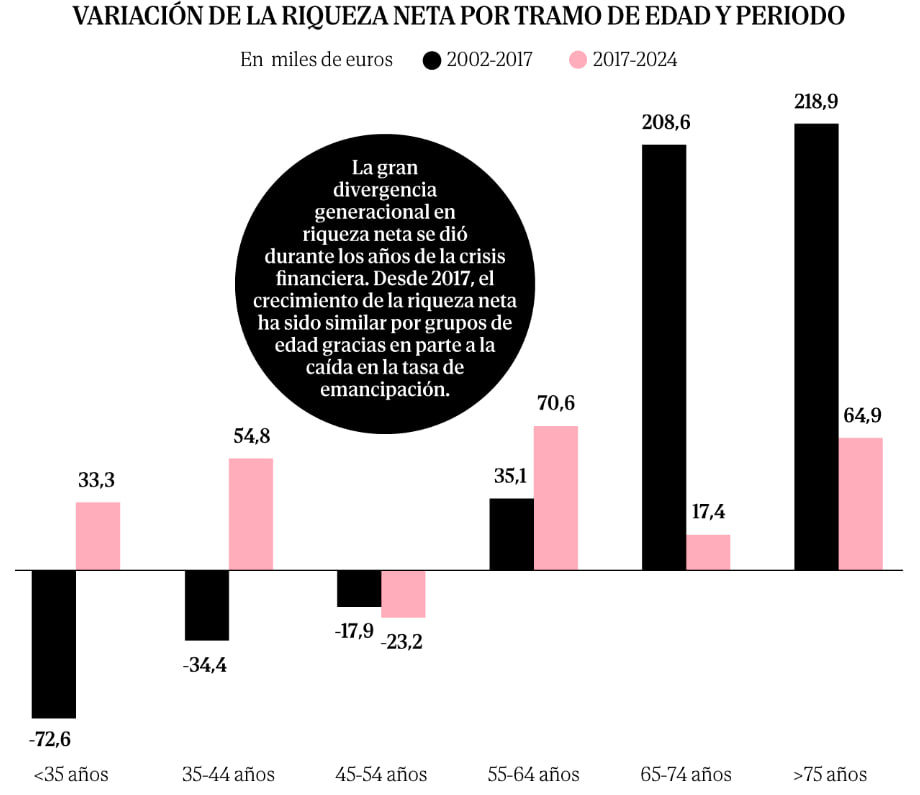
The decline of homeownership as the axis of family wealth is one of the most notable features of the last twenty years. The percentage of households owning their home reached its peak around 2011, at 82.6%, and has since fallen steadily to 70.6% in 2024, more than ten percentage points less. More and more Spanish families are excluded from the main vehicle of wealth accumulation. This decline is especially pronounced among young households and those with lower-middle incomes, who face purchase prices and financing conditions much more demanding than previous generations. Renting, far from being a transitional stage, has become for many a permanent situation with lasting effects on their ability to accumulate wealth.
This structural change has direct implications for inequality. Homeownership has historically been the great wealth equalizer in Spain, an asset accessible to families of all income levels. As the homeownership rate declines, other assets such as financial ones gain prominence in the composition of wealth. And these are distributed much more unequally. The accumulation of financial assets also requires an initial level of savings and financial knowledge that is not equally accessible to all households. The result is a model of wealth accumulation that tends to reinforce starting positions rather than correct them.