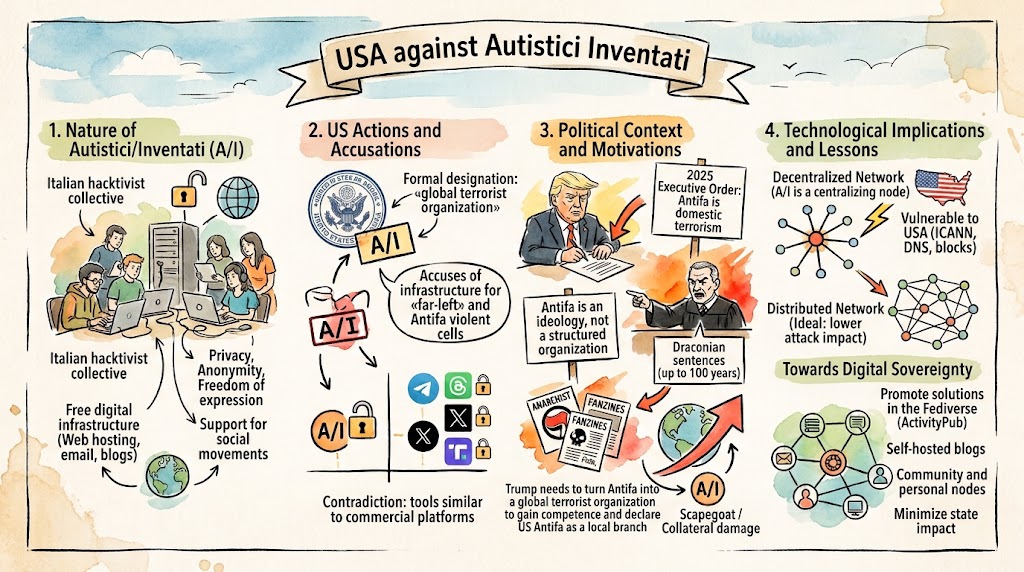
What is Autistici/Inventati
You may not know the name Autistici/Inventati (A/I), but you have surely seen some blogs on NoBlogs.org, the WordPress and email server they maintain for free as their main activity. As they state in their Manifesto:
Our goal is to reclaim spaces on the Internet where we can debate and work on two levels: on one hand, the right and the need for free communication and access to digital resources; on the other, social projects linked to reality and struggles.
Setting up an independent server seems to us a good starting point to achieve our goals.
We believe that communication must be free, and free of charge, and, therefore, universally accessible.
We try to achieve all this by offering internet services (websites, email, mailing lists, chats, blogs, newsletters and more) using our best skills and knowledge to defend both individuals and groups that share our same goals or ideals.
Apart from the commercial mindset of paid services and web spaces, we welcome those who are uneasy about cultural and media censorship, and against the globalized imagery that is prepared, packaged and sold daily.
The services we offer are not intended for commercial use (direct or indirect), nor to be used by organized religions or political parties, or, in short, by those who already have sufficient means and resources to broadly disseminate their own ideas, or who use the concept of representation and delegation (explicit or implicit) in their daily relationships and projects.
In short: A/I is a group that sustains blog and email infrastructure for a whole network of small groups and individuals, guaranteeing anonymity and security for their publications.
US vs. A/I
Last week, the US declared A/I a global terrorist organization. According to the official statement:
Autistici/Inventati (Collective A/I) is an Italy-based extremist group that develops and manages digital infrastructure for violent Antifa cells and other far-left militants worldwide. A/I's radical hacker and technology developer team provides a wide range of services —including encrypted chats and email, web hosting, secure videoconferencing and streaming, anonymity protection, and other technological tools— to Marxist, anarchist, and other left-wing extremist groups in the United States, Europe, and elsewhere.
First question that makes one's eyes hurt: Should Marxist and anarchist groups be globally persecuted and equated with terrorists?
Second question: The cases cited in the statement -organizations that published communiqués on A/I servers- do not grant it a role different from the one that -in many more cases- YouTube, X, or Facebook have had. Privacy tools and the policy of non-censorship are similar to those that Trump-aligned social networks claim to apply, starting with Elon Musk's X and Trump's TruthSocial. And yet, the statement claims that A/I's privacy tools and policies, which are no different from those Telegram claims to have, for example, have the objective of evading the law. An important detail: A/I is based in Italy and has no open legal proceedings there, nor any request for investigation from US judges to the Italian justice system.
Why is the US going after a group that offers privacy-focused hosting?
On September 22, 2025, Trump signed an executive order declaring the Antifa movement a terrorist organization and an internal security threat. At the time, this order raised serious doubts of all kinds. Antifa is an ideology, not an organization.
So in practice, this declaration has served for prosecutors to label as a local cell of a phantom terrorist group a small group that threw fireworks at an ICE facility in Texas, clashing with its agents. Citing the presidential declaration, they obtained draconian sentences of up to 100 years in prison for its members. Being treated as a terrorist group, even those who did not take part in the clashes were sentenced to 30 years, taking as the sole proof that they possessed anarchist pamphlets in their homes.
In reality, these types of presidential declarations so far had a political, not judicial, meaning and were limited to foreign organizations of an international scope. However, it has been followed by similar declarations against Greek, Italian, and German groups of exclusively local dimensions and reach, which European justice had already convicted for attacking foreign detention centers.
Why does the US state apparatus suddenly discover that minuscule local European anarchist groups that have killed no one are a global terrorist threat? Trumpism in power in the US does not hide it. It increasingly resembles the protagonist of Investigation of a Citizen Above Suspicion; its certainty of impunity leads it to go beyond cynicism.
Trump is waging -on behalf of the ultra-MAGA sector- a battle to increase, beyond what the laws dictate, the repression of local protests -more or less violent- of antifa groups against ICE. To justify that bringing the very diverse domestic anarchisms under presidential designation powers falls within his attributions, he needs to turn the Antifa ideology into a global terrorist organization of which the small local US groups would be local cells. Autistici/Inventati is a necessary collateral casualty for that purpose.
What should we learn from the A/I case?
The weakness of the centralized and the decentralized
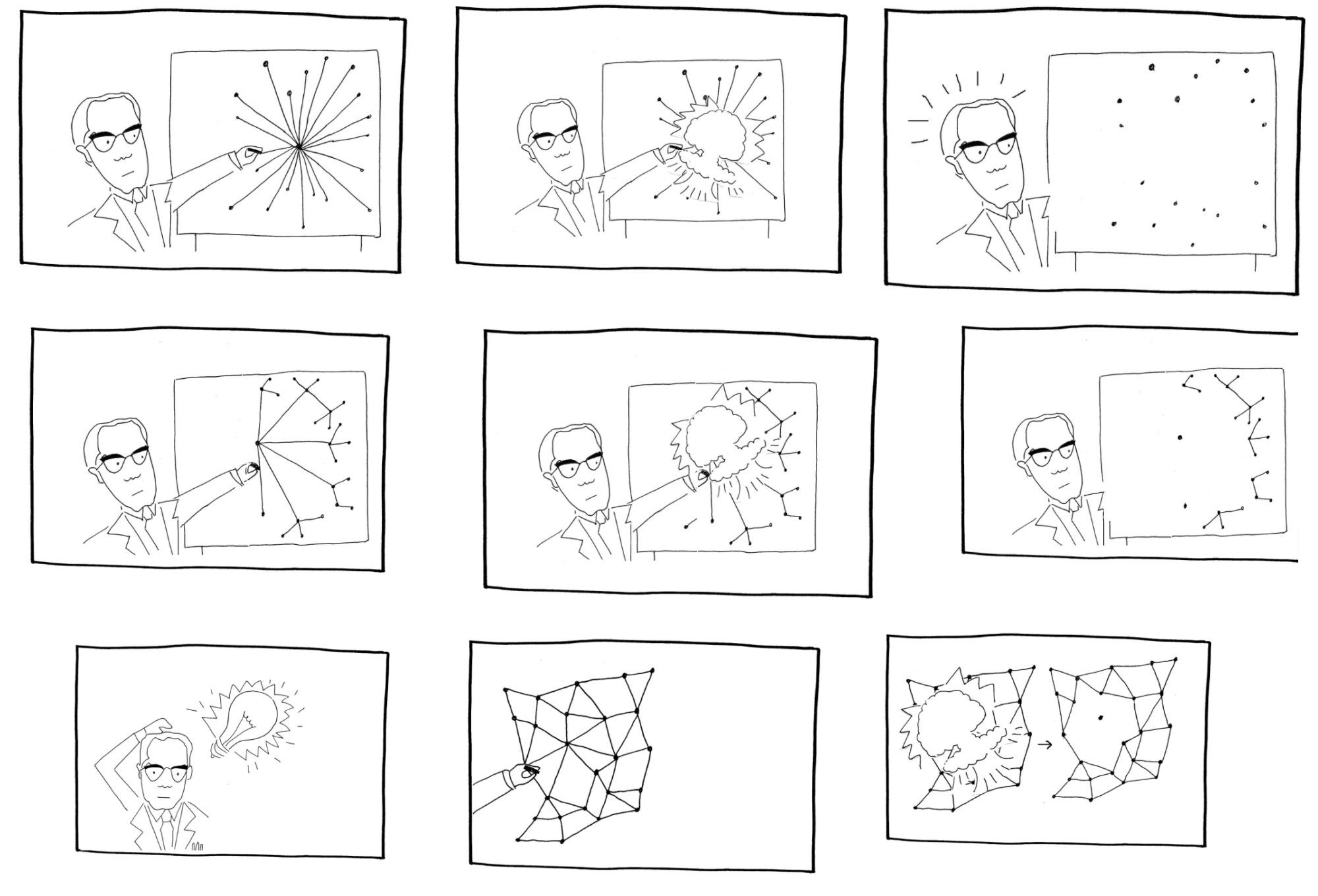
A/I is the exponent of an era in which hacktivist groups strived to bring to the Internet local activist groups, more or less traditional, without technological culture. The resulting structure was decentralized: the nodes depended on local centralizers like A/I (or ourselves). If the centralizing node fell, a small group of local people and organizations was left off the network. The risk was not high as long as the main threat came from automated hacking by cybercriminals and trolls. But today, even the decentralized structure is fragile in the face of US drift. The distributed web becomes more urgent and necessary than ever.
As long as ICANN is in California, the US can, for example, seize domain names and any US DNS provider that serves an organization declared terrorist and does not stop providing its services will be considered a provider of material support, which is heavily penalized.
Distributed minimizes risk
We do not know what the next trick of the US government will be. Whether it is its internal battles against the left or its pressure against commercial rivals, anyone almost anywhere could become collateral damage at any time.
The only possible defense is to generate digital sovereignty: both on a European scale and locally and communally and personally. It is about moving towards a truly distributed structure or at least one of much smaller nodes within a more decentralized global structure. So that each attack -and there will be many more and larger ones- disconnects as few as possible. Ideally only one (distributed network).
And for now, in the short term, this means betting on the reduction in size of fediverse nodes and on self-hosted blogs connected to the Fediverse via ActivityPub. That is, it means taking seriously and as an urgent task recovering sovereignty over the conversation.