The possibility of building what they call a utopia lies in the peripheries
Cities were the laboratories of modernity. Since the late Middle Ages, the global metropolises forged industrial revolutions, formed the great labor movements, and designed the institutional architectures that have governed our world until today. The city was synonymous with progress, freedom, and experimentation. However, something profound is changing in our civilization. In a world saturated with precarization, wars, urban crises, alienation, hyper-commodification, and a chronic exhaustion of traditional ways of living, the future has begun to be imagined and built far from global capitals. The great transformations of history almost always started in small places, when a few people decided to start something new. Today, that spark is igniting in the peripheries.
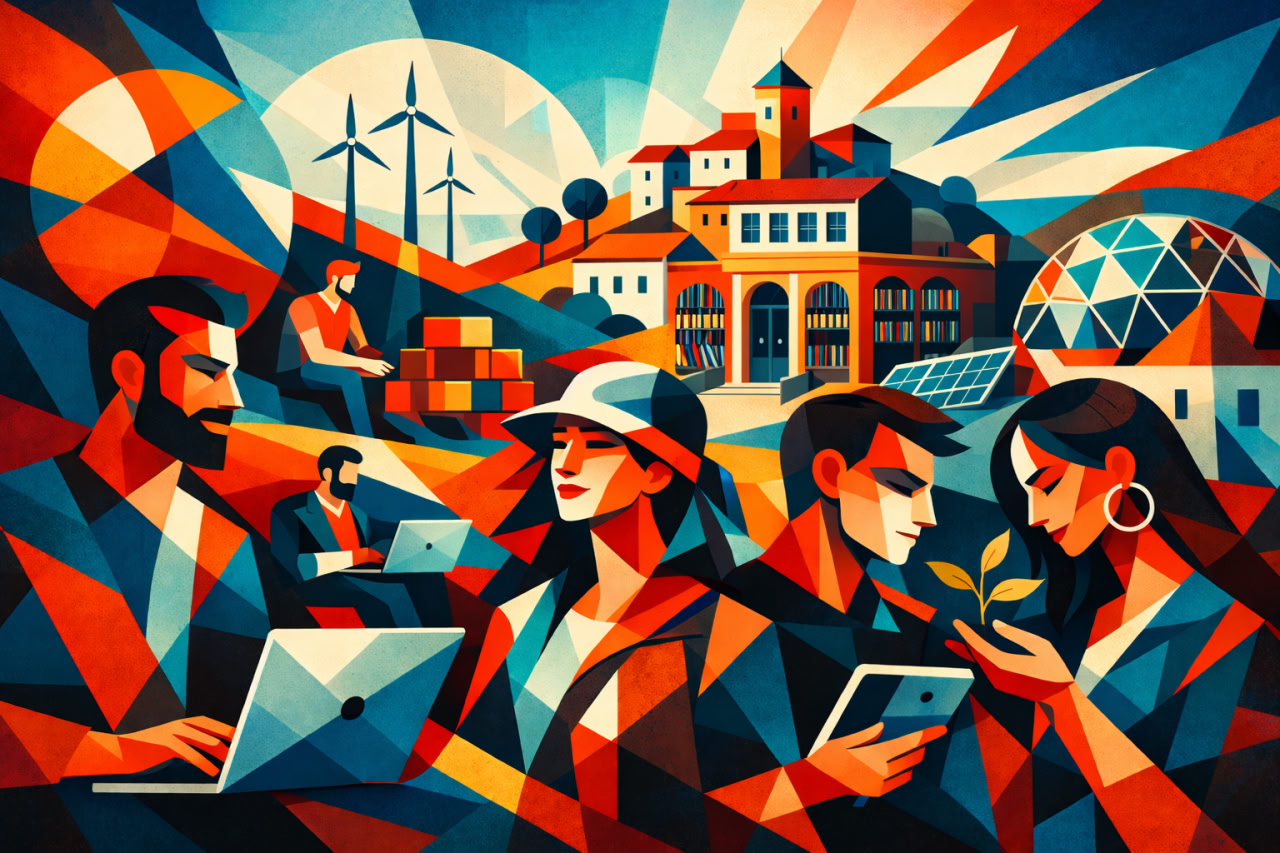
At the southwestern tip of Europe, in green Extremadura, from the Maximalist Studies Center, we are trying to build an environment where living, learning, working, and thinking are not fragmented spheres, but are part of the same vital and integrated project. We are united by the conviction that a new civilization, worthy of Humanity, is possible. Not as a nostalgic refuge or an unattainable utopia, but as a material possibility and a current necessity. And the epicenter of this shockwave is the Juan Urrutia Library (BJU).
We are not simply talking about stacking books on shelves or inaugurating a municipal archive. The Juan Urrutia Library is born as the intellectual and operational heart of a much larger transformation. It is a direct and material invitation to rehearse the society of abundance.
A community of knowledge
When we imagine a library, we usually think of the dusty silence of reading rooms, solitary study, and the static accumulation of knowledge. The BJU radically breaks with that paradigm. Like any research library, it will obviously house books, documentary archives, and foster debates and publications. But we will not define our success by the number of cataloged volumes, nor will we operate under the narrow goals of a conventional think tank, whose objective is usually to influence political elites from the sidelines. We aspire to something much more fun, powerful, useful, and transformative. We are abundantists.
The BJU is conceived as a true community of knowledge. It is the first space entirely dedicated to exploring, theorizing, and, above all, practicing the idea that shared knowledge, open technology, and cooperation can inaugurate a new historical stage. It is a place to study how free knowledge, decentralized networks, and organized communities can radically transform both the large-scale economy and the most intimate daily life.
In a system where artificial scarcity is imposed to maintain structures of power and profitability, abundance arises when the marginal cost of reproducing goods, ideas, or tools tends toward zero. Free software, digitalization, and new forms of productive organization have already shown us that it is possible to work within that logic.
The BJU is the node where these ideas are systematized and returned to the community in the form of action. Because we understand that it is not enough to interpret the world or dream of post-scarcity futures; maximalism is not just a matter of producing more, but of imagining better, and then, with our feet firmly planted on the ground, getting to work to build it.
An Open Ecosystem of Knowledge and Action
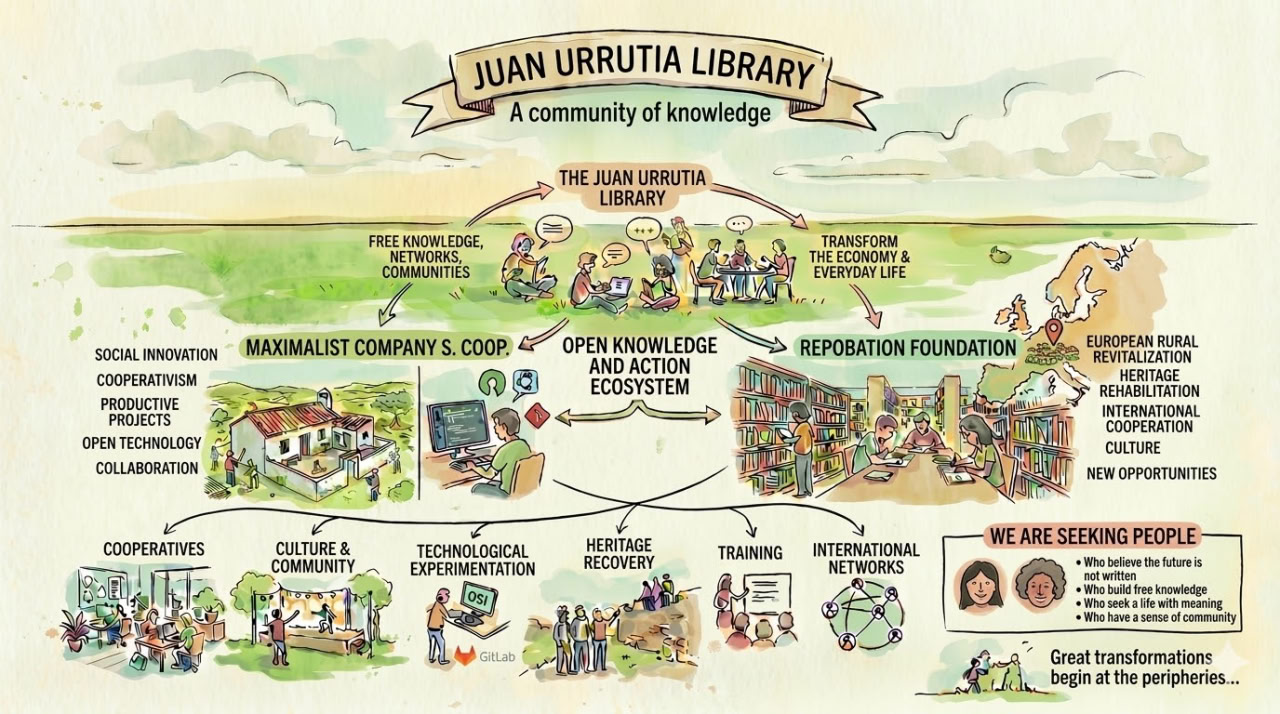
The library, with all its symbolic and formative weight, is just the beginning. Around it, a vibrant, diverse ecosystem is growing, deeply rooted in the material reality of the territory. An open ecosystem of knowledge and action driven by two sister organizations that embody our vision from different perspectives, but which are absolutely complementary. They are the two lungs that allow this project to breathe and move forward: Compañía Maximalista S. Coop. and the Fundación Repoblación.
Associated work and productive innovation
On one hand, we have the Compañía Maximalista S. Coop., a non-profit associated work cooperative dedicated body and soul to social innovation, cooperativism, and the creation of productive projects. Its base of operations is free knowledge, technology, and radical collaboration.
There will be no true emancipation, nor will we find our place in the world, if we do not first conquer work. That is, if we do not recover the ability to self-organize and produce in common, consciously and as equals. Associated work is the only suitable framework that can give meaning to collective production without falling into the alienation of traditional corporations or the dependence of state bureaucracies. The Compañía Maximalista is the empirical demonstration that we can develop cutting-edge technology, design free software, offer high-value services, and create wealth without compromising our morals.
In this environment, open technology is not seen as an end in itself, but as a tool for emancipation. From programming and systems design to exploring how artificial intelligence can be democratized to generate abundance instead of precarity, the cooperative is the productive arm of the ecosystem. Here, free knowledge is not an academic debate; it is the raw material with which we earn our bread and finance our independence.
Rootedness and territorial revitalization
On the other hand, operates the Fundación Repoblación, an organization dedicated to a monumental challenge: revitalizing European rural territories. And we do not do it from a paternalistic, nostalgic, or folkloric approach. We do it through heritage rehabilitation, international cooperation, cultural promotion, and the creation of true, new opportunities to live and work in the villages.
Modernity emptied the countryside to fill the city factories, leaving behind a landscape of forgotten peripheries. But the digital revolution and the crisis of the urban model have reversed the polarity of opportunities. Today, small places offer the perfect canvas to rehearse new ways of living. The Fundación Repoblación ensures that this canvas is ready: rehabilitating historical spaces and creating new community spaces so that old uninhabited houses go from being melancholic ruins to once again being places full of life, with children running and adults debating and creating.
Environmentalism and sustainability that do not arise as a result of a recovered sense of community often end up imposing themselves as authoritarian horrors or empty consumerist trends. The Foundation ensures that our social metabolism with nature is rebuilt from a love for the territory, shared culture, and the recovery of a heritage that belongs to us all.
The six pillars of the ecosystem
Together, the cooperative and the foundation, linked through the work of the Studies Center that will now materialize in the Juan Urrutia Library, are fostering a place where seemingly very different projects coexist, but are intimately connected. The ecosystem is sustained by six fundamental pillars of action:
- Cooperatives: The economic heart. We promote the creation and consolidation of worker-owned enterprises and we boost coworking spaces where digital and analog workers share not just desks and coffee, but a mission: to build a better way of living for everyone. Cooperation is our way of doing things together and our way of working.
- Culture and community: In the face of the atomization of modern society, we seek encounter. It is not just about producing, but about celebrating. From music festivals to theatrical performances, open-air debates, and community dinners. Reinventing the forms of cultural creation and dissemination is the glue that transforms a group of individuals into a resilient community.
- Technological Experimentation: A living laboratory. How can we use open-source software to automate repetitive tasks and free up time for creativity? How can we redesign local supply chains? Here we do not fear the machine; we reprogram it so that it works in favor of abundance and serves all the neighbors and the social and productive fabric.
- Heritage Recovery: We understand old stones not as static museums, but as infrastructure for the future. Restoring ruined heritage houses is an act of rebellion against the devaluation of common History. It is affirming that we are here to stay and honor the work of those who preceded us, giving it a transformative use in the present.
- Training: Pedagogy is continuous. Workshops, seminars, an open reading club, and technical courses on programming or using AI every Friday. Learning never ends, because the tools of tomorrow are being invented today.
- International Networks: Although we operate from a village in southwestern Europe, our gaze is global. We connect and work with other communities, cooperatives, and associations from all over Europe and beyond. We share, investigate, disseminate, and carry out projects with many others to contribute, learn, and keep advancing month by month.
We are looking for people
This machinery of knowledge, heritage, and technology is in motion, but we are not simply looking for weekend visitors or rural tourists. We are not simply looking for new neighbors who come seeking tranquility by isolating themselves behind their garden hedge. Between exclusionary nationalist identitarianism and the discursive obsession with alternatives, we propose a real alternative: cooperation, work, and community building.
That is why our appeal is we are looking for people.
- People who believe that the future is not written, who reject cynicism and defeatism. People who understand that history is not over, that the society in which we live is a human construction and, therefore, can be surpassed and rebuilt better and with abundance for all.
- People who build free knowledge. We need restless minds, programmers, writers, engineers, artists, and artisans who understand that sharing what they know does not impoverish them, but multiplies it. Who believe in the emancipatory power of networks and are willing to contribute their grain of sand to the universal commons of knowledge.
- People who seek a meaningful life. As Adlerian psychology reminds us, mental health and human happiness are inextricably linked to our feeling of social interest and belonging. We do not want people who come to retire or protect themselves from the world, but people who come to activate themselves. Who want to wake up every morning knowing that their work and their intellect are contributing to a greater purpose than mere personal enrichment.
- And who have a sense of community. Because the most advanced technology is useless if we are alone in front of the screen. We are looking for those who value mutual support, face-to-face conversation, caring for the environment and people, and the joy of belonging to a diverse, solid, and supportive human group.
Great transformations begin in the peripheries
If you have ever imagined that another way of living and producing is possible, if you have ever felt that your work should serve for more than just fattening a corporation's profit margins, or if you have dreamed of an environment where Nature, intellect, and community intertwine to allow everyone to build better lives, perhaps this is a good time to get closer.
The Juan Urrutia Library is not a monument; it is a tool. The Compañía Maximalista and the Fundación Repoblación are not abstract entities; they are groups of people getting their hands dirty with soil, boldly designing projects, and typing code until dawn.
It is not an unattainable utopia. It is our task today. The shift from scarcity to abundance will require a titanic effort of imagination and material work. It will require overcoming our own fears and daring to design radically new institutions from the rubble of the old ones.
Throughout the centuries, civilizational changes were rarely born in the center of declining empires, where tension and inertia dehumanize and stifle innovation. They were born on the margins. They were born when a few people, in seemingly inconsequential places, decided to start something new and dared to live today according to the rules of tomorrow's world.
Perhaps this is one of those crucial moments in history.
And perhaps, in this corner of southwestern Europe, with the doors of the Juan Urrutia Library wide open, this is one of those places. We are waiting for you. Write to us.